
Key Takeaways:
- The U.S. electric vehicle (EV) market experienced a significant slowdown in Q1 2024, with sales dropping by 28%, and a 2% decrease in 2023, partly due to the cancellation of federal tax credits.
- Conversely, Europe’s EV market saw nearly 30% growth in 2023, with the trend continuing into early 2026, driven by a wider array of affordable, no-frills models.
- Industry analysts suggest that specific European EVs, such as the Cupra Born, Fiat Grande Panda, Renault 5, and Volkswagen ID.7, could address the U.S. market’s demand for more accessible and diverse electric options.
- These models offer a compelling combination of competitive pricing (in Europe), practical range, and distinctive design, potentially filling a critical gap left by a market predominantly offering premium or high-cost EVs.
- The success of these models in the U.S. would heavily depend on strategic pricing and adaptation to local market conditions, especially considering the U.S. consumer preference for larger vehicles and varying charging infrastructure.
The landscape of electric vehicle adoption presents a stark contrast across continents, with the United States experiencing a notable deceleration while Europe continues its robust expansion. Recent data indicates a significant downturn in the U.S. EV market, with sales in the first quarter of this year estimated to have fallen by 28%. This follows a modest 2% decrease last year, a trend attributed in part to the expiration of the crucial $7,500 federal tax credit.

In sharp contrast, the European EV sector reported a substantial nearly 30% increase in sales last year, with growth showing no signs of abating in the initial months of 2026. This divergence prompts a crucial question among industry observers: could certain successful European EVs, particularly those embodying affordability and practical design, find a receptive audience and stimulate growth within the American market?
The Divergent Paths of EV Adoption
The slowdown in the U.S. electric car market can be attributed to several factors beyond the tax credit adjustments. Consumer preferences, a still-developing charging infrastructure in certain regions, and a market flooded with higher-priced premium EVs have contributed to hesitancy among potential buyers. Many American consumers are seeking more accessible and utility-focused electric options that are currently scarce.
Meanwhile, Europe’s sustained EV momentum is bolstered by a diverse range of models, often priced more competitively and designed for urban practicality. The market’s emphasis on smaller, efficient vehicles with adequate range for daily commuting aligns with European driving habits and regulatory frameworks. This has created a fertile ground for innovative and cost-effective electric offerings.

While Canada prepares to welcome Chinese-made EVs, potentially introducing a new wave of affordable options, the U.S. market remains largely insulated from these imports due to various trade considerations. This situation underscores the potential for European manufacturers to step in and fill the void for affordable, no-frills electric cars.
The critical factor for the introduction of these European EVs in America will undeniably be strategic pricing. Market history has shown that even technologically advanced European models, such as the Volvo EX30, face challenges if their pricing does not align with American consumer expectations and value propositions.
Potential European EVs for the American Market
Cupra Born: A Sporty Compact with European Flair
The Cupra Born, a four-door electric hatchback from the Volkswagen Group’s performance-oriented brand, had previously been considered for a U.S. market entry. However, those plans are currently on hold due to prevailing market instability. Should the brand proceed with its American aspirations, the Born could emerge as a compelling alternative to established rivals like the Nissan Leaf and the Chevrolet Bolt EV.
In Europe, the Cupra Born starts from €40,450 (approximately $46,700) and offers a WLTP range of 428 km (266 miles). Built on the same architecture as the Volkswagen ID.3, a model once envisioned as the electric successor to the popular Golf, the Born distinguishes itself with a more engaging driving experience. Its revised chassis setup and rear-wheel-drive powertrain contribute to a more dynamic feel on the road.
The vehicle’s base trim delivers 204 horsepower, with a sportier specification capable of producing up to 326 horsepower. This combination of performance and practical range could appeal to American buyers seeking an electric vehicle that transcends the purely utilitarian commuter car perception, offering a more spirited driving experience.
Fiat Grande Panda: Affordable Practicality for Urban Commutes
Fiat’s current U.S. market offering is limited to the electric 500e, an urban-focused model that, while stylish, can be perceived as both expensive and compact. The prospective introduction of the Fiat Grande Panda EV could address these limitations, presenting a more spacious yet equally urban-friendly option with a lower price point.
With a European starting price from €24,990 (approximately $28,900) and a WLTP range of 320 km (199 miles), the Grande Panda is positioned as an accessible entry into the EV segment. While still a small car, its four-door configuration enhances practicality, making it a more versatile choice for daily use.
The Grande Panda embodies an unpretentious, no-nonsense design philosophy. Its innovative features include a built-in Level 2 charging cable integrated into the front fascia, enhancing convenience. The vehicle’s chunky styling provides a more substantial presence compared to previous city car models that have struggled to gain traction in the U.S. market.
Renault 5: A Nostalgic Revival for Modern Electrification
The original Renault 5, marketed as “Le Car” during its brief stint in the United States, did not achieve widespread success. However, the all-new electric Renault 5, available in Europe, offers a fresh perspective. Positioned as a captivating and affordable electric hatchback, it could reignite interest in smaller EV segments in the U.S.
Starting from €28,000 (approximately $32,350) in Europe, the new Renault 5 boasts a WLTP range of 312 km (194 miles). Its design is widely praised, combining retro aesthetics with modern EV technology. The vehicle promises a pleasant driving experience and competitive pricing within its segment. Unique optional accessories, such as a baguette holder, highlight its distinctive European charm.
Historically, small hatchbacks have faced an uphill battle in the U.S. market, largely due to consumer preference for larger vehicles. However, the Renault 5’s compelling design, affordability, and electric powertrain could potentially challenge these ingrained preferences, offering a refreshing alternative to the prevailing SUV and truck-dominated market.
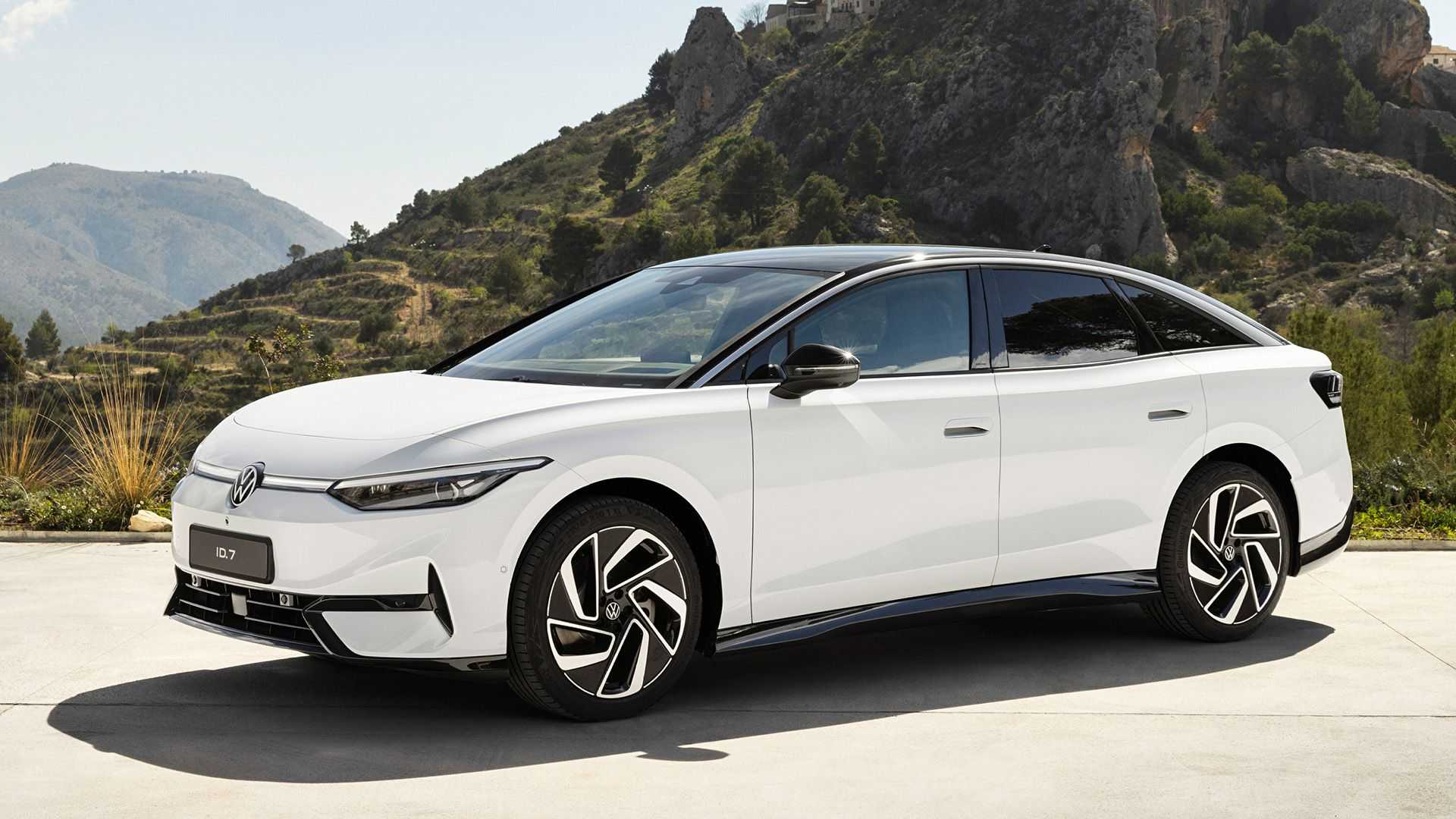
Volkswagen ID.7: A Premium Electric Sedan for Long-Distance Travel
The Volkswagen ID.7 stands out on this list as the only model that came close to a confirmed U.S. market launch before Volkswagen ultimately decided to postpone its introduction. The decision was attributed to what the automaker described as “the ongoing challenging EV climate” in the U.S.
Priced from €54,505 (approximately $62,900) in Europe, the ID.7 offers a substantial WLTP range of 599 km (372 miles). Positioned as an all-electric successor to the Passat sedan, the ID.7 is engineered for comfort and long-distance travel. Driving impressions from Europe, including tests on Germany’s Autobahn, confirm its capabilities as a smooth and capable road-tripping machine.
With the discontinuation of models like the Tesla Model S, the ID.7 could present a strong alternative in the premium electric sedan segment, catering to buyers looking for a sophisticated and range-capable EV. The availability of a wagon variant further expands its appeal, offering additional practicality and cargo space, which could resonate with a niche but significant segment of the American car-buying public.
Challenges and Opportunities for European EVs in America
Introducing these European EVs in America would involve navigating a complex set of challenges, including homologation requirements, establishing robust distribution and service networks, and adapting to U.S. consumer tastes. The preference for larger vehicles, coupled with varying charging standards and infrastructure, demands careful strategic planning.
However, the opportunity to tap into a segment of the U.S. market craving more affordable, efficient, and diverse EV options remains significant. As the initial excitement around premium EVs wanes, and as economic considerations become more prominent for a broader consumer base, the demand for practical and value-driven electric cars is likely to increase. European manufacturers, with their proven track record in developing such vehicles, are uniquely positioned to address this evolving market need.
The Future Outlook for Transatlantic EV Market
The trajectory of the global electric vehicle market is dynamic, with regional disparities presenting both hurdles and unique opportunities. For the U.S. market to fully embrace electrification, a broader spectrum of vehicles—especially those that blend affordability, sufficient range, and appealing design—is essential. The success stories of European EVs offer a compelling blueprint.
Should European automakers successfully adapt their strategies and pricing models for the American consumer, the introduction of models like the Cupra Born, Fiat Grande Panda, Renault 5, and Volkswagen ID.7 could inject new vitality into the U.S. electric car landscape. This shift could not only boost sales but also broaden the appeal of electric mobility, making it accessible to a wider demographic.
FAQ Section
What is the current state of the U.S. EV market?
The U.S. EV market is experiencing a slowdown, with Q1 2024 sales dropping by 28%. This follows a 2% decrease in 2023, partly due to the cancellation of the $7,500 federal tax credit and consumer demand shifting towards more affordable options.
How does the European EV market compare to the U.S. market?
Europe’s EV market is flourishing, having seen nearly 30% growth in 2023 and continued expansion into early 2026. This growth is largely attributed to a wider variety of accessible, smaller, and competitively priced electric vehicle models.
Why are affordable European EVs considered important for the U.S. market?
The U.S. market currently lacks a strong selection of affordable, no-frills electric vehicles. European EVs like the Fiat Grande Panda and Renault 5 could fill this gap, offering practical and cost-effective alternatives to the predominantly premium EVs currently available, potentially accelerating broader EV adoption.
What makes the Cupra Born a suitable option for the U.S.?
The Cupra Born is a sporty four-door electric hatchback with a starting price around $46,700 in Europe and a 266-mile WLTP range. Its engaging rear-wheel-drive powertrain and dynamic chassis setup could appeal to U.S. buyers seeking a fun-to-drive compact EV.
Could the Volkswagen ID.7 succeed in the U.S. despite previous cancellations?
Despite its U.S. launch being postponed due to a challenging EV climate, the Volkswagen ID.7, with its 372-mile WLTP range and premium sedan characteristics, could serve as a strong alternative in the U.S. market, especially given the departure of models like the Tesla Model S.
What challenges would European automakers face in bringing these EVs to the U.S.?
Challenges include adapting vehicles to U.S. regulatory standards (homologation), building extensive sales and service networks, and aligning pricing strategies with American consumer expectations. Overcoming the preference for larger vehicles and integrating with diverse charging infrastructure are also critical.