
In a significant move to align its internal workforce with its evolving vision for sustainable mobility, Toyota Motor North America recently initiated its “Electrification 101” program. This training initiative offered a candid insight into the knowledge gap surrounding electric and hybrid vehicle technologies, even within a leading global automaker. The program revealed that many employees, despite working for an automotive giant, possessed limited understanding of electrification’s intricacies and benefits.
This observation challenges the common assumption that all personnel at a car manufacturing company are inherently automotive enthusiasts or deeply versed in cutting-edge powertrain technologies. For numerous employees across various corporate functions, the fundamental concepts of electrification proved to be new information. Toyota’s proactive approach to address this through comprehensive training underscores the critical role of internal education in driving forward a complex and multifaceted Toyota electrification strategy.
Key Takeaways: Building Internal Expertise
Toyota Motor North America has launched an “Electrification 101” program for its employees to bridge internal knowledge gaps.
The training aims to educate staff members, many of whom lack deep knowledge of electric vehicles (EVs), hybrid, and fuel cell electric vehicle (FCEV) technologies.
This initiative underscores the necessity of internal advocacy and understanding for Toyota’s “multi-pathway” electrification strategy.
The program covered fundamental concepts of various powertrain types, including battery chemistries, charging infrastructure, and core electrical principles, complemented by interactive demonstrations.
The ultimate goal is to foster employee understanding and enthusiasm for electrified vehicles, thereby aligning corporate strategy with internal capabilities and boosting the collective pursuit of its ambitious electrification goals.
Addressing the Knowledge Gap in a Shifting Industry
The automotive landscape is undergoing a profound transformation, with electrification at its core. While industry observers and critics often delve deep into the philosophical and technical debates surrounding electric vehicles, the reality within large corporations can be different. Many employees in administrative, financial, or software development roles may not possess an inherent passion for automotive mechanics or an in-depth understanding of emerging technologies like battery electric vehicles (BEVs) or plug-in hybrid electric vehicles (PHEVs).
For these professionals, joining Toyota might be driven by factors such as career stability, comprehensive benefits, a respectful corporate culture, or the prestige associated with working for the world’s largest automaker. An accountant or an app developer, for instance, typically does not require expertise in lithium-ion battery chemistries or the distinctions between nickel-cobalt-manganese (NCM) and lithium iron phosphate (LFP) battery cells. Even traditional car enthusiasts, often steeped in the legacy of internal combustion engines, may find the technical nuances of modern electric powertrain systems unfamiliar and complex.
The “Electrification 101” Curriculum
Recognizing this internal need, Toyota developed the “Electrification 101” program as a foundational course to bring its curious staff members up to speed. This marks the second instance of such an internal educational offering, following an earlier program that introduced employees to broader automotive fundamentals. This strategic investment in employee education highlights Toyota’s commitment to ensuring its workforce is well-informed about the company’s future direction and overall Toyota electrification strategy.
The program’s nomenclature, “Electrification 101” rather than “EV 101,” is particularly telling. It reflects Toyota’s well-documented “multi-pathway” approach to decarbonization. This strategy emphasizes a diverse portfolio of electrified vehicles, including a strong current focus on hybrids, while simultaneously looking towards battery electric vehicles (BEVs) and, notably, hydrogen fuel cell electric vehicles (FCEVs) for future development. In the most recent quarter, 56.8% of Toyota’s sales comprised electrified models, encompassing hybrids, BEVs, PHEVs, and FCEVs. However, pure BEVs constituted only 1.7% of these sales, illustrating the company’s diversified approach.
Understanding Diverse Powertrain Technologies
A significant portion of the four-hour course was dedicated to classroom instruction, meticulously covering the basics of these various powertrain types. The curriculum included a clear delineation between conventional hybrids and plug-in hybrids. Despite Toyota’s considerable current investment in hybrid technology, substantial effort was also directed towards demystifying common misconceptions surrounding pure electric vehicles. The program framed the current transition by drawing parallels to the early 20th century automotive industry, noting initial challenges with infrastructure, public education, servicing, and evolving regulations, likening the simplicity of owning a horse to the initial comfort with gasoline cars.
The training highlighted the numerous advantages of electrification, emphasizing enhanced efficiency and reduced environmental impact. It also championed the “multi-pathway” strategy, asserting that this diversified approach not only offers customers broader choices but also represents the most efficient allocation of finite battery resources. This perspective, while integral to the Toyota electrification strategy, remains a subject of considerable debate within the broader industry, with much research suggesting that BEVs often offer the cleanest option on a life cycle basis. For instance, studies repeatedly bust the myth that EVs are ‘dirtier’ than gas cars, even when powered by fossil fuels, affirming their cleaner footprint, and highlight how much cleaner EVs truly are.
Key Program Modules and Interactive Learning
While discussing the relative advantages of each powertrain type, the program focused more on the limitations of BEVs, a stance consistent with Toyota’s cautious approach to widespread BEV adoption. It did not delve into the increased maintenance requirements or noise, vibration, and harshness (NVH) characteristics often associated with gasoline cars. The presentation also maintained a characteristically optimistic outlook on hydrogen technology. A slide, for example, highlighted that hydrogen “can reduce ‘range anxiety’ as number of stations grow,” and noted the Toyota Mirai’s impressive range of up to 402 miles per tank. While such figures were pioneering in the early days of EVs, today, at least eight BEV models in the U.S. market already exceed this range, with many more advanced electric vehicles slated for release.
Beyond this specific section, the classroom content was broadly informative and focused on foundational knowledge. Modules included a deep dive into the fundamentals of various battery chemistries, explanations of different charging standards and protocols, and core electrical concepts such as kilowatts (kW) and kilowatt-hours (kWh). The program also provided an overview of ongoing battery recycling efforts, showcasing a holistic view of the electrification ecosystem.
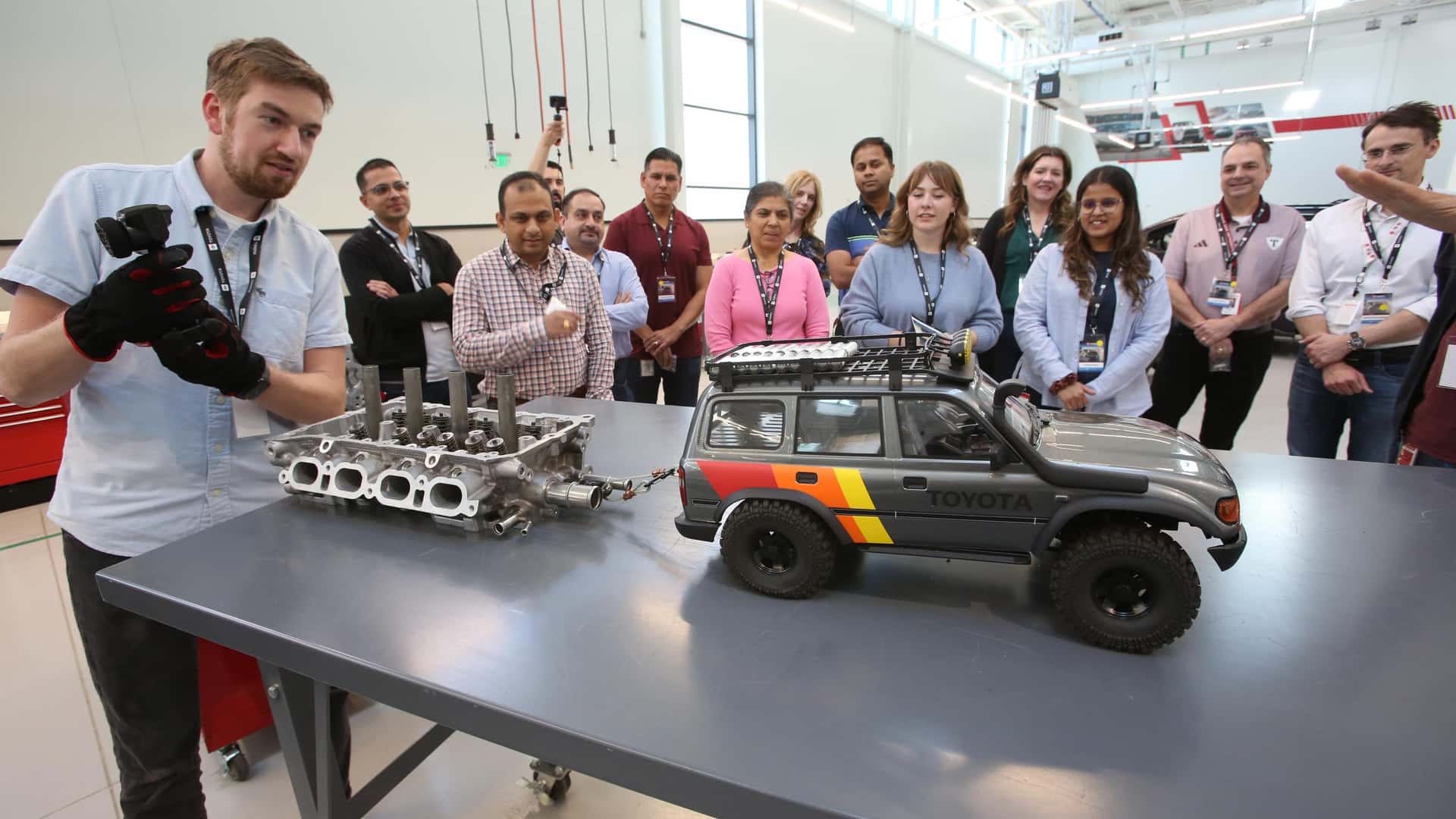
The most engaging segment of the training involved interactive, hands-on activities. Employees were guided to construct a rudimentary electric motor using simple components: a screw, a magnet, a AA battery, and a piece of wire. Participants also assembled a basic potato-based battery and observed different charging outputs in action. A highlight was a demonstration of the instantaneous torque characteristic of an EV motor, where a miniature remote-controlled Land Cruiser effortlessly towed a cylinder head weighing over 30 pounds, vividly illustrating the power and efficiency of electric propulsion.
The Core Revelation: Simplicity and Efficiency of Electric Motors
The fundamental lesson imparted by the program was the remarkable efficiency and simplicity of electric motor technology. Presenters showcased a stripped-down Toyota V-6 engine, revealing its complex array of accessories and intricate parts. This was starkly contrasted with an equivalent electric motor, which demonstrated superior power output within a significantly smaller footprint and a much simpler design. The program also highlighted how integrating an electric motor into a gasoline powertrain, as seen in Toyota’s hybrid systems, reduces overall complexity by eliminating the need for a convoluted transmission system.
The overarching point was that electric propulsion, irrespective of its degree of integration, inherently enhances efficiency with minimal compromises. As the journey towards full electrification progresses, the underlying mechanical systems become progressively simpler. By the time a vehicle reaches full battery electric status, there are significantly fewer components prone to failure or requiring extensive maintenance. This inherent simplicity is a powerful argument for the long-term viability and attractiveness of the Toyota electrification strategy.
However, Toyota representatives maintained that the company continues to prioritize substantial improvements in battery chemistry and charging infrastructure before endorsing BEVs as a universal, one-size-fits-all solution. Despite this cautious stance, the program unmistakably aimed to cultivate enthusiasm among employees for an increasingly electric future, setting the stage for broader internal acceptance and advocacy.
Fostering Internal Advocacy and Strategic Alignment
The importance of this internal educational initiative cannot be overstated. A workforce that genuinely understands and believes in the long-term benefits of electrification is crucial for strategic coherence. Without such understanding, employees in critical roles, such as corporate procurement, might perceive new component designs or the complexities of onboarding novel suppliers merely as additional costs and operational hurdles. This perspective could lead to resistance to change, a natural human tendency when benefits are unclear.
Conversely, an informed and excited workforce is far more likely to embrace and drive change. Such employees become willing to navigate short-term complexities in pursuit of long-term strategic goals, actively influencing their peers and external stakeholders. Brigette Armato, a Toyota employee who participated in the class, exemplifies this transformation. Admitting she initially knew “nothing” about EVs and hybrids, she emerged as an advocate.
“I work with our lease experience team, so I’m actually working with the customers and the vehicles. This was extremely helpful because now I can have an educated conversation with them and maybe convince them to go for an electric vehicle, whereas before I don’t think I had that skill,” Armato stated, underscoring the immediate practical impact of the training. Her newfound knowledge not only equips her to engage customers more effectively but also influences her personal choices. Despite her attachment to her current Toyota 4Runner, she is now actively considering an electric alternative, expressing a desire for Toyota to “gravitate more towards electric vehicles across the lineup.”
This sentiment resonates deeply with the company’s broader objectives. With hundreds of employees already attending these foundational classes and a substantial waitlist for future sessions, Toyota is steadily cultivating a growing cadre of electrification proponents within its North American headquarters. This internal awakening is not about overcoming active resistance but rather about elevating a collective understanding that, much like many car buyers, many employees simply lacked prior comprehensive knowledge. This strategic investment in human capital is a cornerstone of Toyota’s evolving Toyota electrification strategy, promising to accelerate the company’s transition towards a more electrified future.
Frequently Asked Questions (FAQ)
What is Toyota’s “Electrification 101” program?
It is an internal training initiative by Toyota Motor North America designed to educate employees on various electrified vehicle technologies, including hybrids, plug-in hybrids, battery electric vehicles, and hydrogen fuel cell electric vehicles. The program aims to bridge knowledge gaps among staff members.
Why did Toyota launch this electrification training for its employees?
Toyota launched the program to ensure its diverse workforce understands the company’s multi-pathway electrification strategy and the benefits of these technologies. Many employees, not being automotive experts, needed foundational knowledge to become internal advocates and support the company’s future direction.
What types of vehicles are covered in the training?
The “Electrification 101” program covers all forms of electrified powertrains, including conventional hybrids (HEVs), plug-in hybrid electric vehicles (PHEVs), battery electric vehicles (BEVs), and hydrogen fuel cell electric vehicles (FCEVs).
What was the main takeaway from the training regarding electric motors?
The program highlighted the inherent simplicity, efficiency, and power of electric motors compared to complex internal combustion engines. It demonstrated how electric propulsion, even in hybrid form, reduces mechanical complexity and improves overall vehicle efficiency and reliability.
How does this program support Toyota’s overall electrification strategy?
By educating its employees, Toyota aims to foster internal advocacy and strategic alignment. Informed employees can better support product development, engage customers, and overcome internal resistance to change, thereby accelerating the implementation of the company’s ambitious electrification goals.
Is Toyota only focusing on battery electric vehicles (BEVs) with this training?
No, the program reflects Toyota’s “multi-pathway” approach, emphasizing a diverse portfolio. While BEVs are covered, the training also strongly features hybrids and even hydrogen fuel cell technologies, aligning with Toyota’s strategy of offering multiple sustainable mobility solutions.
What surprised attendees about the training?
Many attendees, including a journalist, were surprised by the significant lack of basic electrification knowledge among diverse corporate employees. The program successfully converted skeptics into advocates, highlighting the effectiveness of foundational education in fostering excitement and understanding about future automotive technologies.