
Key Takeaways (TL;DR):
- Toyota’s Woven City, near Mount Fuji, is an ambitious living laboratory designed to test advanced mobility solutions and smart city technologies in a real-world environment.
- Still in its early phases, the city currently houses 100 residents and serves as a ‘proving ground for mobility’ where nascent technologies, including autonomous vehicles, delivery robots, and smart infrastructure, are rigorously tested.
- The project openly acknowledges its ‘work in progress’ status, with engineers continuously refining systems like AI-powered traffic management and virtual power plants.
- Woven City is crucial to Toyota’s transformation into a comprehensive mobility company, addressing challenges from emerging automotive competitors to evolving transportation needs.
Toyota’s ambitious smart city project, Woven City, stands as a testament to the automotive giant’s commitment to shaping the future of urban living and mobility. Located at the base of Mount Fuji, this innovative urban laboratory recently opened its gates to non-Japanese journalists for the first time, revealing a meticulously planned yet distinctly evolving ecosystem.
While the vision for a seamlessly integrated, technologically advanced city is clear, the current reality reflects a dynamic development process. Incidents, such as a traffic light failing to turn green for 30 minutes or a robot becoming stuck and requiring manual intervention, highlight the complex challenges inherent in pioneering smart city technology. Toyota, however, maintains complete transparency, with Daisuke Toyoda, a senior vice president at Woven by Toyota and son of Chairman Akio Toyoda, openly sharing these early operational glitches.
The Vision: A Proving Ground for Future Mobility
Six years after Akio Toyoda first announced plans for a living laboratory dedicated to new mobility technologies, Woven City has materialized. It serves as a critical testing ground where a dedicated community lives and works, pushing the boundaries of what’s possible in future mobility solutions and urban infrastructure. This experimental approach allows for real-time adjustments and refinements, distinguishing it from conventional research facilities.
The core objective, as articulated by executives, is to establish a “proving ground for mobility.” This goes beyond traditional vehicle testing, encompassing the entire urban fabric where vehicles, infrastructure, and people interact. The insights gained from Toyota Woven City are expected to inform the design and deployment of next-generation transportation and smart city frameworks globally.
Woven City in Its Nascent Stage: Population and Footprint
During a recent media visit, the city presented itself as strikingly clean and futuristic, yet notably sparse. The limited number of pedestrians and vehicles contributed to an almost serene atmosphere, partly attributed to the inclement weather on the day of the tour. This quietude underscores its current operational phase, still very much a “work in progress” rather than a fully populated urban center.
Toyota confirms that approximately 100 “Weavers” currently reside in Woven City, occupying 50 households. All residents are affiliated with Toyota, forming an initial community dedicated to living and interacting with the evolving smart city technology. The first phase encompasses a few blocks, with a second phase of expansion already underway. Plans project Woven City’s eventual footprint to increase more than tenfold, accommodating a population of approximately 2,000.
The Inventor Garage: A Hub for Collaborative Innovation
Integral to Woven City’s innovation ecosystem is the “Inventor Garage.” This repurposed former Toyota factory building now functions as a vibrant maker space. Here, various companies collaborating on projects within Woven City can develop and refine their products, fostering a dynamic environment for technological advancement.
The scope of innovation within the Inventor Garage is broad, extending from direct mobility solutions to tangential smart city services. For instance, Toyota supplier Denso is developing wireless EV charging technology, with plans to test roads embedded with induction charging capabilities. A Toyota subsidiary is advancing Cocomo, a sidewalk delivery robot, which is learning complex navigation in Woven City and other test environments. Another firm is exploring compact hydrogen fuel cells, having already developed a hydrogen-powered e-bike prototype for Weavers to test.
Beyond transportation, the facility hosts diverse ventures. Joby Aviation, an electric vertical take-off and landing (eVTOL) company backed by Toyota, has also joined the initiative. Other innovators include a vending-machine company—a significant industry in Japan—and Nissin Foods, which is developing novel food concepts for resident testing. An AI-powered karaoke song selection system further illustrates the breadth of experimentation in this future-focused urban setting.
Integrating Infrastructure for Enhanced Mobility and Safety
Toyota’s overarching goal of achieving “zero accidents” is not solely reliant on vehicle technology. John Absmeier, CTO of Woven by Toyota, emphasized the critical role of urban infrastructure in this pursuit. He explained to reporters, “In the city, in particular, the infrastructure is what we can get access to. We can control, we can test, we can develop new ideas around it. And that’s the biggest difference or opportunity that we have here in the city.”
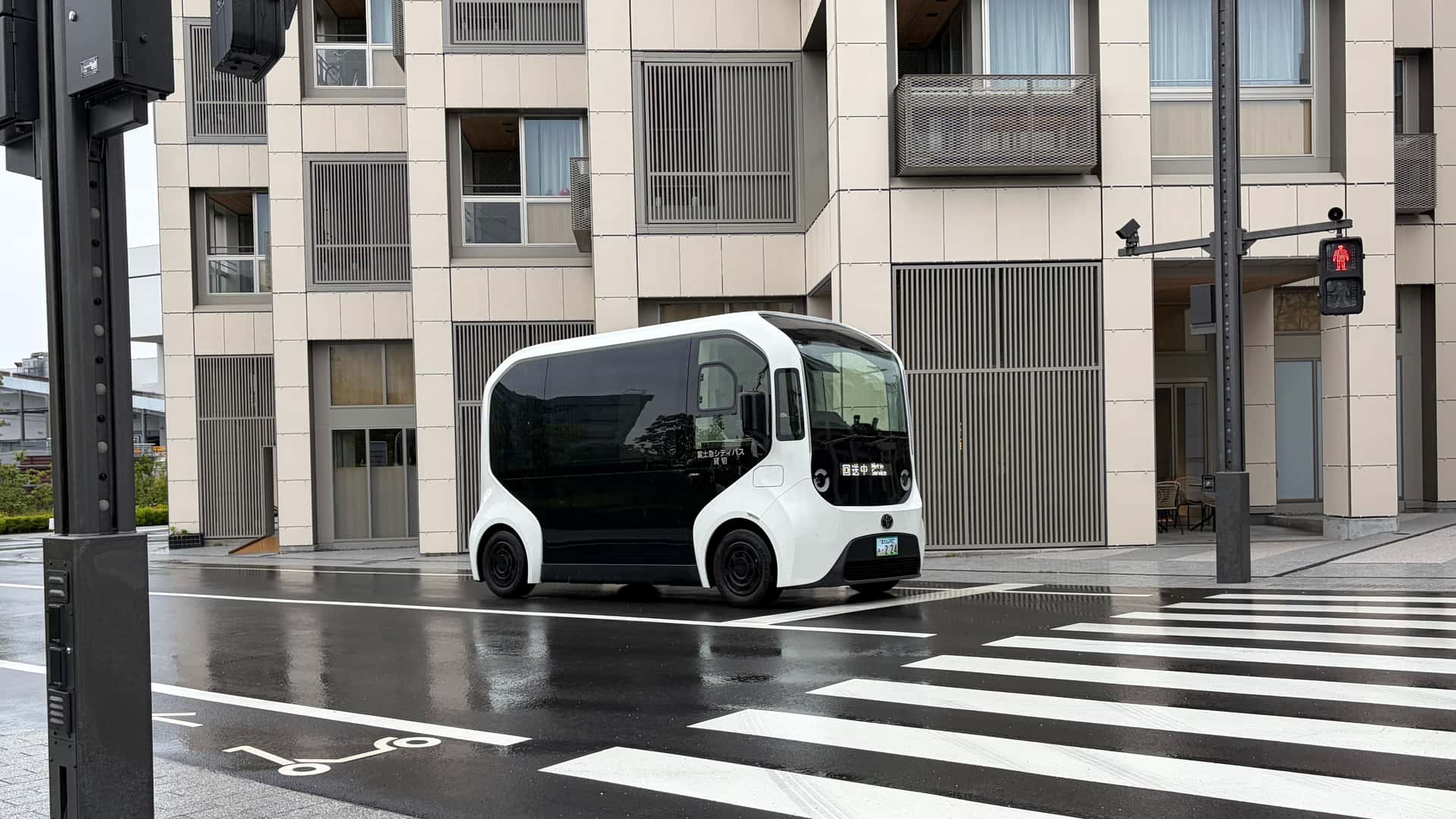
This integrated approach is evident in Woven City’s design. Every intersection is equipped with multiple cameras feeding data into the Woven City AI Vision Engine. This system enables the testing of advanced safety features, such as alerting an approaching autonomous vehicle to a pedestrian unexpectedly entering an intersection. While human drivers currently operate the city’s e-Palette buses, the long-term strategy involves transitioning these to fully autonomous operation. Traffic signals are also designed to prioritize pedestrian movement, although this feature is still undergoing refinement.
Pioneering Smart City Technologies in Action
Woven City is actively testing a diverse array of smart city and mobility solutions designed to enhance urban efficiency and convenience.
Automated Mobility Services: Guide Mobi and Cocomo
One notable innovation is Toyota’s Guide Mobi, a robust, three-wheeled robot equipped with a comprehensive sensor array. This robot is engineered to effectively transform any car into a driverless vehicle by wirelessly connecting to its braking, steering, and acceleration systems. In Woven City, Guide Mobi units retrieve Toyota bZ4X crossovers from a parking garage, delivering them to residents as part of a car-sharing service. Although demonstrations still involve human oversight and the driving experience is evolving, the concept holds significant promise for applications like robo-valets.
Package delivery within Woven City is also largely automated. Instead of traditional delivery trucks entering the urban core, packages are deposited at an underground logistics center. From there, wheeled robots transport items through subterranean tunnels to centralized lockers within each building, ensuring efficient and seamless last-mile delivery. Plans also include integrating helper robots into Weavers’ homes, where they will learn to perform domestic tasks like doing dishes and folding laundry in a real-world context.
Micromobility and Energy Solutions
For personal transportation at the street level, residents have access to the Swake, a unique three-wheeled scooter developed by Toyota. Designed for stability and maneuverability, the Swake features a large platform for both feet and a butt pad for leaning, offering a potentially safer and more accessible micromobility option for those who might find traditional scooters or bikes challenging. Though unavailable during the recent visit due to weather, indoor demonstrations showcased its potential as an efficient urban transport solution.
In terms of sustainable energy, Woven City incorporates an EV-powered virtual power plant (VPP). A dedicated parking garage houses 50 city-owned electric vehicles capable of feeding power back into the urban grid through bidirectional charging. This setup can reduce the city’s peak power demands by 5-10%. While currently a proof-of-concept, this VPP technology could offer a scalable energy solution for industrial sites managing large corporate fleets, optimizing energy consumption and resilience.
The Road Ahead for Toyota’s Urban Experiment
Toyota, like many established automotive manufacturers, is navigating a transformative period. The company faces increasing competition from rapidly innovating Chinese automakers, as well as disruptive Silicon Valley-inspired entities like Tesla and Rivian. Moreover, the emergence of advanced self-driving technologies could fundamentally alter the necessity of personal car ownership.
Tracing its origins from loom manufacturing to becoming the world’s largest car producer, Toyota is now striving to redefine itself as a comprehensive mobility company. The sheer diversity of initiatives within Woven City reflects this expansive redefinition. While the journey is undoubtedly complex and filled with unforeseen challenges, a controlled and adaptive technological playground like Toyota Woven City provides an invaluable environment for developing innovative answers to the evolving landscape of urban mobility and sustainable living. The ongoing refinement of these nascent technologies will be critical to its long-term success and broader impact.
Frequently Asked Questions (FAQ)
What is Toyota Woven City?
Toyota Woven City is an experimental smart city and living laboratory developed by Toyota at the base of Mount Fuji, Japan. It serves as a real-world testing ground for future mobility solutions, autonomous technologies, sustainable infrastructure, and advanced urban living concepts. The project aims to integrate various innovations into a cohesive ecosystem.
Who lives in Woven City and what is its current size?
Currently, an initial group of 100 residents, referred to as “Weavers,” inhabit Woven City across 50 Toyota-affiliated households. The first phase of the city encompasses a few city blocks, with plans for a significant expansion. Eventually, its footprint is expected to grow tenfold, accommodating approximately 2,000 residents.
What kind of technologies are being tested there?
Woven City tests a wide array of smart city technology, including wireless EV charging, autonomous delivery robots (Cocomo), hydrogen fuel cell prototypes (like an e-bike), advanced AI vision systems for traffic management, and bidirectional charging for virtual power plants. Micromobility solutions like the Swake scooter and in-home helper robots are also under development.
What is the primary purpose of Woven City for Toyota?
The primary purpose of Woven City is to serve as a “proving ground for mobility,” allowing Toyota to test and refine cutting-edge technologies in a controlled yet real-world environment. It’s crucial for the company’s transformation into a comprehensive mobility provider, addressing the future of transportation and urban living beyond traditional car manufacturing.
How does Woven City aim to improve safety?
Woven City focuses on integrating vehicle technology with smart infrastructure to achieve a goal of “zero accidents.” This involves systems like the Woven City AI Vision Engine, which uses cameras at intersections to detect potential hazards and alert approaching drivers. The aim is to create a seamless, interconnected safety network throughout the urban environment.
What is the “Inventor Garage”?
The “Inventor Garage” is a dedicated maker space within Woven City, converted from a former Toyota factory. It provides a collaborative environment for various companies to tinker with, develop, and test their products and innovations relevant to smart city technology and future mobility solutions. This fosters a dynamic ecosystem for technological advancement.
What is the Virtual Power Plant (VPP) project in Woven City?
The VPP project in Woven City utilizes a fleet of 50 city-owned electric vehicles housed in a parking garage. These EVs can feed power back into the city’s grid via bidirectional charging, acting as a virtual power plant. This setup helps shave 5-10% off the city’s peak power needs, demonstrating a proof-of-concept for sustainable energy management in urban or industrial settings.