
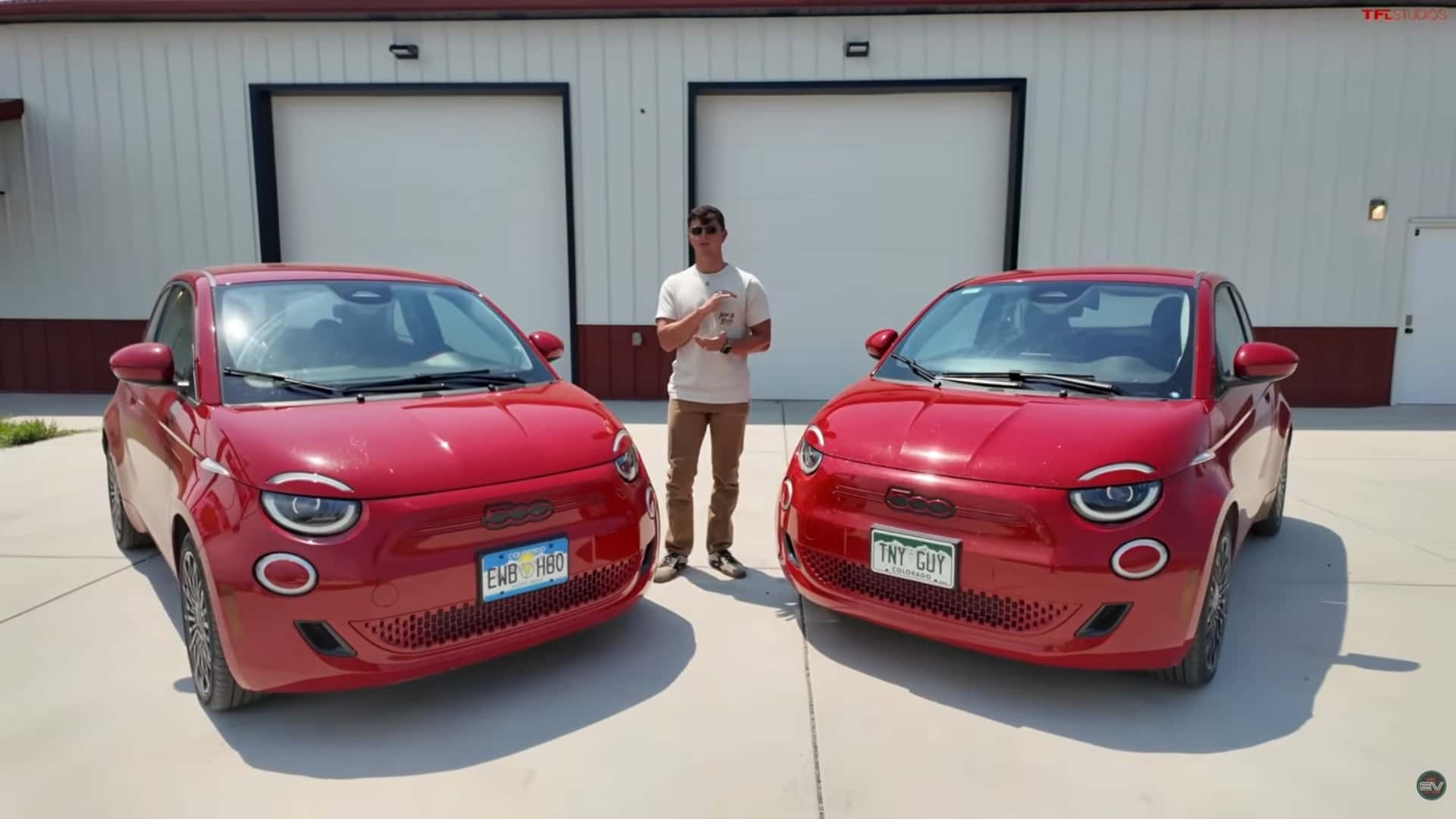
Key Takeaways: Fiat 500e Ownership Experience
- Aggressive Lease Deals: YouTubers Tommy and Case secured Fiat 500e leases in 2024 for minimal upfront costs and low monthly payments, leveraging substantial federal and state EV tax credits.
- Limited Range & Charging: With a 149-mile range and 85 kW fast charging, the 500e is primarily an urban commuter, struggling with longer trips, especially in cold weather where range can drop to 100 miles.
- Technical Glitches: Owners reported recurring issues with charging interruptions, incompatibility with certain chargers, a ‘useless’ mobile app, and even a misaligned rear hatch on one vehicle.
- Charming Daily Driver: Despite the limitations and technical quirks, both hosts found the Fiat 500e to be a practical and reasonably engaging small electric car for daily errands and city driving.
- Value Proposition: The experience underscores that even entry-level or ‘less impressive’ electric vehicles, when acquired cost-effectively, can serve as excellent secondary cars or dedicated urban transport.
In an era where sustainability increasingly influences consumer choices, the allure of electric vehicles (EVs) is undeniable. Yet, the upfront cost often remains a significant barrier for many. However, a unique opportunity arose in 2024, allowing some early adopters to experience EV ownership for a fraction of the typical expense.
Two prominent figures from the TFLEV YouTube channel, Tommy and Case, seized this chance by leasing Fiat 500e models under exceptionally aggressive promotional schemes. Their two-year journey with these ‘mostly free’ electric cars offers invaluable insights into the practicalities and challenges of living with an entry-level EV, revealing that while the price was right, the experience wasn’t entirely seamless.
The Unprecedented Value of the ‘Almost Free’ EV Lease
The genesis of Tommy and Case’s Fiat 500e ownership experience lies in a confluence of factors that created an unprecedented value proposition. In 2024, Fiat initiated robust nationwide promotions for its 500e model, aimed at boosting sales and market penetration for the compact electric hatchback.
These manufacturer incentives were significantly amplified by governmental support for electric vehicle adoption. The federal government’s $7,500 EV tax credit, designed to make electric cars more accessible, played a crucial role. Furthermore, Colorado, where Tommy and Case reside, offered its own substantial $5,000 EV credit, stacking a considerable sum onto the federal incentive.
This strategic layering of discounts and credits effectively reduced the net cost of the Fiat 500e to near zero for the two YouTubers. Tommy, for instance, managed to secure his lease with a mere $1,000 down payment, primarily covering taxes, and has since incurred no monthly payments. Case’s arrangement was similarly advantageous, involving a few hundred dollars upfront for a lease wear-and-tear protection plan, followed by a remarkably low monthly payment of $49.

These figures represent a significant deviation from typical EV lease or purchase costs, positioning their Fiat 500e models as arguably the closest one could get to a ‘free’ car. The strategy by Fiat and the government incentives clearly aimed to stimulate interest in electric mobility, and for these individuals, it translated into an exceptionally cost-effective entry into the EV segment.
Real-World Practicality: Navigating Range and Charging Limitations
Two years into their Fiat 500e ownership, the reality of living with an affordable electric vehicle has come into sharp focus. While the initial investment was minimal, the day-to-day experience highlighted inherent limitations, particularly concerning range and charging infrastructure.
Urban Commuter vs. Road Trip Aspirations
The Fiat 500e is rated with a range of 149 miles on a full charge. This figure, while adequate for daily commutes and city errands, firmly establishes the vehicle’s identity as an urban commuter. Its fast-charging capability, capped at 85 kW, further reinforces this, making it less suitable for long-distance travel where quicker charging times are essential to minimize journey durations.
Both Tommy and Case acknowledged that the 500e is unequivocally not a road trip car. Their ability to manage this limitation stems from having other vehicles available for extended journeys. This setup is common among multi-car households embracing electric mobility, where a smaller EV serves as a dedicated city driver.
The Impact of Cold Weather on EV Performance
The challenges of the Fiat 500e ownership experience are exacerbated during colder months. The vehicle’s range, which stands at 149 miles under ideal conditions, can plummet to approximately 100 miles in cold weather. This reduction significantly curtails the car’s utility, even for local travel.
Moreover, the absence of preconditioning — a feature that warms the battery and cabin before driving, often while still plugged in — means that the 500e starts with suboptimal efficiency in cold temperatures. This lack of a critical EV feature makes undertaking any journey outside town during winter a less than ideal proposition, limiting its flexibility and highlighting a design oversight for colder climates.
Technical Quirks and Daily Annoyances
Beyond the inherent range and charging specifications, the two-year Fiat 500e ownership experience has been punctuated by several minor yet persistent technical issues. These glitches, though not rendering the cars inoperable, have contributed to a less than perfect user experience.
Inconsistent Charging and Connectivity
A recurring complaint across all four Fiat 500e vehicles—those owned by Tommy, Case, Tommy’s in-laws, and a TFL support staff member—is the inconsistency of the charging process. Owners frequently report that the cars often cease charging after only a few minutes, requiring manual intervention to restart the process. This issue is compounded by the fact that the vehicles sometimes fail to charge at all on certain public charging stations, introducing an element of unpredictability to range management.
The accompanying mobile application, intended to provide remote control and monitoring capabilities, has also proven to be largely ineffective. Tommy candidly describes the app as ‘pretty much useless,’ suggesting a disconnect between its intended functionality and actual performance. Adding to the digital peculiarities, the car inexplicably sends an email notification every time it commences or concludes a charging session, an overzealous feature that quickly becomes a minor annoyance rather than a helpful alert.
Mechanical Imperfections: The Case of the Misaligned Hatch
On the mechanical front, Tommy’s Fiat 500e has presented a specific issue with its rear hatch. The hatch is slightly misaligned, leading to functional problems. This misalignment means it occasionally fails to open correctly, requiring extra effort. More significantly, it often allows wind and dust to enter the cabin, compromising the interior’s cleanliness and the overall driving comfort, particularly at higher speeds or on dusty roads.
These minor flaws, though seemingly trivial individually, collectively paint a picture of an EV that, while economically advantageous, might compromise on refinement and consistent reliability in certain areas. This nuanced Fiat 500e ownership experience highlights the trade-offs often associated with highly discounted or entry-level models in the rapidly evolving electric vehicle market.
Driving Dynamics and Comparative Analysis
Despite the various practical and technical challenges encountered, the Fiat 500e has managed to charm its owners, particularly in its role as a local daily driver. The driving dynamics, while not groundbreaking, offer a commendable experience for its segment.
An Engaging Urban Ride
The little Fiats, as Tommy and Case refer to them, are lauded for their capability in around-town runs. Their compact dimensions make them highly maneuverable in urban environments, ideal for navigating congested streets and tight parking spaces. The immediate torque delivery characteristic of electric vehicles contributes to a reasonably responsive and enjoyable driving experience for city speeds.
While the hosts concede that the 500e is not as engaging to drive as its earlier, internal combustion engine counterparts, it still delivers a pleasant ride. The electric powertrain provides a quiet and smooth operation, enhancing the overall cabin experience compared to many traditional gasoline-powered small cars.
Comparing with Other Affordable EVs: Nissan Leaf
The TFL team has also had experience with other deeply discounted EVs, notably the Nissan Leaf. In a direct comparison, Tommy notes that the Fiat 500e offers a superior driving experience compared to the last-generation Leaf models they also leased under similar ‘mostly free’ terms. This suggests that in terms of driving dynamics and a sense of ‘fun,’ the 500e holds an edge among certain budget-friendly EVs.
However, the comparison isn’t entirely one-sided. Tommy also highlights that the last-generation Nissan Leaf was considerably comfier and more practical than the 500e. This indicates a trade-off: while the Fiat might offer a more spirited drive, the Leaf likely provided better passenger comfort and cargo space, factors often critical for a primary vehicle.
Ultimately, this comparative analysis underscores a common theme in the affordable EV market: manufacturers often prioritize different aspects. The Fiat 500e aims for urban agility and a touch of driving zest, while other models might focus on maximizing comfort or practicality within a similar price bracket. This variety provides consumers with choices tailored to their specific needs and priorities in the realm of electric mobility.
The Broader Implications for EV Adoption
The two-year Fiat 500e ownership experience of Tommy and Case offers valuable lessons beyond their personal anecdotes. It provides a microcosm of the challenges and opportunities within the burgeoning electric vehicle market, particularly concerning entry-level models and the motivations for their adoption.
Understanding the ‘You Get What You Pay For’ Paradigm
The prevailing sentiment from their review echoes a classic consumer truism: ‘you get what you pay for.’ While the financial outlay for the 500e was minimal, the vehicles inherently came with certain limitations. Neither the Fiat 500e nor the Nissan Leaf offered road-trip-ready range or cutting-edge technological features. These advanced attributes typically command a premium, which was not the case with these highly incentivized leases.
This highlights a crucial distinction in the EV market. Consumers seeking long-range capabilities, ultra-fast charging, and sophisticated infotainment systems must be prepared for a higher price point. Conversely, those who can leverage aggressive deals for basic EVs understand they are acquiring a specific type of vehicle – one optimized for local travel rather than comprehensive utility.
The Role of Affordable EVs as Daily Drivers
Despite the imperfections and technical quirks, the overall positive experiences shared by the hosts serve as a potent reminder: even some of the ‘least impressive’ electric vehicles on the market can still function as incredible daily drivers. For individuals with predictable commutes, access to home charging, and alternative vehicles for longer journeys, a compact EV like the Fiat 500e represents a highly economical and environmentally conscious choice.
These experiences are critical for the wider electric mobility landscape. They demonstrate that not every EV needs to be a Tesla competitor with hundreds of miles of range to be a successful and satisfying purchase. There is a significant market segment for affordable, practical, and efficient urban electric cars that can effectively replace traditional gasoline vehicles for the majority of daily driving needs, thereby accelerating the overall adoption of zero-emission vehicles.
The success of these ‘mostly free’ Fiat 500e leases illustrates the power of financial incentives in driving EV adoption and the practical viability of smaller, less complex electric cars for specific use cases. As the EV market matures, understanding these nuanced ownership experiences will be vital for manufacturers and policymakers alike to cater to diverse consumer needs and budgets.
Conclusion
The two-year Fiat 500e ownership experience of Tommy and Case from TFLEV provides a compelling, real-world case study on the practicality and perception of entry-level electric vehicles acquired through aggressive lease incentives. While the allure of a ‘nearly free’ car was undeniable, the journey was marked by a mix of convenience, charm, and occasional frustrations.
The vehicles proved highly effective for urban commuting and short-distance travel, offering a reasonably engaging drive and the inherent benefits of electric mobility. However, limitations in range, slower charging speeds, and a scattering of technical glitches, exacerbated by cold weather performance, underscored their niche role as secondary vehicles or dedicated city cars.
Ultimately, this extended review confirms that while not every EV delivers cutting-edge technology or cross-country capability, even the more basic models can serve as excellent, cost-effective daily drivers. Their positive experience, despite the minor inconveniences, highlights the significant strides in electric vehicle accessibility and the potential for a broad spectrum of EVs to meet diverse consumer needs in the evolving landscape of sustainable transport.
Frequently Asked Questions About Fiat 500e Ownership
What made the Fiat 500e leases so affordable for Tommy and Case?
The leases were remarkably inexpensive due to a combination of aggressive nationwide promotions by Fiat and substantial government incentives. This included a federal $7,500 EV tax credit and an additional $5,000 EV credit from the state of Colorado, effectively bringing the net cost down significantly in 2024.
What is the real-world range of the Fiat 500e, especially in cold weather?
The Fiat 500e has an official range of 149 miles. However, owners reported that this range can decrease significantly in cold weather, dropping to approximately 100 miles. This reduction, coupled with the lack of preconditioning, limits its practicality for longer trips during winter months.
Were there any significant technical issues reported with the Fiat 500e?
Yes, several minor technical issues were noted. These included inconsistent charging, where vehicles would often stop charging after a few minutes, and incompatibility with certain public chargers. The mobile app was deemed ‘useless,’ and one car also had a slightly misaligned rear hatch causing wind and dust intrusion.
How does the Fiat 500e compare to other small EVs like the Nissan Leaf?
Tommy found the Fiat 500e more engaging to drive than the last-generation Nissan Leaf models they also leased. However, he noted that the Leaf offered better overall comfort and practicality. This suggests a trade-off between driving dynamics and passenger-focused features among affordable small electric cars.
Is the Fiat 500e suitable as a primary vehicle for all needs?
Based on the ownership experience, the Fiat 500e is best suited as an urban commuter or a secondary vehicle. Its limited range and charging speed make it less ideal for frequent long-distance travel. It excels in daily errands and city driving, especially for those with access to home charging and other vehicles for longer journeys.
Does the ‘mostly free’ aspect of the lease impact the ownership satisfaction?
Despite the technical quirks and range limitations, both owners expressed being charmed by the Fiat 500e. The extremely low cost of ownership meant that they were getting excellent value for money. This underscores that for highly affordable EVs, a less-than-perfect experience can still result in high owner satisfaction for specific use cases.