
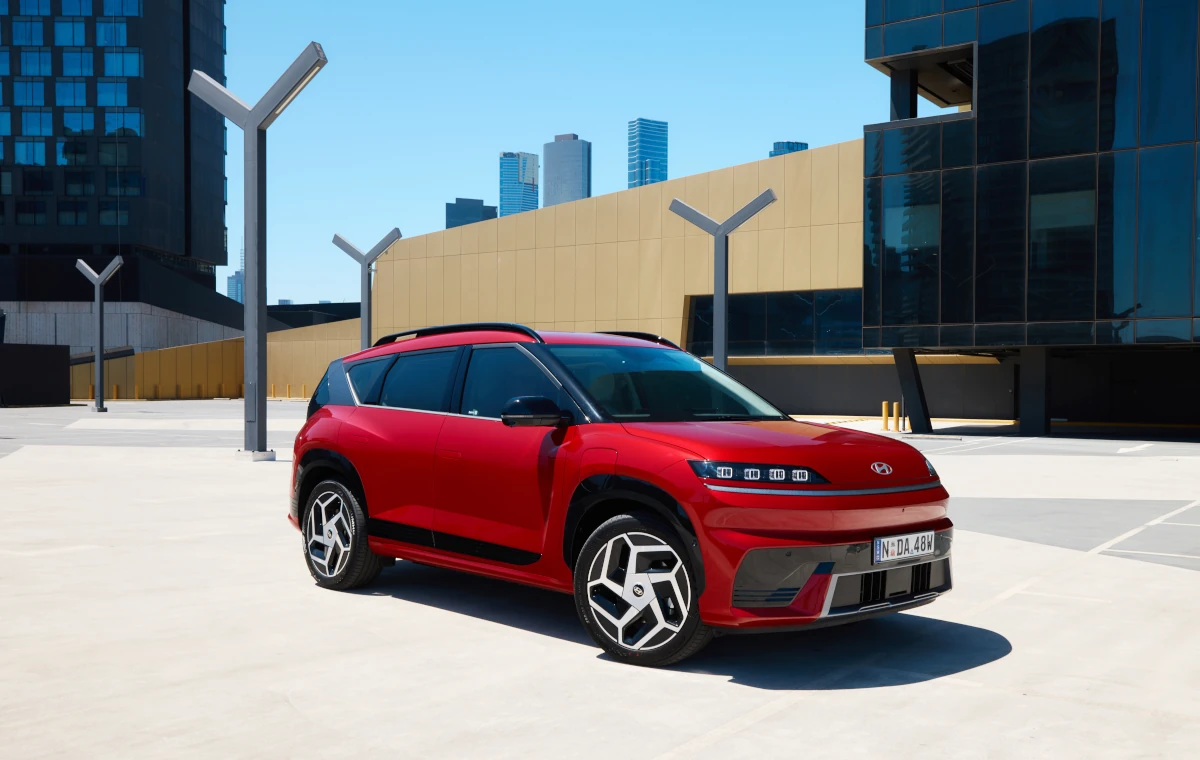
South Korean automaker Hyundai has expanded its electric vehicle (EV) lineup with the introduction of the Elexio, a mid-size SUV designed to be a family-oriented model and potentially its best-selling battery-electric offering to date. The launch marks Hyundai’s entry into a highly competitive segment of the Australian EV market.
A New Contender in the Mid-Size Electric SUV Arena
The Hyundai Elexio represents a significant move for the brand in Australia, being its first passenger vehicle sourced from China. This strategy aligns with its sister brand Kia’s success with the EV5, also manufactured in China. The Elexio enters a market segment already brimming with choices, facing competition from over a dozen other mid-size electric SUVs priced between $50,000 and $60,000.

Furthermore, the Elexio must contend with considerably more affordable offerings from Chinese manufacturers, including models like the Geely EX5, Leapmotor C10, GAC Aion V, and Deepal S07. This crowded field presents a substantial challenge for Hyundai’s new electric SUV.
Pricing and Variants: An Introductory Offer and a Future Base Model
Currently, the Elexio is available in a single Elite variant. An introductory drive-away price of $59,990 is being offered until the end of March 2026. Following this promotional period, the Elite variant’s price will be adjusted to $61,990 plus on-road costs.
A base Elexio model is slated for release in the second quarter of 2026. This model will have a starting price of $58,990 plus on-road costs, positioning it as a more accessible entry point into the Elexio range.

Powertrain and Range: Shared Technology for Consistent Performance
Both the upcoming base variant and the current Elite model will share the same front-wheel-drive powertrain. This system is powered by an 88 kWh BYD Blade LFP (Lithium Iron Phosphate) battery pack.
The Elexio Elite boasts a WLTP-certified range of up to 546 km. The base variant is expected to achieve a slightly higher range of 562 km, attributed to its use of smaller, more aerodynamic wheels compared to the Elite trim.
Design Language: A Move Towards Mainstream Appeal
Observing the Elexio in person reveals a design that deviates from the distinctive pixelated aesthetic characteristic of Hyundai’s other EVs, such as the Ioniq range. Hyundai Australia clarified that this design is inherited from its Chinese manufacturing origins and does not signify a shift in the brand’s overall design strategy.
Subtle design elements include four ‘crystal square’ daytime running lights that form the ‘H’ logo in morse code, a motif echoed on the steering wheel. The rear features a full-width light bar, which Hyundai markets as a ‘starlight pattern’, incorporating a pixelated look.
The Elexio presents a well-proportioned and generally pleasing appearance. This more conventional styling, in contrast to the unique designs of the Ioniq 5, Ioniq 6, and Inster, could potentially broaden its appeal and contribute to higher sales volumes compared to other Hyundai EVs.
Practical Considerations: Charging Port and Storage
Consistent with many Hyundai models, the Elexio’s charge port is located on the right-hand side of the vehicle. This placement may present inconvenience for drivers who frequently rely on kerbside charging, as cables might need to be routed across the bonnet.
Storage capacity is a strong point for the Elexio. The boot offers 506 litres of space, expandable to 1,540 litres when the 60/40 split-folding rear seats are lowered. While there is no front trunk (frunk), a shallow recess beneath the boot floor accommodates charging cables, small items, and a tyre repair kit.
A practical addition is the 15 A vehicle-to-load (V2L) outlet located on the left side of the boot, capable of delivering up to 3.5 kW. However, Hyundai has confirmed that the Elexio will not support vehicle-to-grid (V2G) technology, a feature currently exclusive to the flagship Ioniq 9.
Interior Design and Technology: A Striking Screen and User Experience
The Elexio’s interior adopts a minimalist approach, with few physical buttons, notably excluding them from the dashboard except for the hazard warning lights. The focal point is a large, 27-inch panoramic screen that spans across the dashboard, extending from near the steering wheel to the passenger side.
This panoramic display houses Hyundai’s new generation Connect-C infotainment system, built on the Android Automotive platform. The 4K screen is praised for its crispness and responsiveness, powered by a Snapdragon 8295 chip and an Unreal 3D graphics engine.
However, the placement and functionality of the climate controls on the screen present a challenge. The absence of dedicated physical controls for air conditioning means drivers must navigate small, sometimes difficult-to-reach buttons on the screen. While physical controls for directing airflow are present, the adjustment of temperature and fan speed can be cumbersome while driving.
Hyundai acknowledges that this new system has room for improvement and plans to incorporate customer feedback through future over-the-air (OTA) updates to enhance the user experience.
Driver Information and Comfort Features
Essential driving information is presented on a dedicated panel positioned closer to the driver, supplemented by a new generation projector-based head-up display (HUD). The HUD’s visibility was noted to be significantly reduced when wearing polarised sunglasses, requiring head tilting for clear viewing. Without sunglasses, it provides clear and comprehensive data, including navigation and media details.
Once settled into the Elexio’s comfortable seats, the interior offers a spacious and pleasant environment. The Elite variant features leather-appointed seats with heating and ventilation functions, a welcome feature during warmer conditions.
The forthcoming base model will come with cloth seats, foregoing the heating, ventilation, heated steering wheel, power-adjustable passenger seat, and driver seat memory functions found in the Elite. Other downgrades for the base model include a single wireless charging pad instead of two and a manual tailgate.
Cabin Storage and Rear Seat Comfort
Designed with families in mind, the Elexio cabin boasts an impressive 46 “flexible storage areas.” These include conventional compartments like the centre console, cup holders, and glovebox, alongside less common features such as a shelf on the passenger side of the dash, a rear centre-facing tray, a lower drawer, and cup holders integrated into the rear door armrests.
Rear passenger comfort is a priority, with ample headroom and legroom for even tall occupants. The 175 cm reviewer noted considerable space remaining. The rear floor is flat, the seats recline, and air conditioning vents are positioned on the B-pillars for passenger comfort.
Notably absent is a panoramic glass roof, which may appeal to buyers seeking an alternative to glass roofs that can sometimes contribute to excessive brightness or heat.
Driving Dynamics: A Focus on Smoothness and Compliance
Hyundai Australia conducted a local ride and handling program for the Elexio, collaborating with international engineers to fine-tune the suspension and steering for Australian conditions. The resulting setup prioritises passenger comfort and a compliant ride, while maintaining composure when driven more assertively.
Test drives covered various conditions, including city traffic, highway driving, and winding country roads with imperfections. The Elexio handled these varied surfaces with ease, demonstrating a stable and confident feel.
Acceleration from a standstill or during overtaking manoeuvres is described as smooth but lacking assertive power. The vehicle’s power delivery feels somewhat restricted until speeds approach around 70 km/h, after which it gradually eases off.
Overall, the Elexio performs capably for its intended purpose of family transport. For buyers seeking a sportier driving experience with similar practicality, the Hyundai Ioniq 5 remains an alternative within the brand’s lineup.
Vehicle Controls and Driver Assistance Systems
The Elexio’s steering wheel features familiar controls for cruise control and audio settings, along with paddles for adjusting regenerative braking. The i-Pedal one-pedal driving mode can be activated by holding the left paddle. Four selectable drive modes – eco, normal, sport, and snow – are accessible via a dedicated button.
Hyundai’s adaptive cruise control and lane-centering systems were tested on highway stretches and performed as expected. A more extended period of use would be necessary for a comprehensive assessment.
Some Advanced Driver Assistance Systems (ADAS) exhibited characteristics common to other Hyundai vehicles tested. For instance, the speed limit warning occasionally beeped excessively in school zones when they were not active. This persistent alert can be deactivated by a long press of the steering wheel mute button.
Efficiency and Real-World Range
Accurate efficiency figures were challenging to obtain during the launch event due to driver rotations and varied driving styles. However, observed energy consumption ranged between 190-200 Wh/km during personal driving segments. One test vehicle displayed an average of 179 Wh/km over 1,586 km, suggesting a real-world range of approximately 490 km on a full charge.
Conclusion: A Competent, But Not Standout, Electric SUV
The Hyundai Elexio emerges as a competent new electric vehicle offering. Its spacious and comfortable cabin, abundant storage solutions, and user-friendly controls (once familiarised with the unique screen layout) are likely to appeal to families.
The crucial question is whether the Elexio provides enough compelling reasons for buyers to switch from established medium SUVs or opt for more affordable Chinese competitors. While it meets the expectations for its price segment, it lacks distinctive features that would make it a standout choice.
At its current introductory price of $59,990 driveaway for the Elite variant, the Elexio is reasonably positioned within its competitive set. However, with the price set to increase to over $67,500 on the road after the introductory offer concludes at the end of March 2026, its value proposition becomes less convincing, making the premium for a legacy brand harder to justify.
Given Hyundai’s recent history of offering discounts on its EV range, potential buyers are advised to test drive the Elexio and remain vigilant for well-priced new or demonstrator models that may become available.
Key Specifications: Hyundai Elexio Elite
| Specification | Details |
|---|---|
| Variant | Hyundai Elexio Elite |
| Price | $59,990 driveaway (until March 31, 2026) $61,990 plus on-road costs (thereafter) |
| Paint Colours |
$295 for optional dove grey interior. |
| Battery Size | 88.1 kWh |
| Battery Chemistry & Manufacturer | Lithium iron phosphate (LFP), BYD |
| Range (WLTP) | 546 km |
| Drive Wheels | Front-wheel drive |
| Power / Torque | 160 kW / 310 Nm |
| Max Charging Speed | 10 kW AC, 122 kW DC |
| Charging Time | 7 kW AC (0 – 100 %): 13 hours 50 kW DC (10 – 80 %): 72 minutes 150 kW DC (10 – 80 %): 38 minutes |
| Bidirectional Charging | Yes: V2L (internal socket in the boot) |
| Exterior Dimensions | Length: 4,615 mm Width: 1,875 mm Height: 1,695 mm Wheelbase: 2,750 mm Ground Clearance: 160 mm |
| Kerb Mass | 2,105 kg |
| Storage Space | Frunk: N/A Boot (seats up): 506 L Boot (seats folded): 1,540 L |
| Service Interval | 24 months / 30,000 km |
The full specifications for the Elexio are available on Hyundai Australia’s website.
Watch the review: Hyundai Elexio review: Spacious with solid range
By Tim Eden. Tim has 20 years of experience in the IT industry, including 14 years as a network engineer and site reliability engineer at Google Australia. He is an EV and renewable energy enthusiast passionate about helping people understand and adopt these technologies.