
Key Takeaways
- Toyota Woven City, near Mount Fuji, is Toyota’s ambitious ‘living laboratory’ for advanced mobility, urban innovation, and sustainable technologies.
- Six years after its announcement, the city is operational with 100 residents, serving as a real-world testing ground for future smart city solutions.
- The project focuses on integrating autonomous vehicles, smart infrastructure, delivery robotics, and renewable energy systems like a virtual power plant.
- Despite early operational challenges, Toyota maintains transparency, emphasizing Woven City as a crucial ‘work in progress’ for developing future mobility solutions.
- This initiative underscores Toyota’s strategic evolution from a traditional car manufacturer to a comprehensive mobility technology company.
In the quiet shadow of Japan’s iconic Mount Fuji, a bold experiment in urban living and advanced mobility is taking shape. This is Toyota Woven City, envisioned as a futuristic ‘living laboratory’ where cutting-edge technologies and sustainable practices converge to redefine urban existence. Launched by automotive giant Toyota, the city recently opened its gates to non-Japanese journalists for the first time, offering a rare glimpse into its unfolding reality.
Yet, like any pioneering endeavor, the Toyota Woven City is currently a significant work in progress. Early operational quirks, such as a traffic light that stubbornly remained red for extended periods or city lights activating inexplicably in the dead of night, have been openly acknowledged. There was even an instance where a robot became stuck, necessitating a manual intervention by three individuals.
These candid examples of initial challenges were shared directly by Daisuke Toyoda, a senior vice president at Woven by Toyota, the carmaker’s dedicated mobility technology division, and son of Toyota Chairman Akio Toyoda. Such transparency underscores the project’s foundational ethos: to learn, adapt, and refine in a real-world environment.
Six years after Akio Toyoda first unveiled his vision for this innovative urban hub, the Toyota Woven City has transitioned from concept to concrete reality. A select group of individuals now live and work within its nascent boundaries, actively participating in the rigorous testing and refinement of technologies that hold the potential to shape Toyota’s future—and, indeed, the broader landscape of urban mobility.
The Nascent Landscape of Toyota Woven City
A recent visit to the Toyota Woven City revealed an environment that is meticulously clean, architecturally consistent, and undeniably futuristic. However, the prevailing atmosphere was one of quiet emptiness. Sparse pedestrian traffic, a notable absence of conventional vehicles, and limited signs of bustling daily life characterized the initial impression, partly influenced by the inclement weather during the tour.
This relative quietude reflects the city’s early developmental stage. Toyota has confirmed that an initial cohort of 100 residents, dubbed “Weavers,” currently inhabits the city. These 50 households are all affiliated with Toyota, forming a controlled community for the comprehensive testing of new systems and services.
Strategically located approximately a 90-minute drive from Tokyo, the Toyota Woven City’s first phase encompasses a cluster of buildings spanning an area equivalent to a few city blocks. Construction is already underway for a Phase Two expansion, signaling a planned increase in its physical footprint by more than tenfold. Ultimately, Toyota anticipates the population of Woven City to grow to around 2,000 residents, evolving into a more vibrant, populated ecosystem.
Innovation at the Inventor Garage: A Hub for Future Technologies
The Toyota Woven City serves a dual purpose: it is both a real-world proving ground and a dynamic idea incubator. A crucial component of this innovation ecosystem is the “Inventor Garage,” a former Toyota factory building meticulously repurposed into a cutting-edge maker space. Here, various companies and project teams engaged with Woven City can develop, refine, and iterate on their products and concepts.
During a media event, booths at the Inventor Garage showcased a diverse array of innovations. Many projects are directly aligned with enhancing the movement of people and goods, reflecting Woven City’s core focus on mobility. For instance, Denso, a key Toyota supplier, is actively developing wireless electric vehicle (EV) charging technology, with plans to test roads embedded with induction charging capabilities within Woven City.
A Toyota subsidiary has also pioneered Cocomo, a sidewalk delivery robot that is undergoing rigorous navigation training within Woven City and other environments. Furthermore, a company specializing in compact hydrogen fuel cells demonstrated a proof-of-concept hydrogen-powered e-bike, which residents are expected to test, contributing to the development of alternative energy solutions.
The innovation extends beyond ground-based transportation. Joby Aviation, an electric vertical take-off and landing (eVTOL) firm with significant backing from Toyota, has recently joined the Woven City initiative, exploring future aerial mobility solutions. These collaborations underscore the comprehensive approach to redefining transportation within the smart city framework.
Beyond Mobility: Diverse Innovations in a Connected Ecosystem
While mobility forms the core, the Toyota Woven City is also a testbed for a surprisingly diverse range of non-automotive innovations. This includes a vending-machine company, reflecting the pervasive presence and cultural significance of automated retail in Japan. The renowned ramen manufacturer, Nissin Foods, is utilizing the city as a living lab to test new food concepts directly with the Weavers.
In a more unexpected turn, another company is leveraging artificial intelligence (AI) to enhance the karaoke experience, aiming to help residents select the perfect song. This breadth of experimentation highlights Toyota’s holistic approach to understanding and shaping future living environments, integrating technology into every facet of urban life within the Toyota Woven City.
Woven City: A Proving Ground for Next-Generation Mobility
At its heart, the Toyota Woven City is explicitly designed as a “proving ground for mobility,” a sentiment echoed by Daisuke Toyoda and other executives. This mission extends beyond merely developing advanced vehicles; it encompasses pioneering comprehensive solutions for urban transportation challenges. While traditional carmakers operate facilities for testing vehicles under extreme conditions, Woven City addresses a different frontier: the integration of technology with urban infrastructure.
Toyota’s ambitious goal of achieving a world with “zero accidents” is not solely dependent on improved vehicle technology. John Absmeier, CTO of Woven by Toyota, explained that while self-driving technology is also being tested on public roads, Woven City offers a unique advantage. “In the city, in particular, the infrastructure is what we can get access to,” he stated. “We can control, we can test, we can develop new ideas around it. And that’s the biggest difference or opportunity that we have here in the city.”
Smart Infrastructure and Enhanced Safety Protocols
A cornerstone of this approach is the integration of smart infrastructure. Every intersection within the Toyota Woven City is equipped with multiple cameras that feed data into the Woven City AI Vision Engine. This sophisticated system allows Toyota to develop and test proactive safety measures. For example, the system can detect a person running into an intersection and instantly alert an approaching autonomous vehicle or driver, potentially preventing collisions before they occur.
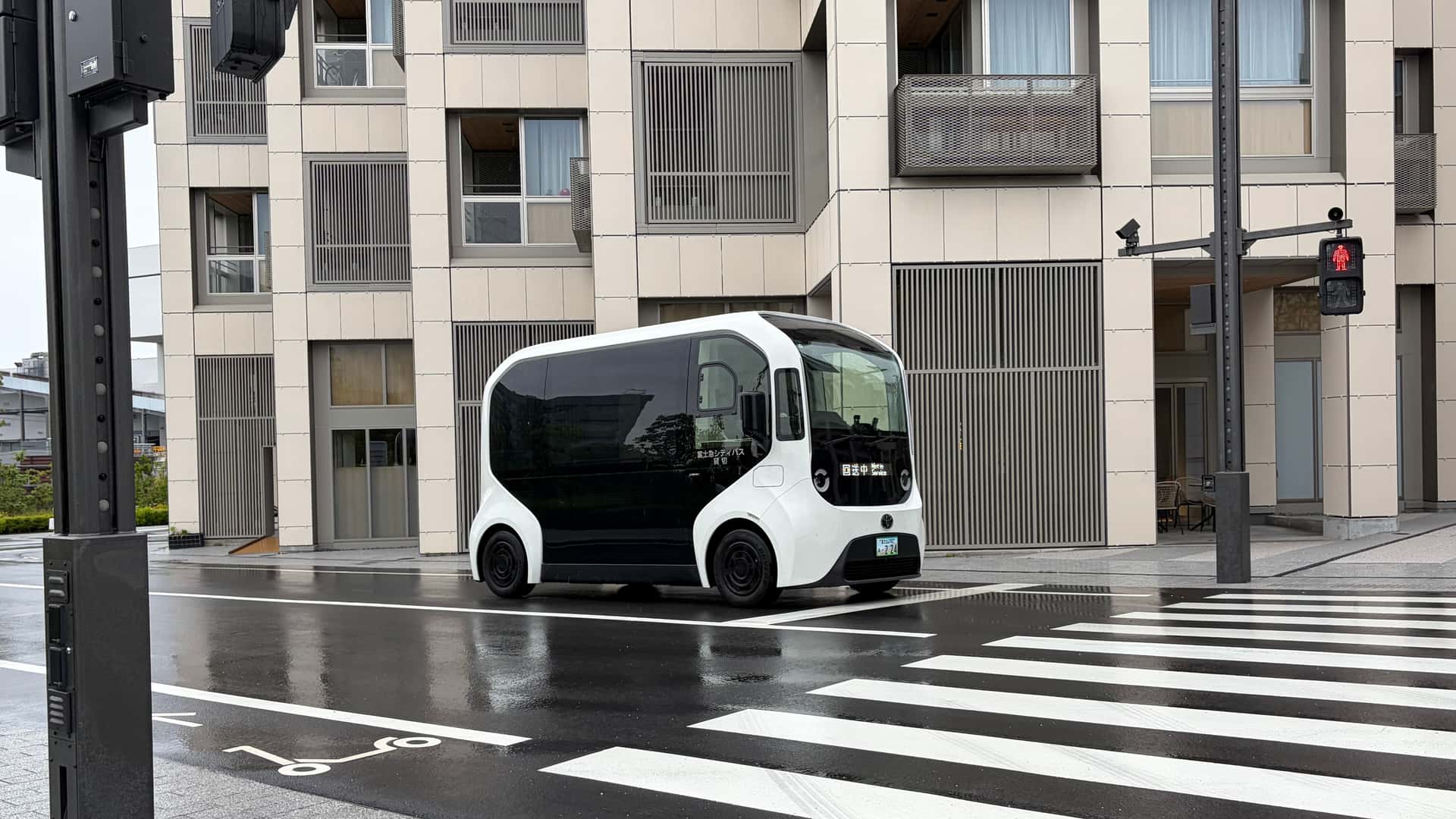
Such real-time tests are currently underway. The bubbly e-Palette buses, which constitute Woven City’s internal transit system, are presently human-driven. However, the long-term plan is to transition these vehicles to full autonomy. Furthermore, the city’s traffic signals are designed to prioritize pedestrians, only shifting to vehicle priority when an approaching car is detected, though this advanced feature is still in its activation phase.
Robotics, Micromobility, and Sustainable Energy Initiatives
The scope of mobility innovation at Toyota Woven City extends significantly into robotics and diverse transportation solutions. Although rain prevented a sighting of the Cocomo delivery robots during the visit, other pioneering bots were on display, showcasing the city’s dedication to automated services.
Guide Mobi: Autonomous Vehicle Towing
Among these is Toyota’s Guide Mobi, a robust, three-wheeled robot equipped with a comprehensive sensor array. Its ingenious design allows it to effectively render any car driverless. In Woven City, Guide Mobi robots are deployed to autonomously tow Toyota bZ4X crossovers from a parking garage, forming a key component of the city’s car-sharing service. Residents can summon a vehicle via an app, and a Guide Mobi delivers it to the curb, wirelessly interfacing with the car’s braking, steering, and acceleration systems from a distance of approximately 10 feet ahead.
During a demonstration, a human monitor was present in the bZ4X’s driver’s seat as a safety precaution, and the driving exhibited some initial unevenness. Nevertheless, the concept holds immense promise for applications such as robo-valets and integrated automated parking solutions, showcasing a novel approach to vehicle deployment.
Automated Deliveries and In-Home Robotics
Package delivery for Weavers is also fully automated. Delivery trucks do not enter the main city area; instead, they deposit packages at an underground logistics center. From this hub, wheeled robots retrieve the parcels and transport them to centralized lockers within each building via a network of tunnels beneath the city. Looking ahead, Toyota plans to introduce helper robots into Weavers’ homes, where these intelligent machines will learn to perform domestic tasks like washing dishes and folding laundry in a genuine living environment, further integrating robotics into daily life.
Swake: A Novel Micromobility Solution
At the street level, residents have access to the Swake, another innovative Toyota creation designed for shared micromobility. These distinctive scooters feature three wheels, providing enhanced stability compared to conventional two-wheeled models. They also incorporate a large platform for both feet and a unique butt pad for leaning, offering a more comfortable and secure ride. Although the Swake service was suspended due to the weather during the visit, an indoor demonstration highlighted its potential as a highly stable and nimble micromobility solution, particularly appealing to individuals who might feel less confident on traditional bikes or scooters.
Virtual Power Plant (VPP): Advancing Sustainable Energy
Further cementing its commitment to sustainability, Toyota Woven City operates an EV-powered virtual power plant (VPP). A dedicated parking garage within the city houses 50 city-owned electric vehicles, all equipped with bidirectional charging capabilities. This innovative setup allows these EVs to feed surplus power back into the city’s grid when needed. Woven City representatives indicate that this VPP can effectively shave off 5-10% of the city’s peak power demands, optimizing energy consumption and resilience.
While the VPP technology currently functions as a proof-of-concept, Toyota views it as a scalable solution, particularly for industrial sites managing large fleets of company-owned electric vehicles. This initiative positions Woven City at the forefront of sustainable energy management, exploring how distributed EV assets can contribute to grid stability and energy independence.
Toyota’s Transformative Vision: Beyond Automotive
In an era defined by rapid technological advancements and shifting market dynamics, Toyota, like many established automotive manufacturers, is strategically recalibrating its identity for the future. The company faces formidable competition not only from the aggressively fast-moving Chinese carmakers but also from Silicon Valley-inspired disruptors like Tesla and Rivian. Furthermore, the advent of self-driving technologies portends a future where the traditional need for personal car ownership might significantly diminish.
Tracing its origins back to the manufacture of looms at the turn of the last century—a heritage reflected in the pervasive “woven” terminology—Toyota ascended to become the world’s largest car manufacturer. Now, it is embarking on its next major transformation: redefining itself as a comprehensive mobility company. The sheer breadth of innovative ideas being explored within the Toyota Woven City underscores this ambitious reorientation, demonstrating a commitment to understanding and shaping what ‘mobility’ truly means in the 21st century.
This transition is undoubtedly complex, requiring significant investment and a willingness to experiment with novel concepts. However, a controlled and dynamic testing environment like the Toyota Woven City offers an invaluable platform. By providing a real-world sandbox for technologies, it enables iterative development, rapid prototyping, and invaluable learning. As the initial teething issues are systematically addressed and refined, Woven City is poised to deliver critical insights and solutions that will help Toyota navigate the evolving landscape of global mobility, forging a path toward a more connected, efficient, and sustainable future.
Frequently Asked Questions About Toyota Woven City
1. What is Toyota Woven City?
Toyota Woven City is a visionary living laboratory and smart city project initiated by Toyota, designed to test and develop cutting-edge technologies related to autonomous driving, robotics, artificial intelligence, and sustainable living in a real-world environment. It serves as a proving ground for future urban mobility solutions.
2. Where is Toyota Woven City located?
Toyota Woven City is strategically located near Mount Fuji, approximately a 90-minute drive from Tokyo, Japan. This location offers a unique blend of natural surroundings and proximity to Toyota’s operational hubs, facilitating the development and testing of advanced urban concepts.
3. Who lives in Toyota Woven City?
Currently, the initial phase of Toyota Woven City is inhabited by 100 residents, referred to as “Weavers,” comprising 50 households. All residents are affiliated with Toyota, forming a controlled community that actively participates in testing and providing feedback on the city’s various technologies and services.
4. What technologies are being tested there?
The city is a hub for diverse technological trials, including wireless EV charging, autonomous e-Palette buses, sidewalk delivery robots (Cocomo), hydrogen fuel cell applications, and advanced smart infrastructure integrated with AI vision systems for enhanced safety. Robotics for in-home assistance and micromobility solutions like the Swake scooter are also being developed.
5. What is the “Inventor Garage”?
The “Inventor Garage” is a repurposed former Toyota factory building within Woven City. It functions as a dedicated maker space and incubator where various companies and project teams can develop, tinker with, and refine their products and concepts related to mobility, smart city solutions, and other innovations, fostering a collaborative ecosystem.
6. How does Woven City contribute to sustainability?
Woven City integrates multiple sustainable practices, including testing a virtual power plant (VPP) that uses 50 city-owned EVs with bidirectional charging to manage energy loads and reduce peak power demands by 5-10%. It also explores hydrogen-powered mobility solutions and optimizes logistics with underground robotic delivery systems to minimize environmental impact.
7. What is the future vision for Woven City?
Toyota envisions Woven City expanding significantly beyond its current footprint and population, aiming for approximately 2,000 residents. The long-term goal is for it to evolve into a fully integrated smart city, continuously refining advanced mobility, robotics, and AI technologies to create a blueprint for a future urban environment that is safe, efficient, and sustainable, reshaping Toyota’s role as a mobility company.