
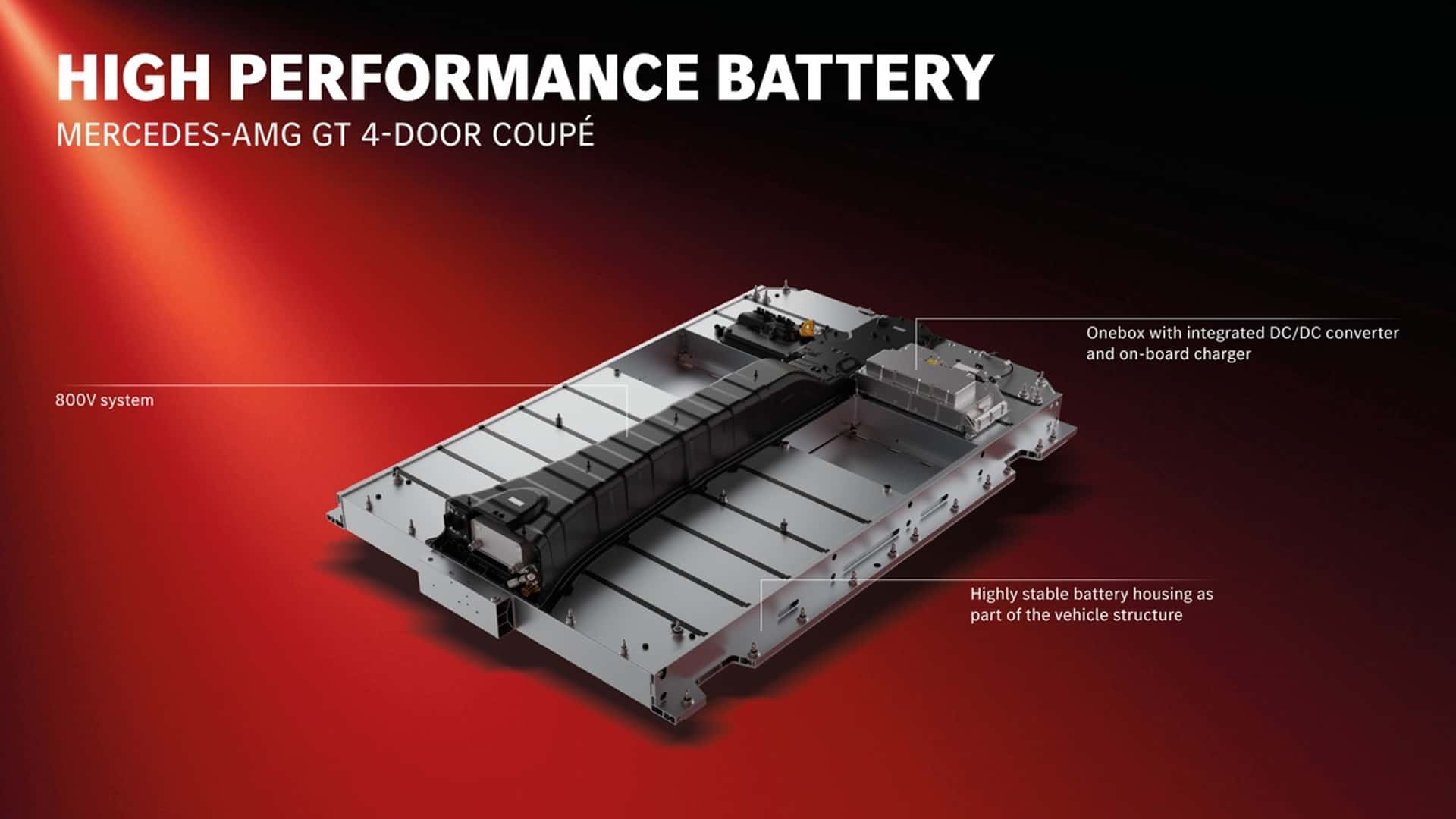
Key Takeaways (TL;DR)
- The new Mercedes-AMG GT 4-Door Coupe features an advanced EV battery with cutting-edge technology designed to overcome traditional performance limitations.
- Central to its innovation is the integration of silicon anodes, which enable significantly faster charging speeds, allowing a 10-80% charge in just 11 minutes.
- An ‘overengineered’ thermal management system, boasting 20 kilowatts of cooling capacity, precisely manages heat across 2,660 individual cells, ensuring optimal performance and longevity.
- This combination of silicon anode chemistry and sophisticated cooling propels the vehicle to 1,153 horsepower and offers a comparable EPA range of over 300 miles.
- The technology sets a new benchmark for high-performance EV batteries, with potential implications for broader electric vehicle adoption in the future.
Electric vehicles, while rapidly advancing, face a formidable challenge: balancing exhilarating performance with battery longevity and rapid charging. The very forces that make high-performance EVs thrilling – sustained high speeds, rapid acceleration, and ultra-fast charging – simultaneously push their integrated battery systems to extreme thermal limits. Effective heat management is not merely a feature; it is the fundamental differentiator between a high-performing, durable EV battery and one prone to rapid degradation or even failure.

Mercedes-AMG, a name synonymous with automotive engineering excellence, is now setting a new benchmark in this critical area. The German automaker has unveiled a series of groundbreaking innovations within the EV battery of its latest generation GT 4-Door Coupe, signaling a significant leap forward in electric powertrain technology.
This super sedan, which has transitioned from a V8 internal combustion engine to an all-electric architecture, garnered considerable attention at its recent launch for its striking design and headline figures, including an astounding 1,153 horsepower and peak charging power of 600 kilowatts. However, beyond these impressive statistics lie two pivotal, yet often overlooked, advancements: a pioneering silicon anode chemistry and a meticulously engineered cooling system.
Mastering the Heat: The Core Challenge for EV Batteries
The operational life of an EV battery is inherently demanding. Subjected to wide temperature fluctuations, the physical stresses of varied road conditions, repetitive hard acceleration, and intense fast-charging cycles, battery cells are constantly pushed to their absolute limits. These combined forces inevitably generate substantial heat, a primary antagonist to both performance and the overall lifespan of the battery pack.

Excessive heat can accelerate cell degradation, reduce charging efficiency, limit power output, and in extreme cases, pose significant safety risks. Consequently, a sophisticated thermal management system is paramount for any high-performance electric vehicle to maintain consistent output, extend range, and ensure long-term reliability.
Recognizing this critical bottleneck, Mercedes-AMG engineers embarked on an ambitious project. Their objective was to develop an EV battery capable of withstanding the rigors of a high-performance luxury vehicle, while simultaneously delivering industry-leading charging speeds and a robust driving range.
Silicon Anodes: A New Frontier in Fast Charging Technology
At the heart of the Mercedes-AMG GT’s remarkable charging capabilities lies its innovative silicon anode technology. The anode, a fundamental component within any lithium-ion cell, dictates both how much energy the battery can store and, crucially, the speed at which it can accept an electrical charge.
Historically, battery manufacturers have predominantly relied on graphite for anode construction due to its inherent stability and acceptable energy density. However, the global supply chain for graphite is largely concentrated, with China holding a significant dominant position, leading to geopolitical considerations and environmental concerns associated with its mining processes.
In response, the industry is witnessing a strategic shift. Automakers are increasingly integrating silicon-graphite composite anodes as an interim measure. This blend leverages the benefits of both materials, offering improved energy density and faster charging compared to pure graphite.
The ultimate goal for many in the sector is to entirely phase out graphite, transitioning towards 100% silicon anodes or advanced synthetic graphite alternatives. Silicon, with its theoretical capacity to store significantly more lithium ions than graphite, promises a leap in energy density and charge rates.
Breaking Charging Barriers
Mercedes-AMG’s implementation of a silicon-containing anode in the GT 4-Door Coupe is a testament to this evolving trend. This cutting-edge EV battery achieves a cell-level energy density of 298 watt-hours per kilogram, positioning it at the very high end of commercially available automotive-grade lithium-ion cells today.
Complementing this advanced anode is a cathode chemistry comprising nickel, cobalt, manganese, and aluminum (NCMA). This specific combination has been historically favored by automakers for its ability to deliver enhanced range and superior energy density, vital attributes for a luxury performance vehicle.
The synergistic effect of these advanced materials allows the Mercedes-AMG GT to achieve unprecedented charging performance. The vehicle can charge at an extraordinary peak rate of 600 kilowatts, enabling it to recover approximately 250 miles of EPA-comparable range in a mere 10 minutes of charging. Furthermore, this sophisticated EV battery system ensures a consistently high discharge rate, directly supporting the vehicle’s formidable 1,000+ horsepower output.
Upon its arrival on U.S. shores later this year, the Mercedes-AMG GT is poised to become the fastest-charging electric vehicle in America, capable of replenishing its charge from 10% to 80% in an astonishing 11 minutes. This rapid charging capability, alongside its 106 kilowatt-hours of usable battery capacity, translates to an impressive 700 kilometers (434 miles) of range on the European WLTP cycle, correlating to well over 300 miles under the more stringent U.S. EPA testing.
Industry-Wide Pursuit of Silicon Anodes
Mercedes-AMG is not an outlier in its pursuit of silicon anode technology. Major players like General Motors, alongside innovative startups such as Group14 and Sila, are actively investing in and developing similar solutions. These efforts underscore a collective industry recognition of silicon’s potential to revolutionize EV battery performance.
Despite these advancements, silicon anodes remain a niche technology within the broader EV landscape. While commercially available in limited quantities, they have yet to achieve the cost-competitiveness and scalability required to universally displace traditional graphite anodes in high-volume production models. The deployment in the Mercedes-AMG GT highlights its current application in premium, high-performance segments, where the benefits outweigh the current cost implications.
Precision Cooling: The Overengineered Heart of Performance
To fully leverage the capabilities of the advanced cell chemistry and manage the immense power output, Mercedes-AMG has implemented what can only be described as an ‘overengineered’ thermal management system. This sophisticated cooling infrastructure is crucial for maintaining optimal operating temperatures across the entire EV battery pack, even under the most strenuous conditions.
A key innovation in the battery’s physical design is the use of slim and tall cylindrical cells, each measuring 4.1 inches in height and 1 inch in diameter. This specific geometry plays a vital role in thermal efficiency; the reduced distance from the cell core to its surface facilitates significantly faster and more efficient heat dissipation, preventing localized hot spots that can compromise performance and lifespan.
Furthermore, each of the 2,660 individual cells within the EV battery pack is meticulously encased in laser-welded aluminum. This design choice enhances the thermal conductivity, allowing cells to cool down or warm up more rapidly and evenly, depending on operational requirements.
The cooling fluid itself is circulated precisely around each individual cell, ensuring uniform heat removal. This granular approach to thermal management is complemented by an advanced feature known as “on-demand cooling.” This intelligent system allows for highly targeted temperature regulation across different battery modules.
If a specific section of the EV battery begins to generate more heat, the system can precisely cool that localized area without increasing coolant flow to the entire pack. This intelligent allocation of cooling resources prevents energy waste from over-cooling other, less stressed areas, optimizing efficiency and responsiveness.
Integrated Cooling Architecture
The intricate thermal management system is orchestrated by a triumvirate of key components: a powerful coolant pump module, an efficient oil-water heat exchanger, and a centralized coolant hub. The pump is responsible for circulating the coolant throughout the pack, while the heat exchanger effectively removes excess thermal energy generated during operation.
The central coolant hub is a masterstroke in engineering, streamlining the coolant distribution into a single, compact housing. This hub provides the AMG GT with unparalleled flexibility for targeted cooling of various vehicle components. For instance, if the primary EV battery pack is operating within ideal temperature parameters, the system can intelligently redirect the coolant flow towards other critical components that require more intensive cooling, such as the electric drive units. This adaptability ensures that all high-power components of the electric powertrain remain within optimal operating temperatures.
Collectively, Mercedes-AMG states that these integrated cooling systems are capable of removing approximately 20 kilowatts of heat. This figure represents a substantial increase over the 5-8 kilowatts of cooling capacity typically found in conventional EV battery thermal management systems, underscoring the extreme measures taken to ensure peak performance and durability for this high-performance vehicle.
Impact and Future Implications for EV Battery Technology
The innovations packed into the Mercedes-AMG GT 4-Door Coupe’s EV battery represent more than just incremental improvements; they signify a paradigm shift in how high-performance electric vehicles can overcome fundamental challenges. The synergy between advanced silicon anode chemistry and an extraordinarily sophisticated thermal management system delivers a compelling blend of power, range, and rapid charging that sets new industry benchmarks.
The immediate impact is evident in the AMG GT’s ability to deliver over 1,000 horsepower consistently and achieve near-record charging times. However, the true test of this pioneering EV battery technology will unfold as the vehicle hits roads globally, allowing for real-world assessment of its long-term durability and minimal degradation over years of demanding use.
Beyond the realm of luxury performance, there is a broader aspiration: that these cutting-edge advancements will eventually trickle down into mass-market electric vehicle models. Ultra-fast charging speeds and robust battery performance, currently a privilege reserved for premium, six-figure EVs, hold the potential to accelerate electric vehicle adoption significantly across all segments. Democratizing these technologies could be a game-changer, making EVs more practical and appealing for a wider consumer base, truly marking a new era for EV battery development.
Frequently Asked Questions (FAQ)
What makes the Mercedes-AMG GT EV battery unique?
The Mercedes-AMG GT’s EV battery stands out due to its integration of silicon anode technology for ultra-fast charging and an advanced, ‘overengineered’ thermal management system. These innovations allow for superior performance, range, and rapid charge times compared to many conventional electric vehicles.
How fast can the new Mercedes-AMG GT charge?
The Mercedes-AMG GT 4-Door Coupe can charge its EV battery from 10% to 80% in approximately 11 minutes. This is achieved through its 600 kW peak charging power, making it one of the fastest-charging electric vehicles available.
What are silicon anodes and why are they important for EV batteries?
Silicon anodes are a new type of battery electrode material that can store significantly more lithium ions than traditional graphite anodes. This higher capacity enables greater energy density and dramatically faster charging speeds for EV batteries, addressing key consumer concerns about electric vehicle adoption.
How does Mercedes-AMG manage heat in its EV battery?
Mercedes-AMG employs a multi-faceted thermal management system. This includes slim cylindrical cells for efficient heat dissipation, laser-welded aluminum encasements, precise coolant flow around each of 2,660 cells, and an ‘on-demand cooling’ system that can target specific battery modules or even other powertrain components.
What is the usable battery capacity and range of the AMG GT?
The Mercedes-AMG GT 4-Door Coupe features a usable EV battery capacity of 106 kilowatt-hours. This translates to an impressive range of up to 700 kilometers (434 miles) on the European WLTP cycle, which is estimated to be well over 300 miles under the stricter U.S. EPA testing standards.
Will this advanced EV battery technology be available in more affordable cars?
Currently, technologies like advanced silicon anodes and sophisticated thermal management systems are primarily found in high-performance and luxury EVs due to cost and scalability. However, industry trends suggest that as these technologies mature and production scales, they are likely to become more accessible in mass-market electric vehicle models over time.