
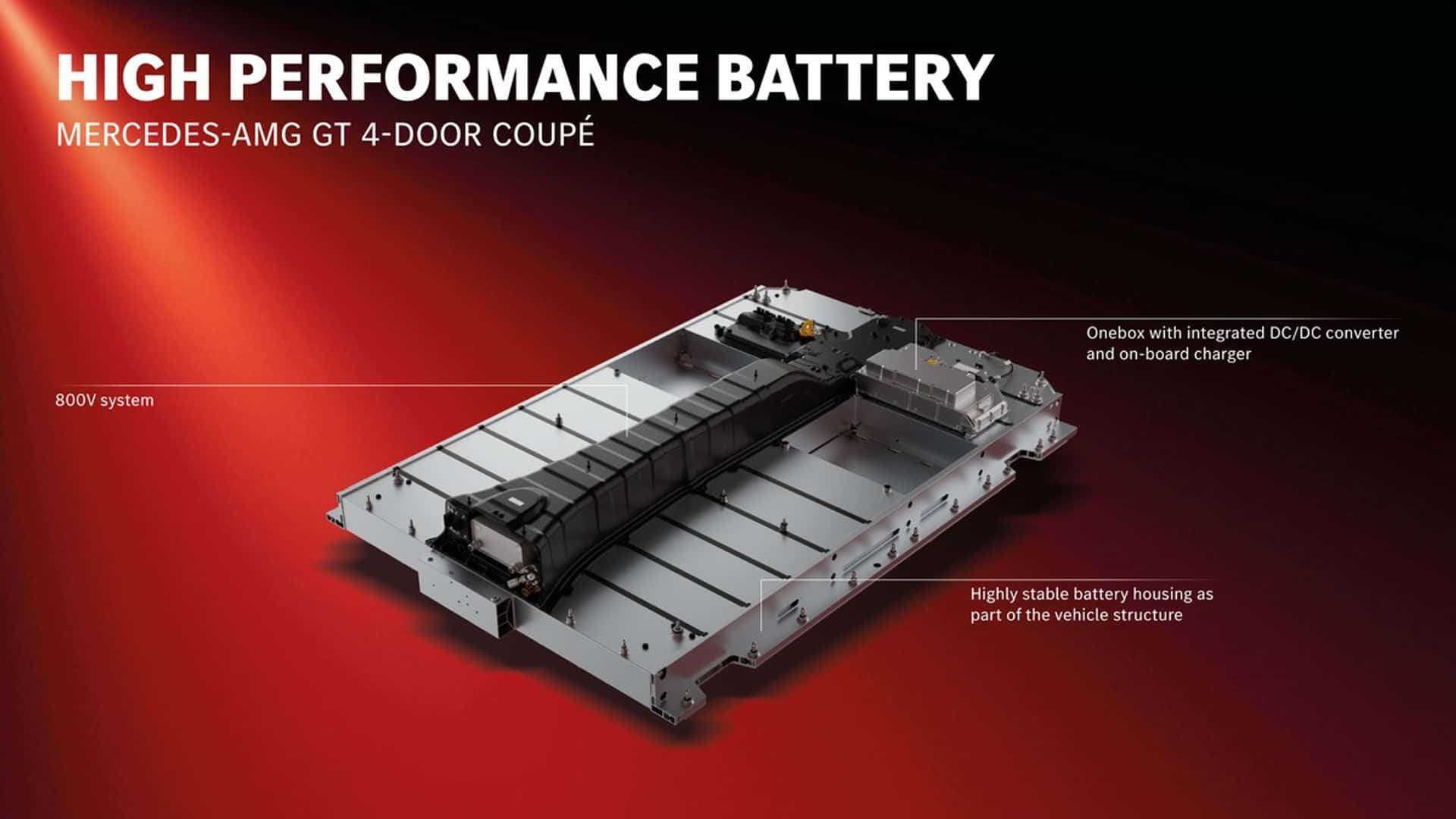
In the rapidly evolving landscape of electric vehicles, battery technology remains a critical frontier. The inherent challenge of managing heat generated during high-performance operation and rapid charging cycles often dictates an EV’s capabilities and longevity. However, a significant leap forward has been unveiled in the new Mercedes-AMG GT 4-Door Coupe, showcasing innovations designed to tackle these very issues head-on. This next-generation super sedan is not just about raw power; it represents a paradigm shift in electric vehicle battery engineering.
The Mercedes-AMG GT, in its latest iteration, has transitioned from a V8 internal combustion engine to an all-electric powertrain. While its striking design and impressive figures, such as 1,153 horsepower and a peak charging power of 600 kilowatts, immediately capture attention, the underlying battery advancements are truly groundbreaking. Two specific innovations stand out: the strategic integration of a silicon anode and a meticulously engineered, multi-faceted cooling loop.

Key Takeaways
- The new Mercedes-AMG GT features a groundbreaking battery system designed for extreme performance and ultra-fast charging.
- It utilizes silicon-containing anodes, a significant departure from traditional graphite, enabling a 10-80% charge in just 11 minutes.
- An advanced, “over-engineered” thermal management system capable of dissipating 20 kilowatts of heat ensures optimal battery temperature control.
- The battery pack employs slim, tall cylindrical cells and a laser-welded aluminum casing for efficient heat transfer.
- This technology promises enhanced range, power delivery, and battery longevity, setting a new benchmark for high-performance EVs.
The Enduring Challenge of Electric Vehicle Battery Heat
Electric vehicle batteries are subjected to immense stress throughout their operational life. They must contend with significant temperature fluctuations, structural stresses from varying road conditions, and the rigorous demands of repeated hard acceleration and intensive fast-charging cycles. Each of these factors contributes to the generation of substantial heat within the battery cells. Uncontrolled heat is the nemesis of EV performance, leading to reduced efficiency, accelerated degradation, and, in extreme cases, potential safety hazards.
Effective thermal management is paramount for an electric vehicle battery to deliver sustained power, maintain optimal range, and ensure a long service life. Automakers are continuously seeking advanced solutions to dissipate this heat efficiently, safeguard battery integrity, and unlock higher performance thresholds. The innovations within the Mercedes-AMG GT battery highlight the industry’s commitment to pushing these boundaries.
Next-Generation Performance and Rapid Charging for the Mercedes-AMG GT
At the core of the Mercedes-AMG GT’s impressive capabilities lies a substantial 106 kilowatt-hours of usable battery capacity. This provides an estimated range of up to 700 kilometers (approximately 434 miles) on the European WLTP cycle. When the vehicle arrives in the U.S. later this year, this translates to well over 300 miles of comparable range on the more stringent U.S. EPA cycle.

Crucially, the Mercedes-AMG GT is poised to become the fastest-charging EV in America, boasting a remarkable claimed charge time of just 11 minutes to go from 10% to 80% state of charge. This blistering speed is a testament to the sophisticated battery architecture and advanced materials employed by Mercedes-AMG engineers.
The Rise of Silicon Anodes
The groundbreaking charging performance of the Mercedes-AMG GT is primarily enabled by its innovative silicon anode technology. The anode is a critical component within a battery cell, responsible for how much energy the battery can store and the rate at which it can be charged. Historically, battery manufacturers have relied heavily on graphite anodes due to their stability and good energy density.
However, the global supply chain for graphite, predominantly controlled by China, coupled with increasing environmental concerns associated with graphite mining, has spurred a concerted effort to find viable alternatives. Automakers are now progressively integrating silicon-graphite anodes as a transitional strategy. The long-term objective is to completely phase out graphite, replacing it with either 100% silicon-based anodes or advanced synthetic graphite alternatives.
Mercedes-AMG is a frontrunner in this space, though it is not alone. Several other prominent companies, including General Motors and innovative startups such as Group14 and Sila, are actively developing and refining silicon anode technologies. It is important to note that, currently, silicon anodes represent a niche technology. While commercially available in limited capacities, they have yet to achieve the cost-competitiveness and scalability required to universally displace traditional graphite anodes in high-volume production.
The silicon-containing anode in the Mercedes-AMG GT achieves an impressive cell-level energy density of 298 watt-hours per kilogram. This figure places it at the upper echelon of commercially available automotive-grade lithium-ion cells today. Complementing this, the cathode of the battery incorporates a nickel, cobalt, manganese, and aluminum (NCMA) chemistry. NCMA cathodes are traditionally associated with delivering extended range and superior energy density, making them an ideal partner for the high-performance anode.
This sophisticated combination of a silicon-containing anode and an NCMA cathode, as stated by Mercedes-AMG, allows the Mercedes-AMG GT to achieve its staggering 600 kW charging rate. It can recover nearly 250 miles of EPA range in a mere 10 minutes of charging and consistently deliver the high discharge rates necessary to unleash its formidable 1,000+ horsepower output.
Over-Engineered Cooling: The Thermal Management Advantage
To effectively manage the immense heat generated by such high-performance characteristics and rapid charging, Mercedes-AMG has deployed an array of sophisticated cooling systems alongside a novel cell design. The automaker utilizes slim and tall cylindrical cells, each measuring 4.1 inches in height and 1 inch in diameter. This optimized smaller diameter is a deliberate design choice, as it significantly reduces the distance heat must travel from the cell’s core to its surface, thereby facilitating faster and more efficient heat dissipation.
Each of the 2,660 individual cells within the battery pack is encased in laser-welded aluminum. This advanced casing material enhances the thermal conductivity, allowing the cells to cool down or warm up with greater speed and precision. Coolant is meticulously circulated to flow evenly around every single cell, ensuring uniform and highly effective heat extraction across the entire pack. This precision is critical for maintaining consistent performance and extending battery life.
Precision and Efficiency: On-Demand Cooling
Further enhancing its thermal management capabilities, Mercedes-AMG has integrated an innovative “on-demand cooling” system. This intelligent system continuously monitors the temperature of each battery module. Should a specific section of the battery begin to generate more heat, the system can precisely direct additional coolant to that particular area. This targeted approach is far more efficient than simply increasing the coolant flow to the entire battery pack, which could inadvertently waste energy or over-cool other areas that do not require it. On-demand cooling optimizes energy consumption and maintains ideal operating temperatures across the entire battery.
The Centralized Cooling Architecture
At the heart of this intricate thermal management system are three primary components: a powerful coolant pump module, an efficient oil-water heat exchanger, and a centralized coolant hub. The pump module is responsible for circulating the coolant throughout the battery pack, ensuring constant flow. The heat exchanger plays a crucial role in actively removing heat from the coolant, preparing it to absorb more heat from the cells.
The central coolant hub is a clever design element that streamlines coolant distribution into a single, compact housing. This hub is instrumental in enabling the Mercedes-AMG GT’s targeted cooling of various components. For instance, if the battery pack is operating within its ideal temperature range, the system can intelligently redirect the coolant flow towards other critical components that require more cooling, such as the high-performance electric drive units. This holistic approach ensures optimal thermal conditions across the entire powertrain.
Collectively, these meticulously integrated systems empower the Mercedes-AMG GT’s battery to remove approximately 20 kilowatts of heat. This capacity is significantly higher than the 5-8 kW of cooling capacity typically found in the thermal management systems of conventional electric vehicle batteries, underscoring the “over-engineered” nature of this advanced setup.
Looking Ahead: The Future of EV Batteries
The advancements demonstrated in the Mercedes-AMG GT represent a monumental step forward in electric vehicle battery technology. While the theoretical promise of these innovations is considerable, the real-world validation will come with the Mercedes-AMG GT’s widespread deployment on roads and its performance over several years. Long-term data on minimal degradation and sustained performance will be crucial in cementing the reputation of this battery architecture.
The broader implications for the electric vehicle industry are significant. The ultimate aspiration is for these pioneering technologies, particularly the high-density silicon anodes and hyper-efficient thermal management systems, to eventually cascade down into mass-market EV models. Achieving blistering charging speeds and robust battery longevity should ideally not be a luxury exclusively reserved for six-figure, high-performance electric vehicles. Mercedes-AMG’s developments offer a glimpse into a future where such capabilities become more accessible, driving the widespread adoption and enhanced practicality of electric mobility for all.
Frequently Asked Questions (FAQ)
What is a silicon anode in an EV battery?
A silicon anode is an advanced battery component that replaces or blends with traditional graphite in lithium-ion cells. Silicon has a significantly higher theoretical energy storage capacity, meaning batteries can store more energy in the same volume and charge faster. The Mercedes-AMG GT employs a silicon-containing anode to achieve its ultra-fast charging speeds and high energy density.
Why is heat management crucial for EV batteries?
Heat is detrimental to electric vehicle battery performance and longevity. Excessive heat can accelerate battery degradation, reduce energy efficiency, limit charging speeds, and, in severe cases, pose safety risks. Effective thermal management, like that in the Mercedes-AMG GT, ensures optimal operating temperatures, preserving battery health and maximizing performance.
How fast can the Mercedes-AMG GT charge?
The Mercedes-AMG GT is engineered for exceptionally fast charging. It can charge from 10% to 80% state of charge in a remarkable 11 minutes. This rapid replenishment capability is largely due to its advanced silicon-containing anode technology and its high-capacity 600 kW peak charging power, setting a new benchmark for production EVs.
What is ‘on-demand cooling’ in the Mercedes-AMG GT battery?
‘On-demand cooling’ is an intelligent thermal management feature in the Mercedes-AMG GT. It allows the battery system to precisely direct coolant flow to specific battery modules that require more cooling, rather than cooling the entire pack uniformly. This targeted approach enhances efficiency, prevents over-cooling, and optimizes energy usage while maintaining ideal operating temperatures.
What is the energy density of the Mercedes-AMG GT’s battery cells?
The silicon-containing anode in the Mercedes-AMG GT’s battery achieves a cell-level energy density of 298 watt-hours per kilogram (Wh/kg). This is considered to be at the high end for commercially available automotive-grade lithium-ion cells today, contributing to both the vehicle’s extended range and its impressive power output.
Will this advanced battery technology be available in mass-market EVs?
While currently featured in high-performance vehicles like the Mercedes-AMG GT, the long-term hope is for these advanced battery technologies, including silicon anodes and sophisticated thermal management, to eventually become more cost-effective and scalable. This would allow them to be integrated into a wider range of mass-market electric vehicles, democratizing ultra-fast charging and enhanced battery performance.