
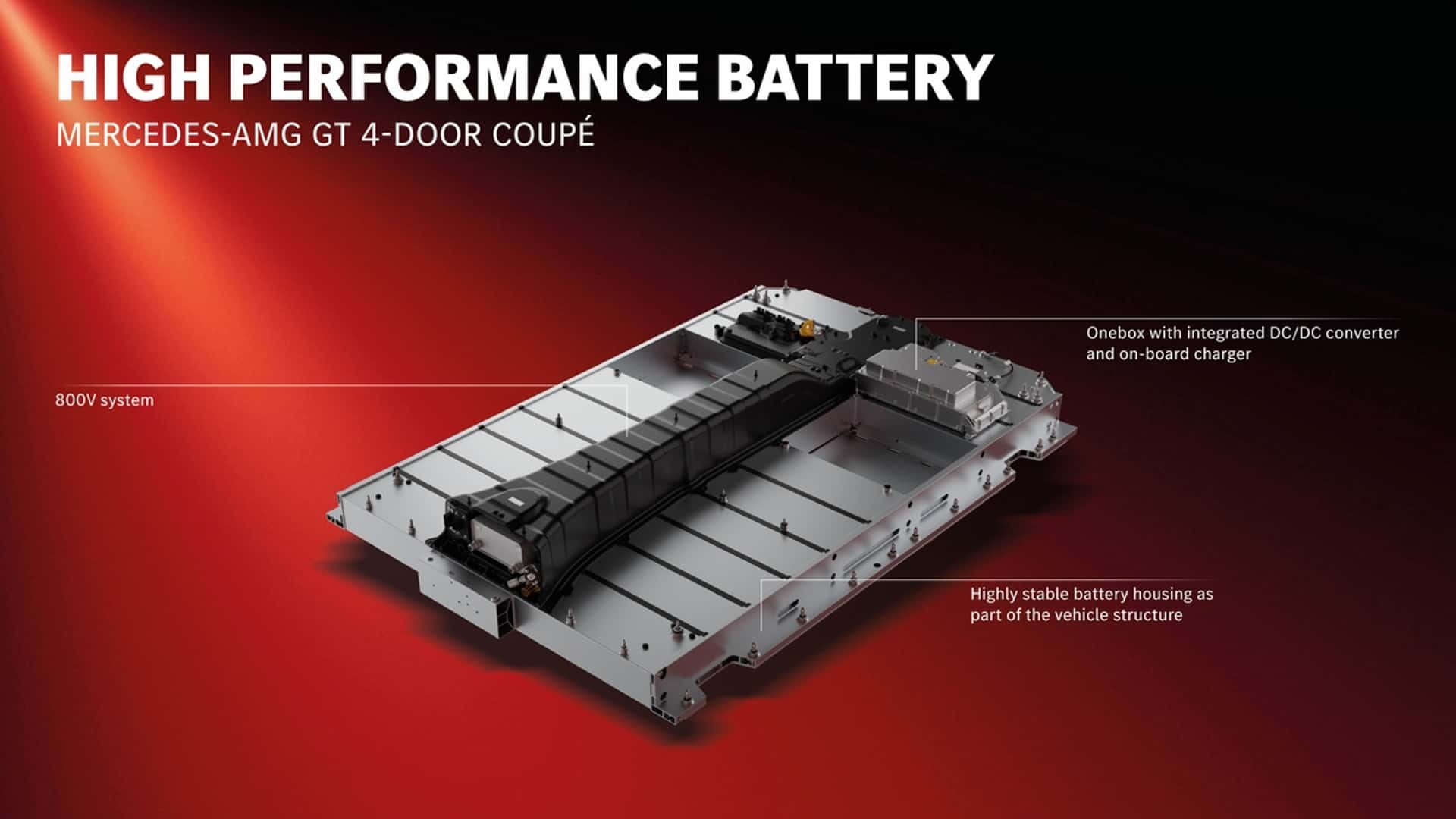
In the rapidly evolving landscape of electric vehicles, the battle against heat is paramount for achieving peak performance and longevity. High-performance EVs, in particular, subject their batteries to extreme conditions, including rapid charging, aggressive acceleration, and diverse environmental temperatures. These forces collectively generate significant heat, a critical challenge that necessitates innovative engineering solutions.
The new Mercedes-AMG GT 4-Door Coupe stands at the forefront of this innovation, showcasing a battery system that redefines the benchmarks for electric vehicle capabilities. Unveiled as an all-electric successor to its V8-powered predecessors, this super sedan integrates groundbreaking battery technology designed to manage the rigors of high-performance driving.

Key Takeaways
- The Mercedes-AMG GT 4-Door Coupe features an advanced battery system with silicon-containing anodes and an “overengineered” cooling loop.
- This technology enables an industry-leading 10-80% charge time in just 11 minutes, delivering approximately 250 miles of EPA range in 10 minutes.
- Silicon anodes, blended with graphite, represent a crucial step towards higher energy density and faster charging speeds, with the long-term goal of 100% silicon integration.
- The EV battery thermal management system can dissipate roughly 20 kilowatts of heat, significantly more than typical systems, ensuring consistent performance and minimizing degradation.
- Future implications include the potential for these advanced battery technologies to filter down into mass-market electric vehicles, democratizing fast-charging capabilities.
The Mercedes-AMG GT’s Electrifying Leap into Performance
The automotive world recently witnessed the launch of the latest Mercedes-AMG GT 4-Door Coupe, a vehicle that has transitioned from a conventional V8 engine to a sophisticated all-electric powertrain. This shift signals a new era for AMG, marrying its legacy of power with cutting-edge electric mobility.
Initial reactions to the new AMG GT focused on its striking design and headline-grabbing specifications, including an astonishing 1,153 horsepower and a remarkable 600 kilowatts of peak charging power. However, beneath these impressive figures lie several critical advancements in battery technology that warrant closer examination: the integration of a silicon anode and an extensively developed cooling system, crucial elements for advanced EV battery thermal management.
Unveiling the Powertrain and Performance Metrics
At its core, the AMG GT is equipped with a 106 kilowatt-hour (kWh) usable battery capacity, providing a substantial range of up to 700 kilometers (approximately 434 miles) on the European WLTP (Worldwide Harmonized Light Vehicles Test Procedure) cycle. This translates to an estimated range of well over 300 miles under the more stringent U.S. EPA (Environmental Protection Agency) testing conditions.

Upon its arrival in the U.S. market later this year, the Mercedes-AMG GT is poised to claim the title of America’s fastest-charging electric vehicle. Mercedes-AMG reports an extraordinary 10-80% charging time in merely 11 minutes. This rapid replenishment capability is a direct result of the innovative battery architecture and advanced EV battery thermal management strategies employed.
The Dawn of Silicon Anode Technology
Central to the AMG GT’s exceptional charging performance is the adoption of a silicon anode. The anode is a fundamental component of a battery cell, directly influencing how much energy the battery can store and, crucially, how quickly it can accept a charge. For decades, battery manufacturers have predominantly relied on graphite anodes due to their stability and energy density.
Addressing Supply Chain and Performance Needs
However, the global reliance on graphite has presented challenges, particularly concerning supply chain vulnerabilities, with China holding significant control over graphite production. Furthermore, environmental considerations associated with graphite mining are prompting the industry to seek alternatives. As an interim measure, automakers, including Mercedes-AMG, are increasingly integrating silicon-graphite anodes. The ultimate objective is to fully transition away from graphite, opting for either 100% silicon anodes or advanced synthetic graphite alternatives.
The silicon-containing anode in the AMG GT achieves a cell-level energy density of 298 watt-hours per kilogram (Wh/kg). This figure places it at the upper echelon of commercially available automotive-grade lithium-ion cells today. Complementing this, the cathode utilizes a Nickel, Cobalt, Manganese, and Aluminum (NCMA) chemistry. NCMA cathodes are traditionally associated with delivering longer ranges and superior energy density, making it an ideal pairing for a high-performance EV.
This sophisticated anode-cathode combination, according to Mercedes-AMG, is the enabler behind the vehicle’s astonishing 600 kW charging rate. It allows the AMG GT to regain nearly 250 miles of EPA range in just 10 minutes of charging and maintain a consistently high discharge rate necessary to deliver its formidable 1,000+ horsepower output.
Current Landscape and Future Prospects of Silicon Anodes
Mercedes-AMG is not alone in exploring the potential of silicon anode technology. Other major players in the automotive sector, such as General Motors, alongside innovative startups like Group14 and Sila, are actively researching and developing silicon-based anode solutions. While promising, silicon anodes currently remain a niche technology.
Their commercial availability is limited, and they have not yet achieved the cost-competitiveness or scalability required to fully displace traditional graphite anodes in high-volume production. Nevertheless, the advancements seen in vehicles like the AMG GT underscore the significant progress being made and the eventual potential for wider adoption.
Precision Engineering: Mastering EV Battery Thermal Management
To sustain such high levels of performance and charging speed, Mercedes-AMG has implemented an array of advanced cooling systems alongside a novel cell design, central to effective EV battery thermal management. The automaker utilizes slim and tall cylindrical cells, each measuring 4.1 inches in height and 1 inch in diameter. This specific, smaller diameter is engineered to reduce the internal distance from the cell core to its surface, facilitating faster and more efficient heat dissipation.
Revolutionary Cooling Systems Explained
Each of the 2,660 individual cells within the battery pack is meticulously encased in laser-welded aluminum, a material choice that enables quicker cooling and warming. This design allows coolant to flow evenly around every cell, efficiently dissipating the heat generated during operation. The system further incorporates what Mercedes refers to as “on-demand cooling.” This intelligent feature ensures that temperatures are uniformly maintained across each battery module. If a specific section of the battery begins to overheat, the system can precisely target and cool that area, rather than indiscriminately increasing coolant flow to the entire pack, which could lead to energy waste or over-cooling of other regions.
Beyond the Core: Integrated Thermal Control
At the technological heart of this intricate cooling architecture are three primary components: a robust coolant pump module, an efficient oil-water heat exchanger, and a centralized coolant hub. The pump is responsible for circulating the coolant throughout the battery pack, while the heat exchanger actively extracts and removes excess heat. The coolant hub, a compact housing, streamlines the coolant flow, enabling highly targeted cooling of various vehicle components.
For instance, if the battery pack is operating within its ideal temperature parameters, the system can intelligently redirect the coolant to other areas that require more cooling, such as the electric drive units. Collectively, Mercedes-AMG states that these sophisticated EV battery thermal management systems are capable of removing approximately 20 kilowatts (kW) of heat. This capacity is substantially higher than the 5-8 kW of cooling power typically found in standard EV battery thermal management systems, highlighting the ‘overengineered’ nature of the AMG GT’s approach.
While these advancements appear exceptionally promising on paper, the true measure of their success will be observed once the AMG GT becomes widely available and, more importantly, over several years of real-world use. The long-term performance, minimal degradation, and sustained efficiency of this battery system will be key indicators of its success. Beyond the realm of high-end performance vehicles, there is a significant aspiration that such cutting-edge EV battery thermal management technologies will eventually become accessible in mass-market models, ensuring that blistering charging speeds and robust thermal stability are not exclusive to luxury EVs but become standard features across the electric vehicle spectrum.
Frequently Asked Questions (FAQ)
What is a silicon anode in an EV battery?
A silicon anode replaces or supplements traditional graphite in EV batteries. It offers higher energy density and faster charging capabilities due to silicon’s ability to store significantly more lithium ions than graphite. Mercedes-AMG uses a silicon-graphite blend in the new GT.
How does the Mercedes-AMG GT achieve such fast charging?
The Mercedes-AMG GT utilizes a combination of silicon-containing anodes, NCMA cathode chemistry, and an advanced EV battery thermal management system. These elements enable a peak charging power of 600 kW, allowing it to charge from 10-80% in just 11 minutes.
What is the range of the new Mercedes-AMG GT 4-Door Coupe?
The Mercedes-AMG GT 4-Door Coupe boasts a 106 kWh usable battery capacity, providing up to 700 kilometers (434 miles) on the WLTP cycle. This translates to an estimated comparable U.S. EPA range of well over 300 miles.
Why is EV battery thermal management crucial for performance?
Effective EV battery thermal management prevents overheating during high-performance driving and fast charging, which can degrade battery life and performance. Mercedes-AMG’s system removes approximately 20 kW of heat, ensuring optimal operating temperatures for sustained power and longevity.
Are silicon anodes common in current EVs?
Silicon anodes are still considered a niche technology in the EV market. While companies like Mercedes-AMG, GM, Group14, and Sila are developing them, they are not yet cost-competitive or scalable enough for widespread adoption in mass-market vehicles compared to traditional graphite anodes.
What is ‘on-demand cooling’ in the AMG GT’s battery system?
On-demand cooling is a sophisticated feature that precisely regulates temperatures across individual battery modules. Instead of uniformly cooling the entire pack, it targets specific areas that become hotter, preventing energy waste and ensuring optimal, uniform thermal conditions throughout the battery for enhanced efficiency and durability.