
Key Takeaways
- Slate, the Jeff Bezos-backed auto startup, has switched from nickel manganese cobalt (NMC) to lithium iron phosphate (LFP) batteries for its upcoming $24,950 electric pickup.
- The new LFP batteries, supplied by Gotion, will be manufactured in Illinois, close to Slate’s Indiana production facility, optimizing logistics and cost.
- This strategic shift, influenced by changes in federal EV tax credit criteria, allows the Slate Truck LFP battery pack to deliver an estimated 205 miles of range, an increase from the previously projected 150 miles.
- While LFP offers greater durability and a lower cost, the vehicle’s power output has seen a slight reduction from 201 to 181 horsepower, though acceleration remains consistent.
- The Slate Truck aims to be America’s most affordable new EV and pickup truck upon its anticipated launch in the fourth quarter of this year, with preorders now open.
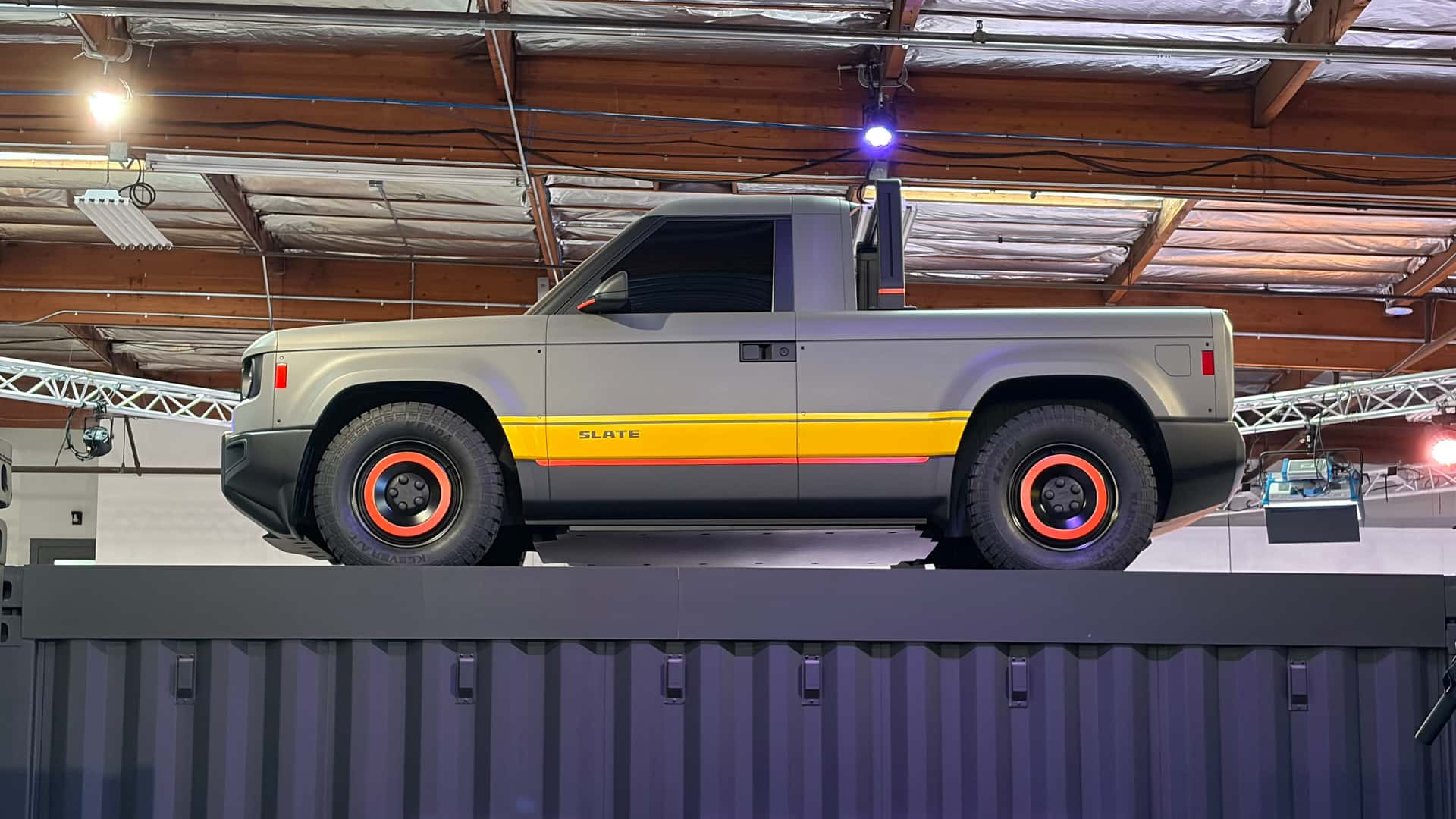
In a significant strategic adjustment, Slate, the Jeff Bezos-backed electric vehicle startup, has announced a crucial change to the power source for its minimalist and ultra-customizable pickup truck. The company confirmed Wednesday that it will equip its vehicles with a lithium iron phosphate (LFP) battery pack, moving away from the previously planned nickel manganese cobalt (NMC) chemistry announced last April.
This decision underscores Slate’s commitment to affordability and efficiency, positioning its two-door pickup as potentially America’s cheapest new electric vehicle and most affordable truck. With a newly announced base price of $24,950, the Slate Truck is slated to commence sales by the end of this year.
The Strategic Pivot to LFP Batteries
The new LFP batteries for the Slate Truck will be supplied by Gotion, a prominent battery manufacturer. Chris Barman, Slate’s president of vehicles, confirmed to InsideEVs that these battery packs will be produced at Gotion’s facility in Illinois. This location offers a logistical advantage, being geographically close to Slate’s own manufacturing plant, which operates out of a former printing facility in Indiana.
The shift to a Slate Truck LFP battery configuration marks a significant evolution in the company’s manufacturing strategy. LFP battery technology, known for its robustness and cost-effectiveness, has gained increasing traction in the electric vehicle sector, especially for mass-market offerings where price accessibility is paramount.
Navigating Regulatory Changes and Supply Chains
Initially, Slate had not opted for LFP batteries primarily due to the stringent domestic sourcing criteria associated with the $7,500 federal EV tax credit. These regulations required qualifying electric vehicles to meet increasingly demanding requirements concerning the origin of battery components and minerals, favoring North American or allied trading partner sources and explicitly excluding connections to “foreign entities of concern,” particularly China.

Given that the LFP supply chain has historically been heavily concentrated in China, and U.S.-based manufacturing for this chemistry was still in its nascent stages, Slate had initially chosen NMC batteries from South Korea’s SK On. However, a pivotal legislative development last year, the “One Big Beautiful Bill Act,” eliminated this incentive.
This legislative change, while removing the potential for Slate to hit its ambitious initial price tag of under $20,000, paradoxically provided the startup with greater flexibility to explore alternative battery options. “The shakeup also gave Slate the flexibility to explore other battery options,” Barman explained to InsideEVs. Concurrently, the overall availability of LFP technology in the market expanded significantly between Slate’s early planning stages and the present.
Barman elaborated on the timeline and considerations: “When we first started on the journey, and this is going quite a few steps back into 2022, there weren’t a lot of LFP options. We had been talking to Gotion all along the way. Part of the reason that we didn’t select them is because they wouldn’t have met the foreign entity of concern requirement, and at that time they didn’t quite have the capacity that we needed.”
Advantages of LFP Technology for the Slate Truck
The decision to utilize a Slate Truck LFP battery brings several advantages. The new 65-kilowatt-hour LFP pack is reportedly more cost-effective than the NMC solution Slate had previously planned. Furthermore, the localized production of these batteries by Gotion, situated approximately 90 miles from Slate’s vehicle assembly plant, significantly reduces logistics costs.
A notable design innovation enabled by the LFP switch is the adoption of prismatic, or box-shaped, cells. This allows for a module-free battery pack design, wherein the cells are stacked directly into the vehicle’s underbody. This streamlined architecture, increasingly pursued by other major automakers in their latest EV models, maximizes energy storage within the Slate’s compact footprint.
As a direct result of these efficiencies and design optimizations, the estimated driving range of the Slate Truck has seen a substantial improvement. The range jumped from an estimated 150 miles last year to a more competitive 205 miles in its production form. “We were excited to be able to provide more range and really maintain the price point that we were looking to hit,” Barman stated.
Durability and Charging Flexibility
LFP batteries are renowned for their enhanced durability and cycle life compared to high-nickel cells. Unlike NMC batteries, which typically perform best when a buffer is maintained at both ends of the charge cycle, LFP cells can be regularly charged to 100% and discharged close to zero without significantly compromising their longevity. This characteristic makes LFP a practical choice for a low-range vehicle, providing users with maximum usable capacity without concerns about degradation.
Understanding the Trade-offs and Market Positioning
While the adoption of the Slate Truck LFP battery offers considerable benefits, particularly in terms of cost and range optimization, it does come with certain engineering trade-offs. Slate engineers confirmed that the LFP pack operates at a slightly lower voltage. Consequently, the vehicle’s power output has seen a modest reduction from 201 horsepower to 181 horsepower.
Despite this decrease in peak power, the truck’s acceleration remains unaffected, maintaining an 8-second sprint to 60 mph. This indicates that the engineering team has managed to optimize the power delivery for daily driving scenarios where instantaneous torque and efficiency are prioritized over raw peak horsepower.
Consolidated Battery Offerings
Earlier plans for the Slate Truck had included the option of a larger battery pack, estimated to offer around 240 miles of range. This would have placed it in closer competition with established affordable EVs such as the Chevy Bolt, which offers 262 miles. However, the current LFP pack fully utilizes the available space within the truck’s underbody. Offering a higher-range variant would necessitate a switch back to a higher-density battery chemistry, which would negate the cost benefits of LFP.
Slate executives ultimately concluded that the 205-mile range provided by the new LFP pack was sufficient to meet the needs of their target market. Eric Keipper, the startup’s head engineer, articulated this decision: “Being in that sweet spot, it felt like a good place to just have a single battery and read the room from there.” This approach simplifies the product lineup and focuses on delivering a compelling value proposition at the sub-$25,000 price point.
Looking Ahead: Production and Market Impact
With preorders for the Slate Truck now officially open, the company is on track to commence production in the fourth quarter of this year. The vehicle’s unique combination of minimalist design, customizability, and an aggressive price point, backed by its innovative Slate Truck LFP battery strategy, aims to disrupt the burgeoning electric pickup market.
As the electric vehicle landscape continues to evolve, Slate’s calculated move to embrace LFP technology, while adapting to market dynamics and regulatory shifts, will undoubtedly be a closely watched development. The success of the Slate Truck will offer valuable insights into what American consumers truly prioritize in the affordable EV segment.
Frequently Asked Questions About the Slate Truck’s Battery
What type of battery will the Slate Truck use?
The Slate Truck will use a lithium iron phosphate (LFP) battery pack, transitioning from its initial plan to use nickel manganese cobalt (NMC) batteries. This change aims to balance performance with enhanced affordability and durability for the electric pickup.
Who is supplying the LFP batteries for the Slate Truck?
The LFP batteries for the Slate Truck are being supplied by Gotion. These battery packs will be manufactured at Gotion’s facility located in Illinois, establishing a localized supply chain close to Slate’s Indiana production plant.
Why did Slate switch to LFP batteries?
Slate switched to LFP batteries primarily due to their lower cost and increased availability. Changes to federal EV tax credit criteria, which previously incentivized domestic sourcing, also provided flexibility for this strategic pivot, along with reduced logistics costs.
What is the estimated range of the Slate Truck with LFP batteries?
The production version of the Slate Truck, equipped with its new 65-kilowatt-hour LFP battery pack, is estimated to offer a driving range of 205 miles. This represents a significant increase from the 150 miles initially estimated last year.
Are there any trade-offs with the LFP battery switch?
Yes, one trade-off is a slight reduction in power output. The Slate Truck’s horsepower has decreased from 201 HP to 181 HP due to the LFP pack’s slightly lower voltage. However, the vehicle’s 0-60 mph acceleration remains unchanged at 8 seconds.
When will the Slate Truck be available for purchase?
Preorders for the Slate Truck are currently open. The company anticipates commencing the production and delivery of these electric pickup trucks in the fourth quarter of this year, making it an affordable EV option for consumers.