
In an unexpected development that has captivated the automotive industry, Rivian, the electric vehicle manufacturer, has offered a tantalizing glimpse into its potential future product portfolio. This revelation emerged not during its highly anticipated Investor Day call on June 25, 2024, but from a strategic pre-announcement: a monumental joint venture with German automotive giant Volkswagen. While the Investor Day was widely expected to focus on financial guidance and updates on existing models like the Rivian R2, R3, and R3X, the alliance and subsequent shareholder communications have hinted at an expansive roadmap for Rivian’s future vehicles.
Key Takeaways
- Rivian announced a joint venture with Volkswagen, involving an investment of up to $5 billion from VW.
- The partnership will see Rivian sharing its advanced software expertise with Volkswagen.
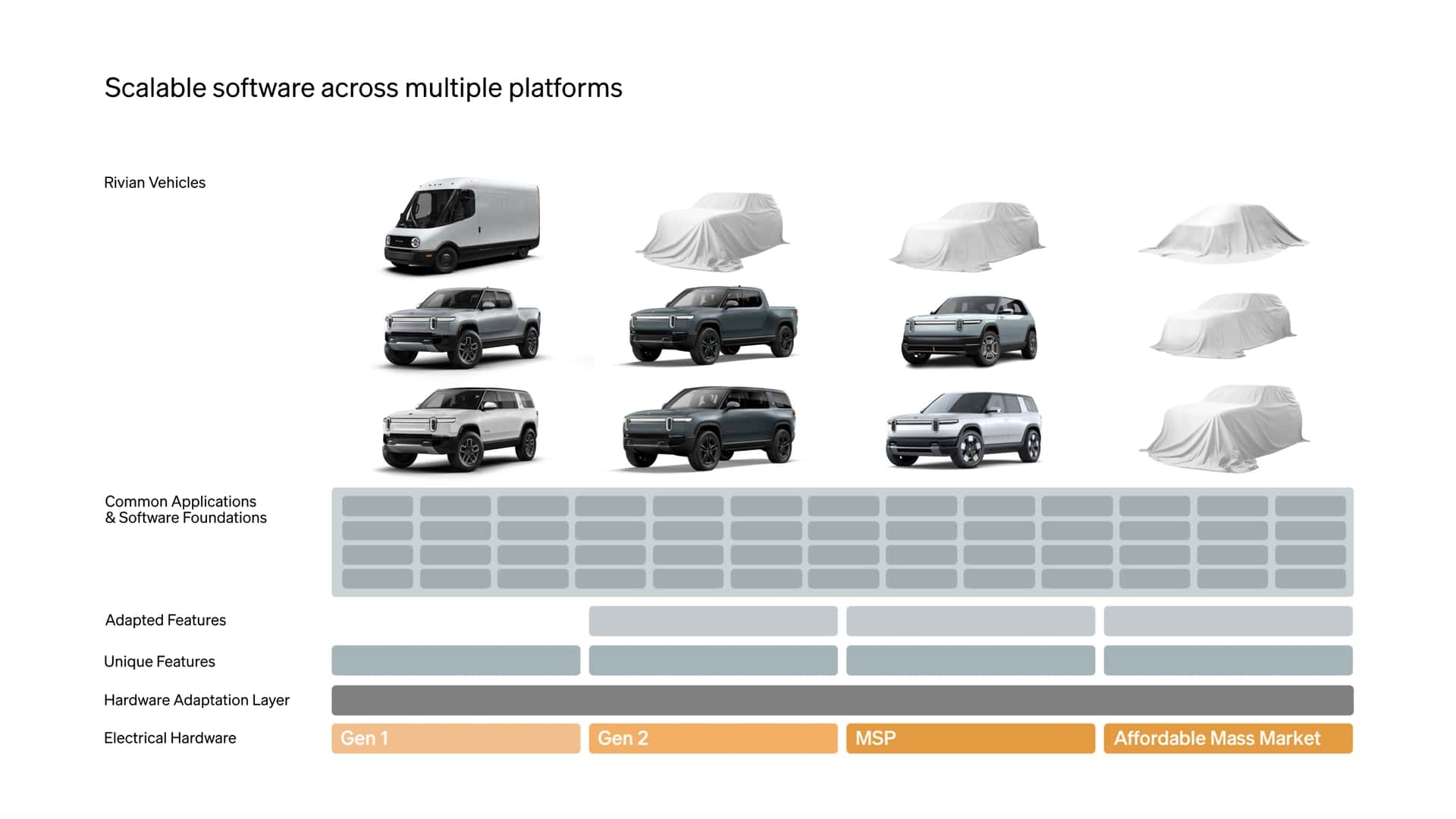
- A shareholder letter accompanying the announcement displayed an image with multiple covered vehicle shapes, suggesting an expanded product pipeline.
- These veiled models appear to extend beyond the recently revealed R2, R3, and R3X, hinting at several new Rivian models.
- The image includes a potential R1X and other SUV-like forms, though some shapes may be placeholder graphics.
- Rivian’s spokesperson declined to comment on specific future products, maintaining industry standard protocol.
The Strategic Alliance: Volkswagen’s $5 Billion Bet on Rivian’s Software
The core of this week’s news centered on a transformative partnership between Rivian and Volkswagen. Announced just ahead of Rivian’s Investor Day, this joint venture signifies a crucial strategic move for both companies. Volkswagen, one of the world’s largest automakers, is poised to invest a substantial sum of up to $5 billion into Rivian. This significant financial injection is not merely capital; it is a clear endorsement of Rivian’s technological prowess, particularly in electric vehicle software.
Under the terms of the agreement, Rivian will share its cutting-edge electrical architecture and software technology with Volkswagen. This collaboration is designed to accelerate Volkswagen’s development of software-defined vehicles, a critical area where traditional automakers often seek expertise from agile EV innovators. For Rivian, the partnership provides a much-needed capital infusion, bolstering its financial stability and enabling further investment into research, development, and scaling production for Rivian’s future vehicles.
Decoding the Shareholder Letter: A Peek at Rivian’s Future Vehicles
While the financial and technological aspects of the Volkswagen deal were paramount, a deeper dive into Rivian’s latest shareholder letter, observed by BloombergNEF’s Corey Cantor on Threads, revealed even more intriguing details. The letter included a compelling image that served as a visual roadmap, showcasing what appeared to be several new Rivian models hidden under sheets, distinct from its established and upcoming product lines.
The image meticulously organized Rivian’s evolutionary trajectory. On the far left, it depicted the company’s first generation of electric vehicles: the acclaimed R1S SUV, the versatile R1T pickup truck, and the custom electric delivery vans currently utilized by Amazon. Adjacent to these were representations of the second-generation R1 vehicles, which InsideEVs recently reviewed, highlighting their advancements and refinements.
Beyond the R1: The Mysterious Covered Vehicles
However, the real excitement lay in the veiled forms. Positioned above the second-generation R1 models was another vehicle shrouded in white, leading to speculation that it could be the long-rumored R1X, a performance-oriented variant. This particular detail immediately ignited discussions among enthusiasts and industry analysts alike, eager to discern the precise nature of this enigmatic addition to Rivian’s product roadmap.
The subsequent columns in the image unveiled an array of other covered shapes, predominantly SUV-like silhouettes. Crucially, these shapes appeared separate from, and in addition to, the Rivian R2, R3, and R3X models that had already captured public attention earlier this year. This suggests a more extensive and diversified pipeline for Rivian’s future vehicles than previously imagined, indicating that the company is planning a broad expansion of its offerings across various segments.
Interpreting the Silhouettes: Variants or Placeholders?
A notable aspect of these mysterious shapes is the apparent repetition of two specific covered forms. This could imply a couple of scenarios. It might suggest that Rivian is planning multiple variants of the same core vehicle platform, catering to different market needs or performance requirements. Alternatively, and as cautioned within the original report, these repeating shapes might simply be stock ‘TBD’ (To Be Determined) images, serving as placeholders that do not necessarily represent the final designs or dimensions of the planned vehicles. Until further official announcements provide clarity, drawing definitive conclusions remains speculative.
When approached for comment, a Rivian spokesperson maintained the standard industry stance, declining to elaborate on future products. This is a common practice among automakers, who typically prefer to reveal new models closer to their official launch dates, building anticipation and managing expectations. Despite the lack of specific details from the investor call, the visual evidence from the shareholder letter unequivocally confirms a broader development strategy for Rivian’s future vehicles.
Strategic Outlook: Diversifying Rivian’s Portfolio
The presence of these new, undisclosed models suggests a concerted effort by Rivian to broaden its market appeal and solidify its position in the fiercely competitive electric vehicle sector. Expanding beyond its popular R1S and R1T, and even beyond the eagerly awaited R2, R3, and R3X, indicates a long-term vision for diversification. This strategy could involve targeting new customer demographics, entering different price points, or introducing vehicles with distinct functionalities.
For a company like Rivian, which has carved a niche in adventure-focused electric trucks and SUVs, expanding its product line is crucial for sustained growth and profitability. The investment from Volkswagen not only provides the financial muscle but also the strategic validation that could accelerate the development and market introduction of these new Rivian models. This move could also enhance Rivian’s operational efficiencies through shared platforms or components in the long run.
The Evolving EV Landscape and Rivian’s Position
The electric vehicle market is characterized by rapid innovation, intense competition, and significant capital expenditure. Companies like Rivian must constantly innovate and adapt to consumer demands while managing complex supply chains and manufacturing challenges. The partnership with Volkswagen, coupled with the potential for numerous new models, positions Rivian to navigate these complexities more effectively.
By leveraging its software expertise and securing substantial investment, Rivian is enhancing its credibility and stability within the global automotive landscape. The forthcoming products, whether they are new form factors, different vehicle classes, or specialized variants, will be critical in defining Rivian’s trajectory in the coming years. This proactive approach to product development and strategic alliances underscores Rivian’s ambition to remain a frontrunner in the premium EV segment and expand its influence.
The Road Ahead for Rivian’s Future Vehicles
While the Investor Day itself provided limited specific product details, the preceding announcements and the revealing image in the shareholder letter have painted a compelling picture. Rivian is clearly working on an extensive roadmap for its next generation of SUVs and trucks, moving well beyond the models that have already generated significant buzz. The joint venture with Volkswagen is a testament to Rivian’s technological leadership and provides a strong foundation for bringing these ambitious plans to fruition. The market will undoubtedly be watching closely for more definitive information on these exciting new Rivian models as the company progresses on its journey.
FAQ Section
What was the main announcement regarding Rivian and Volkswagen?
Rivian and Volkswagen announced a joint venture where Volkswagen will invest up to $5 billion into Rivian. In return, Rivian will share its advanced electrical architecture and software technology with Volkswagen, aiming to accelerate the development of software-defined vehicles for both companies.
How many new Rivian models were hinted at in the shareholder letter?
The shareholder letter image displayed several covered vehicle shapes beyond the R2, R3, and R3X, and existing R1 models. It included a possible R1X and numerous SUV-like silhouettes in subsequent columns, indicating a substantial expansion of Rivian’s future vehicles product pipeline.
What is the significance of the image with covered vehicles?
The image provides the first public indication of Rivian’s long-term product strategy, hinting at models that extend beyond its currently announced lineup. It suggests a more diverse range of electric SUVs and trucks are under development, reinforcing Rivian’s commitment to expanding its market presence.
Could the repeated covered shapes in the image represent multiple vehicles?
The repetition of some covered shapes could indicate either multiple variants of the same vehicle platform or might simply be stock ‘TBD’ (To Be Determined) placeholder images. Rivian has not provided specific clarifications, so definitive interpretation remains speculative at this stage.
Why did a Rivian spokesperson decline to comment on these new models?
Automakers typically decline to comment on unreleased or future products as a standard industry practice. This allows companies to control the narrative, build anticipation, and make official announcements on their own timeline, ensuring strategic reveals and managing market expectations effectively.
How does the Volkswagen partnership impact Rivian’s ability to develop new vehicles?
The partnership provides Rivian with a significant capital infusion of up to $5 billion, which is crucial for funding research, development, and scaling production. This financial backing is expected to accelerate the creation and market introduction of new Rivian models, strengthening its competitive position in the EV market.
What are the ‘first generation’ and ‘second generation R1 vehicles’ mentioned?
The ‘first generation’ refers to Rivian’s initial production models: the R1S SUV, R1T pickup, and its Amazon delivery vans. ‘Second generation R1 vehicles’ likely refers to updated versions of the R1S and R1T that Rivian recently unveiled and began offering, featuring enhanced technology and performance improvements.