
Key Takeaways
- Rivian announced a surprise joint venture with Volkswagen, securing a $5 billion investment for software expertise.
- A recent shareholder letter contained an image hinting at several undisclosed Rivian’s future models, distinct from the R2, R3, and R3X.
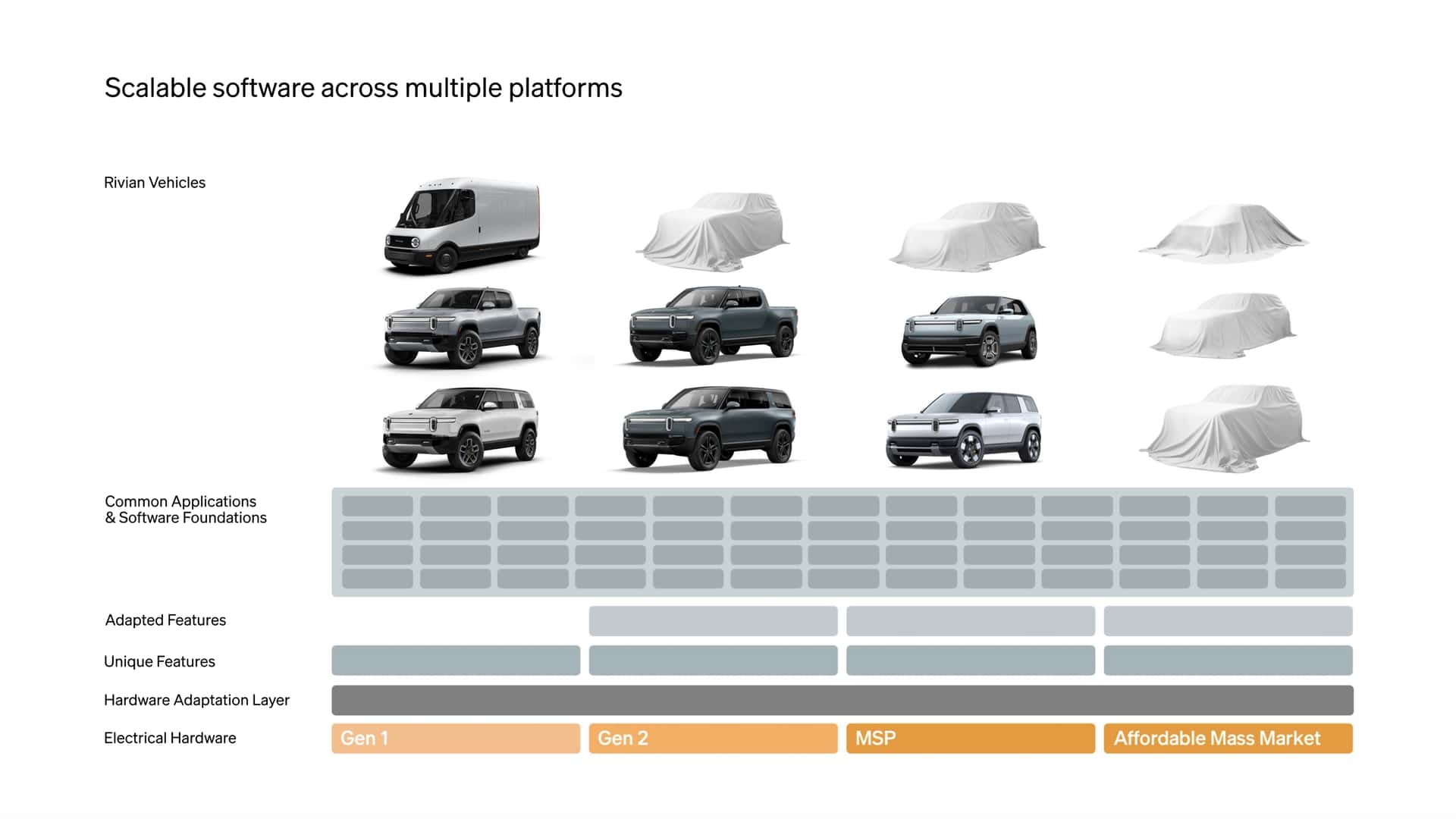
- The image displays covered vehicles alongside existing R1S/R1T and second-generation R1 platforms, suggesting a broader product roadmap.
- Speculation includes a potential R1X and new SUV-like forms, though some shapes might be placeholders.
- This strategic alliance and the potential for new vehicles underscore Rivian’s commitment to expanding its electric vehicle portfolio and market presence.
The electric vehicle (EV) landscape was recently shaken by an unexpected strategic announcement: Rivian’s unprecedented joint venture with automotive giant Volkswagen. This significant development, released just ahead of Rivian’s Investor Day on June 25, 2024, promises not only a substantial financial injection for the American EV manufacturer but also offers intriguing glimpses into Rivian’s future models, potentially extending far beyond the already anticipated R2, R3, and R3X platforms.
The news, initially projected to be a routine investor briefing filled with financial guidance and incremental updates on upcoming vehicles, instead delivered a bombshell. Rivian, known for its innovative electric trucks and SUVs, revealed a partnership poised to reshape its trajectory and influence the broader EV market, sparking immediate interest across the global automotive sector.

Strategic Alliance: Volkswagen’s Billions for Rivian’s Software Prowess
At the heart of this groundbreaking collaboration is a monumental investment from Volkswagen, totaling up to $5 billion. This substantial capital infusion is earmarked to solidify Rivian’s financial foundation and accelerate its ambitious product development plans. In return, Rivian will share its highly acclaimed electric vehicle software and electrical architecture expertise with the German automotive behemoth, leveraging its technological leadership.
This agreement marks a pivotal moment for both companies. For Rivian, the investment offers a crucial financial lifeline, providing the necessary resources to scale production, enhance existing offerings, and, most importantly, finance the research and development of Rivian’s future models. It also serves as a powerful validation of Rivian’s technological capabilities, particularly its advanced software platform, which has garnered industry recognition for its seamless integration and user experience.
For Volkswagen, this joint venture provides immediate access to cutting-edge EV software, potentially streamlining its own transition to electric vehicles and addressing challenges in its software development initiatives. The partnership is structured to create a new, equally owned and controlled joint venture, aiming to maximize synergies and foster innovation in the rapidly evolving EV sector.

Decoding the Shareholder Letter: A Glimpse at Undisclosed Vehicles
While the financial and technological implications of the Volkswagen deal captivated headlines, a keen eye spotted another crucial detail embedded within Rivian’s latest shareholder letter. Corey Cantor of BloombergNEF highlighted an image from the release that has ignited widespread speculation about the company’s long-term product strategy. This visual roadmap presents several obscured vehicle shapes, concealed beneath sheets, hinting at a diversified portfolio of Rivian’s future models.
The visual, a slide from Rivian’s official release, methodically outlines the company’s product evolution. On the far left, it clearly depicts the first generation of Rivian electric vehicles. This includes the acclaimed R1S SUV, the innovative R1T pickup truck, and the fleet of electric delivery vans currently utilized by Amazon, Rivian’s prominent commercial partner. These models established Rivian as a serious contender in the premium EV market, combining robust performance with distinctive design and off-road capabilities.
Adjacent to these foundational vehicles, the slide showcases the second generation R1 vehicles. These updated versions of the R1S and R1T recently made their debut, featuring notable enhancements in performance, efficiency, and technology. InsideEVs, a leading automotive publication, recently provided in-depth coverage and driving impressions of these refreshed models, highlighting their advanced capabilities and refined user experience.
Beyond R1: Mysteries of the Covered Shapes
The true intrigue, however, lies in the silhouettes positioned further along the timeline. Above the second-generation R1 vehicles, an additional covered shape sparks immediate curiosity. Automotive enthusiasts and industry analysts are already pondering its identity, with some suggesting it could potentially be the long-rumored R1X – a high-performance variant or a more specialized iteration of the R1 platform. This potential model could further expand the appeal of Rivian’s flagship series, catering to a niche demand for ultimate capability.
Moving to subsequent columns within the illustrative slide, the “real mysteries” begin to unfold. Here, several SUV-like shapes are presented under protective covers. Crucially, these shapes appear distinct and separate from even the R2, R3, and R3X models that Rivian had previously unveiled and which have already generated significant public excitement. The R2 is positioned as a more accessible, mid-sized electric SUV, while the R3 and R3X represent compact, sporty crossover variants designed for broader market appeal. The vehicles in the shareholder letter suggest an even wider scope for Rivian’s future models.
The presence of these entirely new, unidentifiable forms points towards a more expansive and aggressive product roadmap than previously disclosed. It implies that Rivian is exploring multiple new segments or body styles, potentially aiming to capture a larger share of the evolving electric vehicle market. This diversification would be critical for sustained growth and competition against a rapidly growing field of EV manufacturers globally.
Interpreting the Design Language and Potential Variants
A noteworthy observation from the shareholder slide is the apparent repetition of two of the covered shapes. This visual recurrence opens up two primary interpretations, both of which have significant implications for Rivian’s product strategy. One possibility is that Rivian is separately listing multiple variants of the same core vehicle platform. For instance, a single underlying architecture could give rise to different wheelbase options, distinct body styles (e.g., a two-door versus a four-door SUV), or specialized versions tailored for specific markets or use cases.
Alternatively, and perhaps more cautiously, the repeating shapes could simply be stock “TBD” (To Be Determined) images. In this scenario, these generic silhouettes would not represent the final shapes and sizes of the planned vehicles but rather placeholders for future development. Automakers often use such visual representations in internal documents or early-stage communications to indicate upcoming product slots without revealing specific design details. Given the early stage of these potential reveals, exercising caution in interpretation is paramount. As the original analysis advised, “I’d avoid inferring too much until we get more clarity.”
When approached for comment on these intriguing new disclosures, a Rivian spokesperson maintained the industry’s conventional stance, stating, “A Rivian spokesperson declined to comment on our report.” This non-committal response is standard practice for automakers, who typically prefer to control the timing and messaging around their upcoming vehicle launches, ensuring a strategic and impactful reveal.
The Road Ahead for Rivian’s Product Portfolio
Despite the limited official commentary, the discovery of these new silhouettes undeniably confirms that Rivian has an extensive product roadmap in development. The company is actively planning a “next crop of SUVs and trucks” that extends “beyond even the ones that have already taken the internet by storm” — referring to the R2, R3, and R3X. This strategic foresight is critical in the highly competitive and capital-intensive electric vehicle industry, where continuous innovation and product freshness are key to market leadership.
The Volkswagen partnership is expected to play a crucial role in accelerating the development and eventual market introduction of these Rivian’s future models. The infusion of $5 billion significantly bolsters Rivian’s ability to invest in tooling, manufacturing expansion, and continued innovation in battery technology and electric drivetrain systems. This financial stability, combined with Rivian’s proven engineering capabilities, positions the company strongly for sustained growth and market penetration.
As Rivian continues to scale its production capacity for the existing R1 series and prepares for the launch of the R2 and R3 models, the prospect of even more vehicles in the pipeline paints a compelling picture of its long-term vision. The company is not merely content with its current niche; it aims for a broader market presence, offering a diverse range of electric vehicles to cater to varied consumer preferences and needs, from adventure-seekers to urban commuters.
Impact on Market Position and Industry Outlook
The implications of these potential new models, coupled with the strategic alliance with Volkswagen, are far-reaching. For Rivian, it strengthens its credibility as an innovator and a reliable technology partner within the global automotive ecosystem. It also allows the company to potentially address new market segments, from more urban-centric EVs to specialized utility vehicles, expanding its revenue streams and reducing reliance on a limited product offering.
The broader electric vehicle market will also be watching closely. Rivian’s ability to rapidly develop and introduce new, competitive models, supported by a global automotive powerhouse like Volkswagen, could intensify competition and accelerate the pace of innovation across the industry. This is a clear signal that Rivian is not just surviving but thriving, poised to become a dominant player in the global EV transition. The coming months and years will undoubtedly bring more clarity and official announcements regarding these exciting new developments, shaping the future of electric mobility.
Frequently Asked Questions About Rivian’s Future Models
What was the main announcement from Rivian’s Investor Day?
Rivian unexpectedly announced a joint venture with Volkswagen. Volkswagen will invest up to $5 billion into Rivian, primarily to access Rivian’s advanced electric vehicle software and electrical architecture expertise. This partnership surprised many industry observers who anticipated a more conventional investor briefing.
What clues about new vehicles were found in Rivian’s shareholder letter?
A slide in Rivian’s shareholder letter revealed an image showcasing several covered vehicle silhouettes. These forms hint at potential Rivian’s future models beyond the currently known R2, R3, and R3X. The image also depicted existing R1S/R1T and second-generation R1 vehicles, offering a visual roadmap of product evolution.
Are these new vehicles definitely separate from the R2 and R3?
Based on the shareholder letter’s image, the shapes in question appear to be distinct from the previously unveiled R2 and R3 models. This suggests Rivian is developing an even wider range of vehicles than initially anticipated, potentially targeting new market segments or offering different body styles within its expanded portfolio.
What is the significance of the repeating covered shapes in the image?
The repetition of two covered shapes could imply either multiple variants of a single core vehicle platform (e.g., different sizes or configurations) or that these are generic “To Be Determined” placeholder images. Industry analysts advise caution, suggesting these might not represent final designs but rather future product slots.
How does the Volkswagen partnership impact the development of Rivian’s future models?
The up to $5 billion investment from Volkswagen provides a substantial financial boost to Rivian. This capital is critical for funding research, development, and manufacturing scale-up for both existing and Rivian’s future models. The partnership is expected to accelerate Rivian’s product roadmap, strengthening its competitive position in the global EV market.
When can we expect more official details on these potential new vehicles?
Automakers typically maintain secrecy around unannounced products. While the shareholder letter offers an intriguing glimpse, Rivian has not provided official comments or timelines regarding these specific covered vehicles. Further details are likely to emerge as these models progress through their development phases and approach market readiness.