
Key Takeaways
- Tesla is actively developing a ride-hailing service, aiming to combine elements of Airbnb and Uber.
- The ambitious plan for Tesla’s robotaxi fleet involves both company-operated autonomous vehicles and owner-contributed cars.
- Owners will have flexibility to ‘add or subtract their cars from the fleet’ and control user access (friends/family, five-star users, or anyone).
- The technological foundation relies on a ‘vision-only architecture with end-to-end neural networks, trained on billions of miles of real-world data.’
- This strategic pivot comes amidst investor scrutiny and follows previous reports about a shift away from a cheaper consumer vehicle, although Tesla has since clarified it’s accelerating ‘new vehicles, including more affordable models,’ with robotaxis to follow.
- Skepticism remains regarding Tesla’s ability to achieve full self-driving capabilities, a prerequisite for a viable robotaxi service, given the current limitations of its Full Self-Driving (FSD) feature.
During its first-quarter earnings call, Tesla provided fresh insights into its long-anticipated plans for a robotaxi business, confirming its development of a sophisticated ride-hailing service. This initiative, described by CEO Elon Musk as a ‘combination of Airbnb and Uber,’ aims to establish a flexible ecosystem for autonomous transport, integrating both company-owned fleets and privately-owned Tesla vehicles.
The announcement addresses considerable speculation and investor queries that preceded the call, particularly concerning Tesla’s strategic direction following reports of a potential shift in production priorities. While specific timelines for the deployment of Tesla’s robotaxi fleet remain somewhat abstract, the automaker outlined key aspects of its operational model and underlying technological advancements.
Tesla’s Dual Approach to Autonomous Ride-Hailing
Tesla’s strategy for its autonomous ride-hailing service appears to be multifaceted, designed to leverage both its direct control over a dedicated fleet and the expansive network of its existing vehicle owners. This hybrid model distinguishes Tesla’s approach within the nascent autonomous mobility sector.
According to CEO Elon Musk, the company intends to operate a significant portion of its self-driving taxi fleet independently. This core fleet would presumably offer a consistent and reliable service, directly managed by Tesla, ensuring quality control and optimized deployment strategies.
Crucially, the plan also integrates Tesla vehicle owners into the ride-hailing network. Musk elaborated on this concept, stating that Tesla owners would be able to “add or subtract their cars from the fleet whenever they want.” This unprecedented level of flexibility could transform personal vehicle ownership into a dynamic income-generating asset.
Furthermore, owners will possess granular control over how their vehicles are utilized within the service. “They can decide if they want to only let the car be used by friends and family, or only by five-star users or by anyone,” Musk explained. This tiered access system could foster trust and tailor the experience to individual owner preferences, mirroring elements of both peer-to-peer car sharing and traditional ride services.
The Airbnb and Uber Analogy
The comparison to ‘a combination of Airbnb and Uber’ succinctly captures the essence of Tesla’s vision. Like Uber, it envisions an on-demand transportation service, instantly accessible through an application. Similar to Airbnb, it suggests a decentralized network where private asset owners (Tesla cars) can offer their resources for commercial use, albeit autonomously.
This model could potentially unlock substantial revenue streams for Tesla owners, turning idle vehicles into profitable assets. For Tesla itself, it promises a scalable service without the immediate capital expenditure required to build out an entirely company-owned fleet for global operations, accelerating the expansion of Tesla’s robotaxi fleet.
The Technological Underpinnings of Tesla’s Autonomy
The viability of Tesla’s robotaxi fleet hinges entirely on its ability to deliver fully autonomous driving capabilities. The company’s first-quarter earnings report reiterated its commitment to a specific technological pathway for achieving this ambitious goal, emphasizing a ‘vision-only architecture’ complemented by advanced artificial intelligence.
The report explicitly states, “We have been investing in the hardware and software ecosystems necessary to achieve vehicle autonomy and a ride-hailing service.” This continuous investment underscores the complexity and long-term nature of developing robust self-driving technology capable of navigating diverse real-world scenarios without human intervention.
Central to Tesla’s strategy is its belief that “a scalable and profitable autonomy business can be realized through a vision-only architecture with end-to-end neural networks, trained on billions of miles of real-world data.” This approach contrasts with some competitors who rely on a suite of sensors including lidar and radar, in addition to cameras.
Vision-Only Architecture and Neural Networks
A ‘vision-only architecture’ means Tesla vehicles primarily use cameras to perceive their surroundings, emulating human sight. This system processes visual data through ‘end-to-end neural networks,’ which are sophisticated AI models capable of learning directly from vast datasets. These networks are trained on ‘billions of miles of real-world data’ collected from Tesla’s existing fleet, allowing them to identify objects, predict behaviors, and make driving decisions.
This data-centric approach is intended to refine the vehicle’s decision-making processes, leading to safer and more reliable autonomous operation. The development of such a system is a monumental engineering challenge, requiring continuous iteration and validation to handle the unpredictable nature of roads and traffic.
First-Quarter Earnings Report and App Previews
Beyond Musk’s direct statements, the earnings report itself offered tangible, albeit limited, details regarding the ride-hailing venture. It confirmed that Tesla is “currently working on ride-hailing functionality that will be available in the future,” a clear signal of ongoing, concrete development efforts.
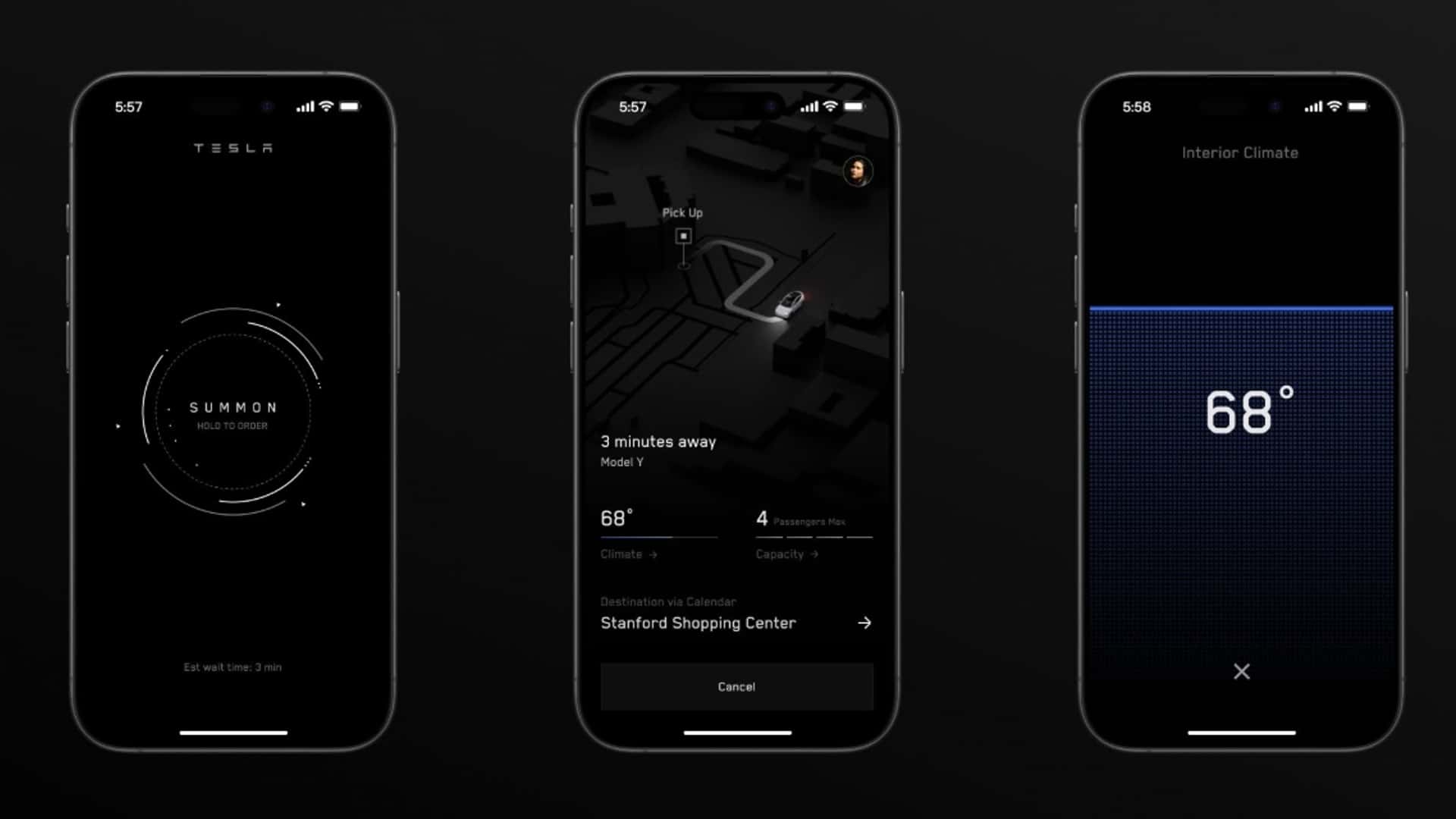
The report also included a preview of what the integrated ride-hailing functionality might look like within the existing Tesla app. These renderings depicted a ‘Summon’ button, suggesting a straightforward method for users to order an autonomous taxi.
One screen in the preview displayed a temperature setting of 68 degrees, hinting at potential in-app control over climate settings within the robotaxi before a ride commences. While these details are ‘scant,’ they provide a glimpse into the user experience Tesla envisions for its autonomous mobility service, prioritizing convenience and personalization for users of Tesla’s robotaxi fleet.
Navigating Strategic Shifts and Investor Confidence
The announcement of Tesla’s robotaxi plans arrives in a complex corporate landscape, marked by shifting priorities and intense investor scrutiny. Earlier reports from Reuters had indicated that Tesla might have ‘scrapped plans’ for a long-anticipated cheaper consumer vehicle to focus squarely on robotaxis, creating considerable uncertainty among shareholders and prospective buyers.
During the same earnings call, Tesla sought to clarify its broader product strategy. The company stated it is “accelerating the launch timing of new vehicles, including more affordable models,” while also indicating that the robotaxi service would arrive ‘later on.’ This adjustment aims to balance the pursuit of cutting-edge autonomy with the market demand for more accessible electric vehicles.
The mention of the ride-hailing business can be interpreted as a strategic move to “assuage investors” who have been seeking clarity on Tesla’s future growth drivers. By outlining a concrete vision for a potentially highly profitable autonomous mobility segment, Tesla aims to reinforce confidence in its long-term technological leadership and market expansion strategy.
The Road Ahead: Challenges to Full Autonomy
Despite the grand vision for Tesla’s robotaxi fleet, the realization of a widespread, fully autonomous ride-hailing service faces significant technological and regulatory hurdles. The core challenge lies in achieving true Level 5 autonomy, where a vehicle can operate completely without human intervention in all driving conditions.
Tesla’s existing Full Self-Driving (FSD) feature, while advanced, currently requires ‘total driver supervision and regularly makes mistakes.’ This necessitates that a human driver remains attentive and ready to intervene, a limitation that must be overcome for a commercial robotaxi service to operate safely and legally.
Historically, CEO Elon Musk has made ambitious projections regarding Tesla’s autonomy timelines. For instance, he famously proclaimed that the company would have ‘1 million robotaxis on the road by 2020.’ While these statements showcase Tesla’s aspiration, the subsequent delays have led industry observers and investors to approach new timelines with cautious optimism.
The transformation of FSD from a driver-assist system to a truly autonomous taxi service represents a monumental engineering feat. It demands not only flawless performance in diverse environments but also a robust regulatory framework that permits driverless operations on public roads, both of which are still works in progress.
Conclusion
Tesla’s latest announcements regarding its robotaxi fleet signify a continued commitment to revolutionizing urban mobility through autonomous technology. The proposed ‘combination of Airbnb and Uber’ model, blending company-operated units with owner contributions, presents a highly scalable and potentially lucrative business opportunity that could redefine ride-hailing services.
The company’s steadfast reliance on a vision-only architecture, powered by extensive real-world data and advanced neural networks, underscores its unique technological philosophy. While the ambition is clear, the path to full autonomy and widespread deployment of Tesla’s robotaxi fleet is fraught with formidable technical and regulatory challenges.
Investors and enthusiasts will continue to monitor Tesla’s progress closely, balancing the excitement surrounding its innovative vision with a pragmatic understanding of the complexities involved in bringing a truly driverless taxi service to fruition. The coming years will be crucial in determining whether Tesla can convert its long-held autonomous dreams into a tangible, operational reality.
FAQ Section
What is Tesla’s robotaxi fleet plan?
Tesla plans to launch a ride-hailing service that combines company-operated autonomous vehicles with privately-owned Tesla cars. Owners can opt to add their vehicles to the fleet, deciding who can use them (friends/family, five-star users, or anyone) and pulling them out whenever desired, akin to a hybrid of Airbnb and Uber.
How will Tesla’s robotaxi service work technically?
The service will rely on a “vision-only architecture with end-to-end neural networks.” This means the cars will use cameras and advanced AI, trained on billions of miles of real-world driving data, to achieve full self-driving capabilities without human intervention. Tesla is actively investing in the necessary hardware and software ecosystems.
When will Tesla’s robotaxi fleet be available?
While Tesla has confirmed it is “currently working on ride-hailing functionality that will be available in the future,” a definitive launch date has not been provided. CEO Elon Musk indicated that robotaxis would arrive ‘later on,’ suggesting that the service is still some time away from public deployment.
What control will Tesla owners have over their cars in the robotaxi fleet?
Tesla owners will have significant control. They can “add or subtract their cars from the fleet whenever they want.” Moreover, they can specify user access, choosing to allow usage only by friends and family, by highly-rated users, or by the general public, providing a flexible income-earning opportunity.
What is Full Self-Driving (FSD), and how does it relate to robotaxis?
Full Self-Driving (FSD) is Tesla’s advanced driver-assistance system that requires constant driver supervision. For the robotaxi fleet to operate truly autonomously, FSD must evolve into a fully self-driving system that performs reliably without human intervention. Currently, FSD still makes mistakes and is not legally or technically ready for unsupervised commercial operation.
Why is Tesla pursuing a robotaxi fleet now?
The push for a robotaxi fleet appears to be a strategic move to assure investors about Tesla’s future growth avenues amidst market uncertainties. It follows reports of a potential pivot from a cheaper consumer car, signaling a strong commitment to pioneering autonomous mobility as a significant long-term revenue stream for the company.
What are the main challenges for Tesla’s robotaxi plans?
The primary challenges include achieving reliable, error-free full self-driving capabilities in diverse environments, securing necessary regulatory approvals for driverless operations, and managing public perception and trust in autonomous vehicles. Past ambitious timelines for autonomy have also led to cautious optimism among industry observers.