
In a surprising development that sent ripples through the global automotive industry, Rivian’s recent Investor Day on June 25, 2024, proved to be far from a routine financial briefing. The event, initially anticipated to focus on fiscal guidance and updates on known projects like the Rivian R2, R3, and R3X, instead became the backdrop for a monumental announcement: a strategic joint venture with German automotive giant Volkswagen.
This unprecedented collaboration sees Rivian lending its acclaimed software expertise to Volkswagen, a move poised to accelerate the European conglomerate’s electric vehicle (EV) ambitions. In return, Rivian is set to receive a substantial investment of up to $5 billion, fortifying its financial position and fueling its ambitious growth plans. However, the revelations extended beyond financial and strategic alignments, offering intriguing glimpses into Rivian’s future vehicles that stretch far beyond its publicly known models.
Key Takeaways:
- Rivian announced a joint venture with Volkswagen, exchanging software expertise for a $5 billion investment.
- The partnership aims to accelerate software-defined vehicle platforms for both companies.
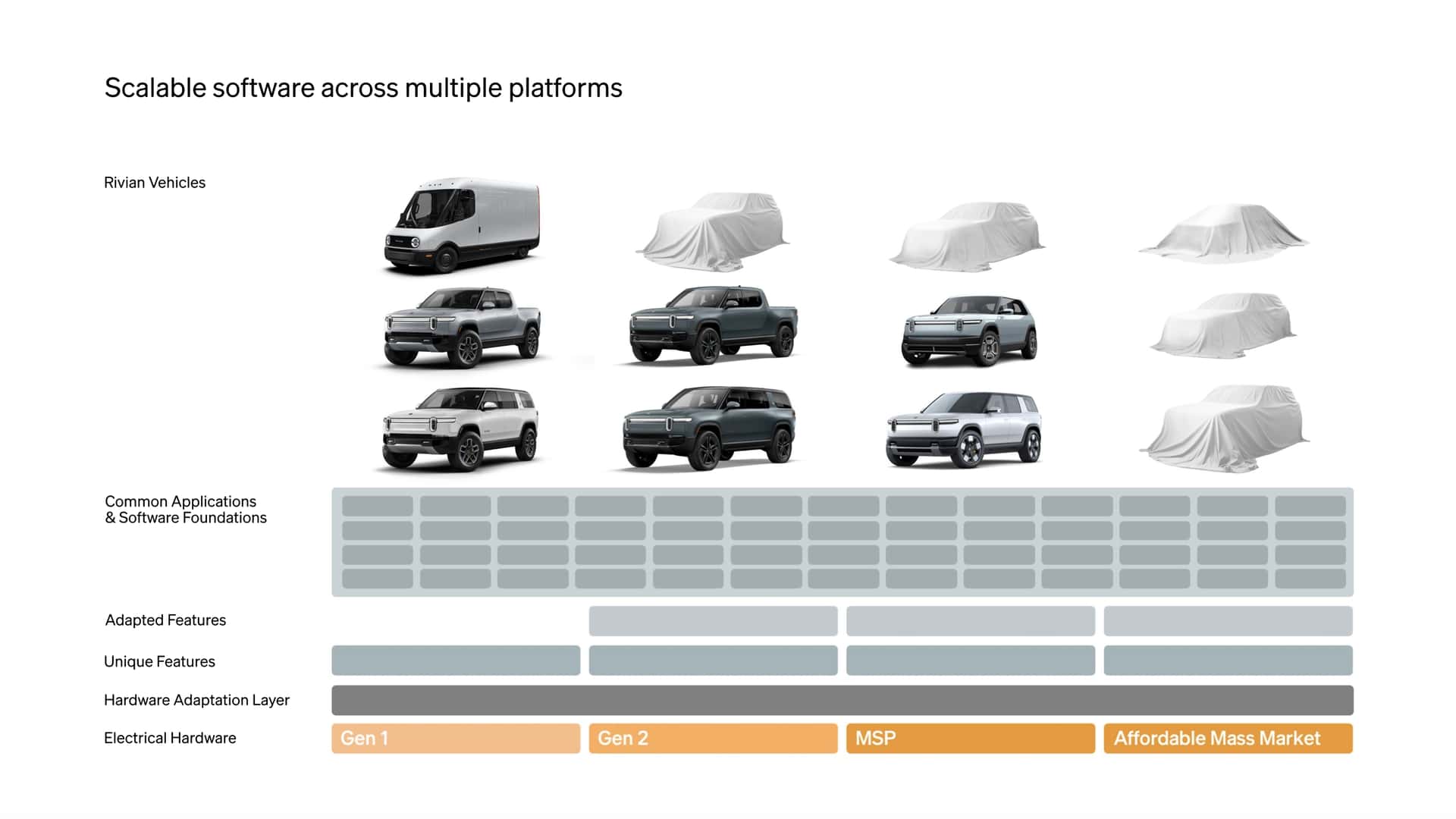
- A shareholder letter accompanying the announcement revealed an image hinting at several previously unseen Rivian’s future vehicles, including potential new SUVs and trucks.
- These mysterious covered vehicles appear to be distinct from the anticipated R2, R3, and R3X models.
- Rivian declined to comment on the specific nature of these undisclosed products, maintaining industry standard secrecy.
A Strategic Alliance Reshapes the EV Landscape
The joint venture between Rivian and Volkswagen marks a significant moment in the evolving electric vehicle industry. Volkswagen, a powerhouse in traditional automotive manufacturing, has been aggressively pursuing its transition to electric mobility. The integration of Rivian’s advanced software and electrical architecture is expected to provide a crucial acceleration in this endeavor, particularly in developing next-generation software-defined vehicle (SDV) platforms.
Rivian’s reputation for innovative software, user experience, and robust electrical systems has garnered considerable praise since the launch of its R1T pickup and R1S SUV. This expertise is now poised to benefit Volkswagen’s future EV lineup, potentially streamlining development cycles and enhancing the technological sophistication of its vehicles.
Unveiling the Investment Details and Operational Impact
Central to this partnership is Volkswagen’s substantial financial commitment to Rivian. The investment, slated to reach up to $5 billion, provides a significant capital injection for the American EV startup. This funding is crucial for Rivian as it navigates the capital-intensive process of scaling production, expanding its product portfolio, and solidifying its market presence.
The deal is structured to involve an initial $1 billion investment, followed by additional capital infusions over time. This financial backing will undoubtedly strengthen Rivian’s balance sheet, providing the resources necessary to continue investing in research and development, manufacturing capabilities, and the rollout of its highly anticipated next-generation models, including the R2 and R3.
Beyond the financial aspect, the joint venture entails the formation of a jointly controlled and owned company. This entity will be responsible for developing next-generation electric architectures and software technology, which will then be leveraged by both Rivian and Volkswagen brands. This collaborative development approach aims to create efficiencies and accelerate the pace of innovation for both automotive manufacturers.
Glimpses of Rivian’s Future Vehicles: Beyond R2 and R3
While the Volkswagen partnership dominated headlines, a lesser-noticed but equally compelling detail emerged from Rivian’s latest shareholder letter. First highlighted by Corey Cantor of BloombergNEF on Threads, an image within the letter showcased several previously unseen Rivian’s future vehicles, concealed under protective sheets.
This visual roadmap offers a tantalizing preview of what could be in Rivian’s product pipeline well beyond the highly anticipated R2, R3, and R3X models. The image, a strategic inclusion in a document intended for investors, suggests a more expansive product strategy than previously understood.
Decoding the Enigmatic Image
The shareholder letter’s slide provides a structured overview of Rivian’s product evolution. On the left, it clearly depicts the first generation of Rivian EVs, encompassing the acclaimed R1S SUV, the R1T electric pickup truck, and the custom electric delivery vans developed for Amazon. Moving to the center, the slide illustrates the second generation R1 vehicles, which recently underwent extensive testing and review.
However, it is the obscured forms that capture immediate attention. Positioned above the second-generation R1 vehicles is another covered shape, prompting speculation about a potential “R1X” — a high-performance or specialized variant that might build upon the successful R1 platform. This could represent a strategic extension of its premium large vehicle segment.
The most significant mysteries, however, reside in the subsequent columns of the image. Here, multiple SUV-like shapes are visible, distinctly separate from the known silhouettes of the R2 and R3 compact and mid-size electric SUVs unveiled earlier in the year. These new shapes suggest an entirely new segment of Rivian’s future vehicles, potentially hinting at different form factors, sizes, or market targets that Rivian is exploring.
Interpreting the Future Product Pipeline
An interesting observation within the visual is the repetition of two distinct covered shapes. This could indicate that Rivian plans to offer multiple variants of the same foundational vehicle, such as different body styles, powertrain configurations, or specialty trims. Alternatively, and as a note of caution, these could be placeholder “TBD” (To Be Determined) images, serving as visual representations of planned future slots rather than definitive renderings of final designs. Journalists and analysts are advising against drawing overly specific conclusions until more concrete information becomes available.
When approached for comment on these undisclosed vehicles, a Rivian spokesperson maintained the industry-standard stance, declining to offer any specific details. This typical response for unannounced products underscores the early stage of these potential models and the company’s strategic decision to control the timing of future product reveals. It reinforces the idea that these are indeed future products currently under wraps.
The Broader Context of Rivian’s Expansion
The revelation of these potential new models, coupled with the Volkswagen partnership, paints a clear picture of Rivian’s ambitious expansion strategy. The company is not merely focused on refining its current offerings or launching its next-tier mass-market vehicles (R2, R3). Instead, it appears to be laying the groundwork for a much broader product portfolio that could address various consumer segments and commercial applications in the years to come.
The $5 billion investment from Volkswagen directly supports this expansion, providing the necessary capital for research, development, and scaling production lines for a wider array of Rivian’s future vehicles. This strategic financial bolstering helps de-risk Rivian’s long-term product roadmap and enables it to compete more effectively in an increasingly competitive global EV market.
By offering a diverse range of electric SUVs and trucks, Rivian aims to capture a larger share of the burgeoning EV market. This strategy is critical for a company looking to transition from a niche luxury EV manufacturer to a significant player across multiple vehicle categories.
Industry Implications and Market Reaction
The dual announcement of the Volkswagen partnership and the veiled images of Rivian’s future vehicles has been met with significant interest from financial markets and industry analysts. The partnership is seen as a vote of confidence in Rivian’s technological capabilities and a smart move for Volkswagen to accelerate its software development.
For Rivian, the partnership provides not only capital but also a strategic alliance with a global automotive giant, potentially opening doors for future collaborations beyond software, such as component sharing or even joint manufacturing in the long term. This alliance positions Rivian as a key technology provider in the automotive ecosystem, elevating its status beyond just a vehicle manufacturer.
The mere hint of additional future products also signals a robust and long-term vision for Rivian, reassuring investors about the company’s sustained innovation and growth trajectory. It suggests that Rivian’s commitment to advancing electric mobility extends far beyond its current known models, promising a dynamic future for the brand and the wider EV landscape.
Conclusion
Rivian’s Investor Day proved to be anything but ordinary, delivering a dual punch that has reshaped perceptions of the company’s future. The strategic alliance with Volkswagen, bringing substantial investment and a commitment to joint software development, provides a solid financial and technological foundation. Concurrently, the tantalizing image within the shareholder letter has ignited speculation about an expanded lineup of Rivian’s future vehicles, moving beyond the R2 and R3 to encompass entirely new electric SUVs and trucks.
While specific details remain under wraps, these developments collectively underscore Rivian’s ambition to become a dominant force in the electric vehicle market, driven by innovation, strategic partnerships, and a continuously expanding product portfolio. The automotive world will be keenly watching as these covered shapes gradually reveal the next chapter in Rivian’s electrifying journey.
Frequently Asked Questions About Rivian’s Future
What was the main announcement from Rivian’s Investor Day?
Rivian announced a significant joint venture with Volkswagen. This partnership involves Rivian sharing its software expertise for electric vehicle platforms, while Volkswagen will invest up to $5 billion into Rivian, strengthening its financial position and accelerating joint technological development.
What new vehicles were hinted at in Rivian’s shareholder letter?
An image in Rivian’s shareholder letter, spotted by BloombergNEF, displayed several covered vehicle shapes. These mysterious silhouettes suggest new Rivian’s future vehicles, potentially including an “R1X” variant and other distinct SUV-like models beyond the previously announced R2, R3, and R3X.
How does the Volkswagen investment benefit Rivian?
The $5 billion investment from Volkswagen provides Rivian with crucial capital to fund its operations, scale production, and accelerate the development and launch of its expanded product portfolio, including the newly hinted-at models. It also signifies a strong vote of confidence from a major automotive player.
What is the nature of the software collaboration with Volkswagen?
The joint venture involves forming a new company co-owned by Rivian and Volkswagen. This entity will focus on developing advanced electric architectures and software technology, which both brands will then integrate into their respective next-generation electric vehicles, aiming for shared innovation and efficiency.
Are the new vehicles definitely coming to market?
The image from the shareholder letter serves as a strategic peek into Rivian’s long-term product roadmap. While it suggests future product intent, specific models, timelines, and final designs are not yet confirmed. A Rivian spokesperson declined to comment on these future products, as is standard practice in the industry.
What impact could this partnership have on the electric vehicle market?
This alliance could significantly accelerate software-defined vehicle development across the industry. For Rivian, it ensures robust funding and a strategic partner. For Volkswagen, it fast-tracks its software capabilities. The expanded lineup of Rivian’s future vehicles also promises increased competition and innovation in the rapidly growing EV segment.