
Key Takeaways
- Tesla’s newly detailed robotaxi strategy involves both a company-operated fleet and the integration of privately owned Tesla vehicles.
- CEO Elon Musk described the model as a “combination of Airbnb and Uber,” allowing owners flexibility in how their vehicles participate.
- The company reiterated its commitment to a “vision-only architecture with end-to-end neural networks” for achieving full autonomy.
- While accelerating the launch of more affordable traditional models, Tesla indicated that the dedicated robotaxi would arrive later.
- Skepticism remains regarding the timeline and full realization of Tesla’s self-driving capabilities, given past predictions and the current state of its Full Self-Driving (FSD) feature.
During its first-quarter earnings call on April 23, 2024, Tesla provided crucial insights into its long-anticipated robotaxi strategy, addressing pervasive questions from analysts, investors, and enthusiasts. The automaker confirmed plans for a sophisticated ride-hailing service, revealing a dual operational model.
This evolving strategy encompasses a significant portion of the fleet being directly operated by Tesla, complemented by a unique integration for existing Tesla owners. These details mark a pivotal moment in understanding the electric vehicle manufacturer’s future trajectory in autonomous mobility.
Tesla’s Dual-Layer Robotaxi Approach
Tesla CEO Elon Musk elaborated on the company’s vision during the investor conference call. He stated that Tesla intends to manage a substantial fleet of its own self-driving taxis, positioning the company as a direct participant in the future of autonomous ride-hailing.
Crucially, Musk also outlined a mechanism for private Tesla owners to engage with the service. Owners would possess the agency to “add or subtract their cars from the fleet whenever they want.” This flexibility extends to granular control over who can utilize their vehicle.
Musk explained, “they can decide if they want to only let the car be used by friends and family, or only by five-star users or by anyone.” This model reflects a hybrid approach, drawing parallels to established sharing economy platforms.
To encapsulate this multifaceted strategy, Musk succinctly described it as a “combination of Airbnb and Uber.” This analogy suggests a platform where Tesla ensures vehicle quality and operational standards, while offering private owners a revenue-generating opportunity with adjustable parameters.
Technological Underpinnings and Future Functionality
The company’s first-quarter earnings report further solidified the technological investments supporting this ambitious robotaxi strategy. The report explicitly noted that Tesla is “currently working on ride-hailing functionality that will be available in the future.”
Tesla highlighted its strategic focus, stating, “We have been investing in the hardware and software ecosystems necessary to achieve vehicle autonomy and a ride-hailing service.” This commitment underscores a comprehensive development effort spanning both physical vehicle components and advanced algorithmic intelligence.
A core tenet of Tesla’s autonomy development remains its “vision-only architecture.” The earnings report reaffirmed this approach: “We believe a scalable and profitable autonomy business can be realized through a vision-only architecture with end-to-end neural networks, trained on billions of miles of real-world data.”
This statement emphasizes the reliance on cameras and neural networks as the primary sensors for self-driving, distinguishing Tesla’s method from competitors who often incorporate lidar and radar technologies.
Glimpse into the User Experience
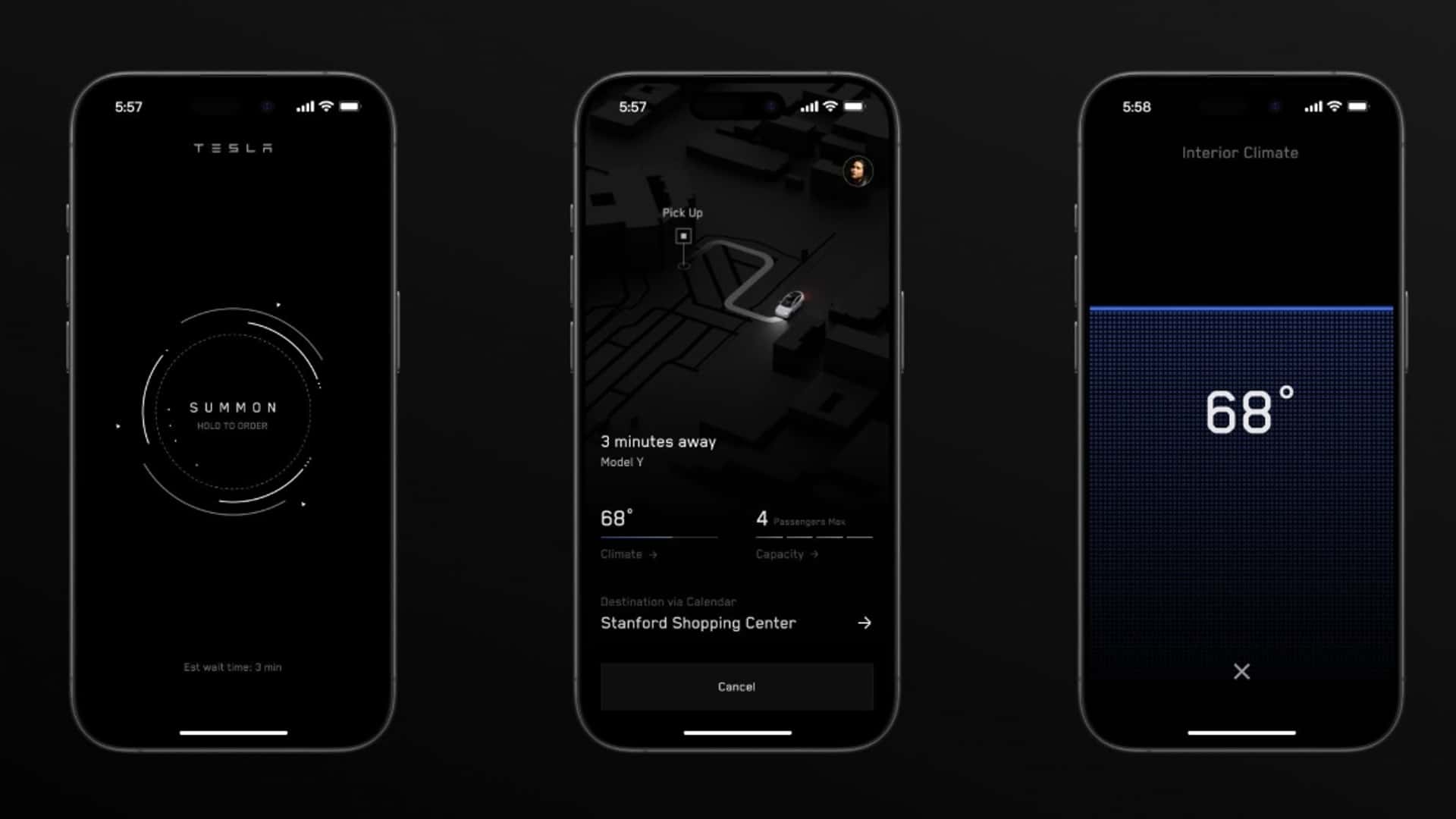
Accompanying these announcements, Tesla released preview renderings of what the ride-hailing functionality might look like when integrated into the existing Tesla application. These mock-ups offer a preliminary view of the user interface for accessing the autonomous service.
One notable feature displayed is a prominent “Summon” button, intuitively suggesting the mechanism for requesting a self-driving taxi. Another screen within the rendering showcased a temperature setting of 68 degrees, hinting at potential in-cabin climate control options for passengers before their journey begins.
While these visual cues are illustrative and details remain scant, they provide a tangible, albeit early, indication of the anticipated seamless interaction between the user and the future robotaxi fleet. Such features aim to enhance passenger comfort and personalization in autonomous travel.
Market Speculation and Production Adjustments
The latest disclosures arrive amidst a period of considerable speculation surrounding Tesla’s strategic priorities. A report by Reuters had previously suggested a shift, indicating that Tesla had shelved plans for a more affordable consumer vehicle to instead accelerate its robotaxi project. This sparked significant investor concern and public debate.
However, Tesla utilized its earnings call to address these reports, clarifying its broader product roadmap. The company stated that it is “accelerating the launch timing of new vehicles, including more affordable models.” This suggests a revised strategy that seeks to balance the introduction of entry-level consumer EVs with the continued development of the autonomous ride-hailing service.
Crucially, Tesla indicated that the dedicated robotaxi would be introduced at a later stage, suggesting that its development and deployment will follow the launch of these new, more accessible traditional vehicle models. This strategic sequencing aims to reassure investors about the continued expansion of Tesla’s core automotive business while maintaining a long-term vision for autonomous services.
Challenges and Past Predictions
Despite the comprehensive outline of its robotaxi strategy, the successful implementation of this vision hinges entirely on Tesla’s ability to deliver truly self-driving vehicles. This has been a persistent challenge for the automaker, which has faced scrutiny over the capabilities of its advanced driver-assistance system.
The company’s Full Self-Driving (FSD) feature, despite its name and significant cost, currently requires constant and total driver supervision. Reports indicate that FSD, while improving, still exhibits instances of making mistakes, underscoring the complexities of achieving Level 5 autonomy.
Furthermore, CEO Elon Musk’s past projections regarding autonomous capabilities have often been ambitious, yet have seen significant delays. Notably, Musk famously declared that Tesla would have one million robotaxis operational on the road by the year 2020. This prediction, which did not materialize, serves as a reminder for observers to approach new timelines and pronouncements with a degree of caution.
The journey from advanced driver-assistance to full, unsupervised autonomy is technically demanding and fraught with regulatory hurdles. Tesla’s ability to overcome these challenges will be paramount to the realization of its robotaxi strategy and its long-term impact on the mobility landscape.
Frequently Asked Questions (FAQ)
What is Tesla’s robotaxi strategy?
Tesla’s robotaxi strategy involves operating its own fleet of self-driving taxis while also allowing private Tesla owners to integrate their vehicles into the network. This hybrid model, described as a “combination of Airbnb and Uber” by Elon Musk, offers flexible participation options for owners to earn revenue.
How will Tesla owners participate in the robotaxi fleet?
Tesla owners will have the option to “add or subtract their cars from the fleet whenever they want.” They can also set preferences, choosing to allow usage only by friends and family, five-star rated users, or any approved passenger, providing significant control over their vehicle’s usage.
What is the “vision-only architecture” that Tesla mentioned?
Tesla’s “vision-only architecture” refers to its approach to autonomous driving technology, which relies primarily on cameras and neural networks to perceive and interpret the environment. Unlike many competitors, Tesla largely eschews lidar and radar, believing that a robust vision system is sufficient for full self-driving capabilities.
When can we expect Tesla’s robotaxi service to be available?
While Tesla confirmed it is “currently working on ride-hailing functionality that will be available in the future,” the company indicated that a dedicated robotaxi vehicle would arrive later, after the launch of “new vehicles, including more affordable models.” Specific timelines remain fluid and subject to ongoing development and regulatory approvals.
What are the primary challenges for Tesla’s robotaxi plans?
The main challenge lies in achieving true, unsupervised full self-driving capabilities, a feat Tesla’s current Full Self-Driving (FSD) software has yet to accomplish. Overcoming complex technical hurdles, ensuring safety, navigating regulatory landscapes, and scaling operations effectively are critical obstacles that must be addressed for successful deployment.
How does this robotaxi strategy impact Tesla’s plans for more affordable vehicles?
Following initial reports suggesting a shift away from cheaper cars, Tesla clarified that it is “accelerating the launch timing of new vehicles, including more affordable models.” This indicates a dual focus: expanding its core consumer vehicle lineup while also pursuing the long-term vision of a robotaxi fleet, with the latter expected later.