
Key Takeaways:
- Tesla outlined its comprehensive vision for a hybrid Tesla robotaxi service during its first-quarter earnings call on April 23, 2024.
- The planned service aims to integrate both company-operated autonomous vehicles and a unique peer-to-peer car-sharing model for existing Tesla owners.
- Owners will have the flexibility to integrate their personal vehicles into the autonomous fleet, defining usage parameters such as user types and availability.
- The foundation of this ambitious strategy rests on a “vision-only architecture” powered by end-to-end neural networks, trained on billions of miles of real-world data.
- This strategic pivot and detailed announcement are intended to address investor questions and provide clarity on the automaker’s future roadmap, despite ongoing technological challenges in achieving full autonomy.
During its much-anticipated first-quarter earnings call, electric vehicle giant Tesla provided significant insights into its long-speculated entry into the ride-hailing market. The company, through statements from CEO Elon Musk and its official earnings report, revealed a novel approach to its upcoming Tesla robotaxi service, envisioning a model that fuses elements of leading ride-sharing and short-term rental platforms.
Investors, analysts, and enthusiasts had convened with numerous pressing questions, particularly concerning the practical implementation of Tesla’s reported shift towards autonomous taxis. While exhaustive details remain under wraps, the recent disclosures have shed more light on the automaker’s strategic direction for autonomous mobility solutions.
The Hybrid Vision for Tesla Robotaxi Service
Elon Musk, Tesla’s Chief Executive Officer, elaborated on the dual-pronged strategy for the Tesla robotaxi service during the investor conference call. He articulated a vision where Tesla would not only manage its proprietary fleet of self-driving vehicles but would also empower existing Tesla owners to participate in the autonomous network.
Musk likened the operational model to a “combination of Airbnb and Uber,” suggesting a blend of owner-driven asset utilisation and a professionally managed service. This innovative concept aims to create a broad and flexible network of autonomous vehicles.
Empowering Owners: A Flexible Fleet Contribution Model
A core component of Tesla’s planned ride-hailing offering is the ability for current vehicle owners to integrate their cars into the autonomous fleet. This would allow owners to “add or subtract their cars from the fleet whenever they want,” offering unparalleled flexibility and control over their assets.
Furthermore, owners would possess the discretion to “decide if they want to only let the car be used by friends and family, or only by five-star users or by anyone.” This granular control over user access underscores a commitment to owner empowerment and security within the nascent Tesla robotaxi service ecosystem.
Technological Bedrock: Vision-Only Autonomy
The company’s first-quarter earnings report provided a deeper technical rationale behind its autonomy ambitions. Tesla affirmed its dedication to developing ride-hailing functionalities slated for future release, underscoring years of investment in both hardware and software ecosystems essential for achieving vehicle autonomy.
A critical highlight from the report is Tesla’s unwavering belief that “a scalable and profitable autonomy business can be realized through a vision-only architecture with end-to-end neural networks, trained on billions of miles of real-world data.” This commitment to a camera-centric system, eschewing lidar or radar as primary sensors for autonomous driving, distinguishes Tesla from many competitors in the field.
Leveraging Advanced AI and Extensive Data for Autonomy
The reliance on a “vision-only architecture” necessitates sophisticated artificial intelligence and robust machine learning capabilities. Tesla’s approach involves training complex “end-to-end neural networks” on an immense dataset accumulated from its global fleet.
The phrase “billions of miles of real-world data” signifies the company’s continuous effort to refine its self-driving algorithms, enabling them to navigate diverse driving conditions and scenarios. This extensive data collection and processing are paramount to developing a safe and reliable Tesla robotaxi service.
Anticipated User Experience and App Integration
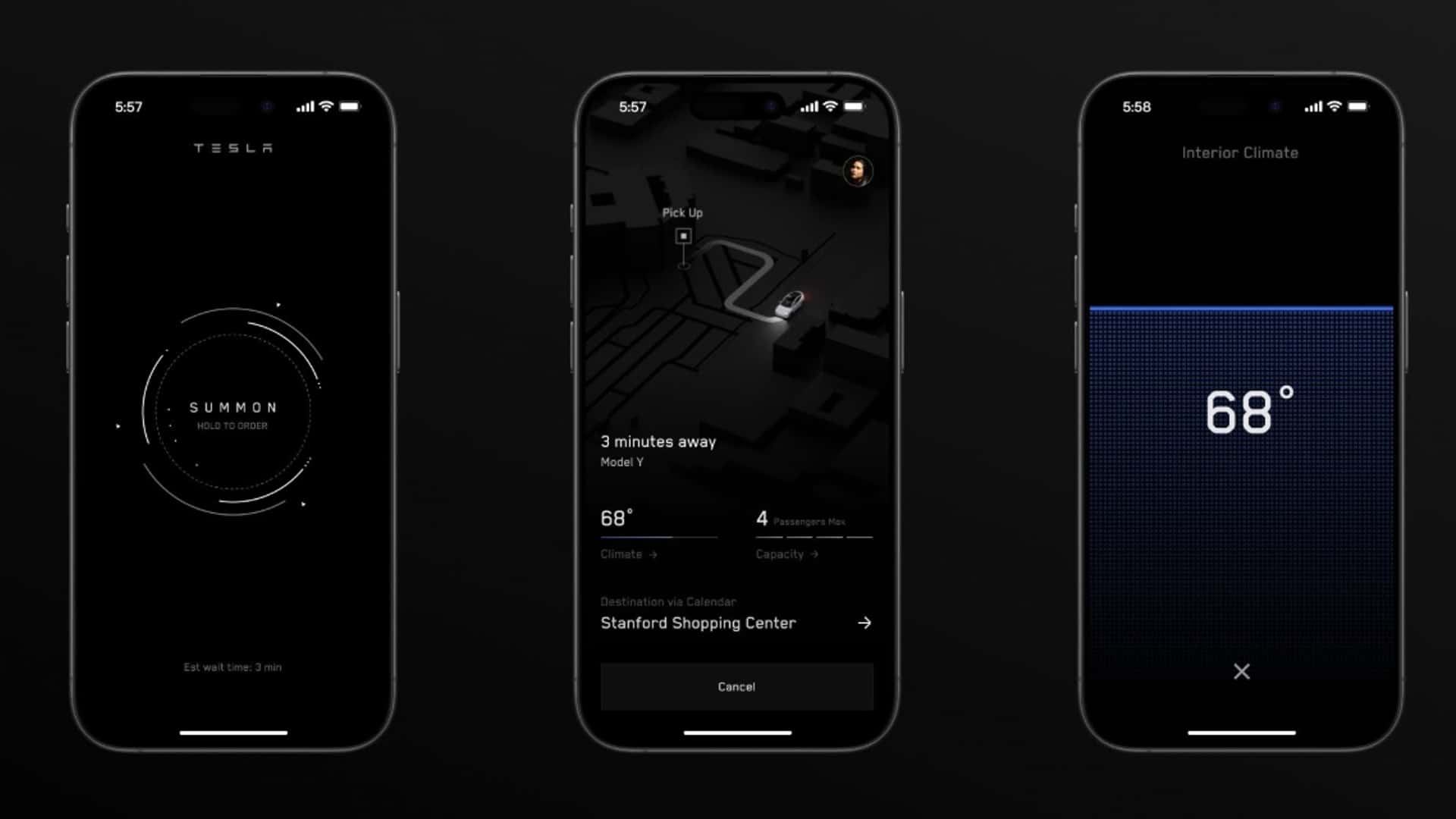
Tesla offered a glimpse into the prospective user interface for its ride-hailing functionality, integrated directly within the Tesla app. Renderings showcased a prominent “Summon” button, presumably the primary interface for requesting an autonomous taxi.
Intriguingly, one screen displayed a temperature setting of “68 degrees,” hinting at potential advanced features. This could suggest that future customers will be able to customise cabin climate settings prior to their robotaxi arrival, enhancing passenger comfort and personalisation. While specific details remain minimal, these previews underscore Tesla’s focus on a seamless and intuitive user experience.
Addressing Investor Confidence and Product Strategy Shifts
The unveiling of the Tesla robotaxi service strategy comes at a pivotal time for the company. Recent reports, notably from Reuters, suggested that Tesla might have shelved plans for a more affordable consumer vehicle to prioritize its robotaxi project. This sparked considerable uncertainty regarding the automaker’s future product roadmap and market positioning.
In response to these concerns and to assuage investors, Tesla confirmed during the earnings call that it is actively “accelerating the launch timing of new vehicles, including more affordable models.” This statement indicates a commitment to expanding its product lineup while simultaneously advancing the robotaxi initiative, though the autonomous taxi itself is slated for a later introduction.
Balancing Affordability with Autonomous Ambition
The strategic challenge for Tesla lies in balancing its long-term vision for autonomous mobility with the immediate demand for more accessible electric vehicles. The clarification regarding the acceleration of affordable models suggests a dual strategy: addressing immediate market needs for EV adoption while steadily progressing towards the futuristic Tesla robotaxi service.
This approach aims to sustain growth and revenue streams from traditional vehicle sales, which are crucial for funding the capital-intensive research and development required for full autonomy. The promise of a ride-hailing business serves as a long-term growth driver, offering a new revenue paradigm beyond vehicle sales.
Navigating the Road Ahead: Challenges and Skepticism
Despite the grand vision, the successful deployment of a fully autonomous Tesla robotaxi service hinges on the company’s ability to achieve true self-driving capabilities. This remains a significant hurdle, one that Tesla has yet to fully overcome after years of ambitious pronouncements.
The company’s existing Full Self-Driving (FSD) feature, a premium software suite, currently mandates constant driver supervision and has been noted for making errors. This necessitates a transition from driver-assisted autonomy to entirely unsupervised operation for a commercial robotaxi service to be viable and safe.
The Reality of Full Self-Driving and Past Promises
The current iteration of Tesla’s FSD system, despite its name, does not confer full autonomous driving capabilities. It functions as an advanced driver-assistance system, requiring the driver to remain attentive and ready to intervene at all times. This distinction is crucial when considering the leap to a commercial, driverless taxi service.
Furthermore, Elon Musk has a history of making ambitious timelines for autonomous technology that have not always materialised. Notably, he famously predicted in 2019 that Tesla would have one million robotaxis operational by 2020. This historical context underscores the need for a measured perspective when evaluating current timelines and future claims regarding the Tesla robotaxi service.
Potential Disruption to the Ride-Hailing Market
Should Tesla successfully deploy its robotaxi service, it could represent a significant disruption to the established ride-hailing and transportation sectors. A fleet of autonomous vehicles, particularly if augmented by owner-contributed cars, could dramatically alter operational costs and efficiency compared to human-driven services.
The prospect of a fully automated, scalable mobility service operating with lower per-mile costs has the potential to reshape urban transportation, offering new conveniences and efficiencies to consumers globally. However, the path to realising this potential is fraught with technological, regulatory, and logistical complexities.
Conclusion
Tesla’s detailed outline of its Tesla robotaxi service strategy marks a significant moment in the company’s trajectory. The vision of a hybrid fleet, combining company-owned autonomous vehicles with owner contributions, presents an innovative model for future mobility.
While the technological challenges of achieving true, unsupervised self-driving remain substantial, and past promises serve as a cautionary reminder, the commitment to a vision-only architecture and extensive data training reinforces Tesla’s long-term autonomous ambitions. The coming years will be crucial in determining whether this ambitious “combination of Airbnb and Uber” can transition from a bold proclamation to a revolutionary reality.
Frequently Asked Questions (FAQ)
What is Tesla’s new robotaxi service strategy?
Tesla’s strategy involves a dual approach: operating its own fleet of self-driving taxis and allowing existing Tesla owners to integrate their personal vehicles into the autonomous network. This creates a hybrid model combining company-managed services with a peer-to-peer sharing capability, akin to a blend of Uber and Airbnb functionalities.
How will Tesla owners participate in the robotaxi fleet?
Tesla owners will have the option to add or remove their cars from the autonomous fleet at their convenience. They can also set preferences for who can use their vehicle, such as limiting access to friends and family, only five-star rated users, or making it available to anyone on the platform.
What technology underpins Tesla’s autonomous driving?
Tesla is committed to a “vision-only architecture” for its autonomous vehicles. This system relies on a network of cameras and advanced artificial intelligence, specifically “end-to-end neural networks,” which are extensively trained on billions of miles of real-world driving data collected from Tesla’s global fleet.
When can we expect the Tesla robotaxi service to launch?
While specific launch dates remain unconfirmed, Tesla indicated during its Q1 earnings call that the ride-hailing functionality will be available “in the future.” The company also stated it is accelerating the launch of “new vehicles, including more affordable models,” with the robotaxi service arriving at a later stage.
What are the main challenges for Tesla’s robotaxi plans?
The primary challenge is achieving truly unsupervised full self-driving capability, as Tesla’s current FSD feature still requires constant human driver supervision. Overcoming regulatory hurdles, ensuring public trust in driverless technology, and scaling the infrastructure for a large-scale autonomous fleet are also significant obstacles.
How does this strategy impact Tesla’s plans for cheaper vehicles?
Initially, reports suggested that robotaxis were prioritized over a cheaper consumer vehicle. However, during the Q1 earnings call, Tesla clarified that it is accelerating the launch of “new vehicles, including more affordable models,” alongside its robotaxi development. This indicates a commitment to both product lines, albeit with a sequential rollout.
Has Elon Musk made previous predictions about robotaxis?
Yes, Elon Musk famously predicted in 2019 that Tesla would have one million robotaxis on the road by 2020. This prediction, however, did not materialise, leading to a degree of skepticism regarding future timelines and ambitious claims for the company’s autonomous driving advancements.