
Key Takeaways:
- Tesla confirmed its plans for a proprietary ride-hailing service, detailing a unique model.
- CEO Elon Musk described the envisioned service as a “combination of Airbnb and Uber.”
- The company intends to operate a significant portion of the autonomous taxi fleet itself.
- Tesla owners will have the option to integrate their personal vehicles into the network, setting usage parameters.
- The Q1 earnings report highlighted ongoing investment in hardware and software for vehicle autonomy.
- Despite past ambitious timelines, a robotaxi launch is positioned for a later date, following accelerated “new vehicles, including more affordable models.”
- The success of this strategy hinges on achieving fully autonomous driving capabilities, a goal that has faced persistent challenges.
NEW DELHI: Tesla, the electric vehicle giant, has provided a clearer glimpse into its ambitious plans for a self-driving taxi service. Following extensive speculation, details emerging from the company’s first-quarter earnings call on Tuesday, April 23, 2024, indicate a unique hybrid approach to the future of urban mobility.
This strategic pivot, first reported by Reuters concerning a shift from developing a cheaper consumer car to prioritizing autonomous taxis, has been a central point of discussion among analysts, investors, and enthusiasts alike. While specifics remain guarded, Tesla has now outlined a foundational model for its ride-hailing venture.
Musk’s Vision: A Hybrid Mobility Model
During the recent conference call with investors, Tesla CEO Elon Musk articulated the company’s dual strategy for its forthcoming robotaxi fleet. He stated that Tesla intends to operate a substantial portion of this self-driving taxi network directly.
Crucially, the vision extends beyond a company-owned fleet. Musk elaborated on a system where individual Tesla owners could actively participate, likening the model to a “combination of Airbnb and Uber.” This innovative concept suggests a collaborative ecosystem where vehicle owners can leverage their autonomous vehicles for commercial purposes.
Detailing the owner participation aspect, Musk explained, “they can decide if they want to only let the car be used by friends and family, or only by five-star users or by anyone.” This flexibility implies a tiered system of access and trust, granting owners significant control over their vehicle’s use within the ride-hailing network. Owners would also be able to “add or subtract their cars from the fleet whenever they want.”
This hybrid model signifies a potential paradigm shift in vehicle ownership and utilization. It suggests a future where personal electric vehicles could seamlessly transition into revenue-generating autonomous taxis, blurring the lines between private ownership and public utility.
Technological Foundations and Challenges
Tesla’s first-quarter earnings report corroborated the strategic direction, explicitly stating that the company is “currently working on ride-hailing functionality that will be available in the future.” The report further underscored the significant investments being made to bring this vision to fruition.
“We have been investing in the hardware and software ecosystems necessary to achieve vehicle autonomy and a ride-hailing service,” Tesla affirmed. The company detailed its core technological belief, asserting, “We believe a scalable and profitable autonomy business can be realized through a vision-only architecture with end-to-end neural networks, trained on billions of miles of real-world data.”
This commitment to a vision-only architecture, relying solely on camera data and artificial intelligence, contrasts with approaches by some competitors that integrate additional sensors like lidar. The immense dataset of real-world driving miles is central to training these neural networks, aiming to achieve reliable and safe self-driving capabilities across diverse environments.
User Interface and Integration
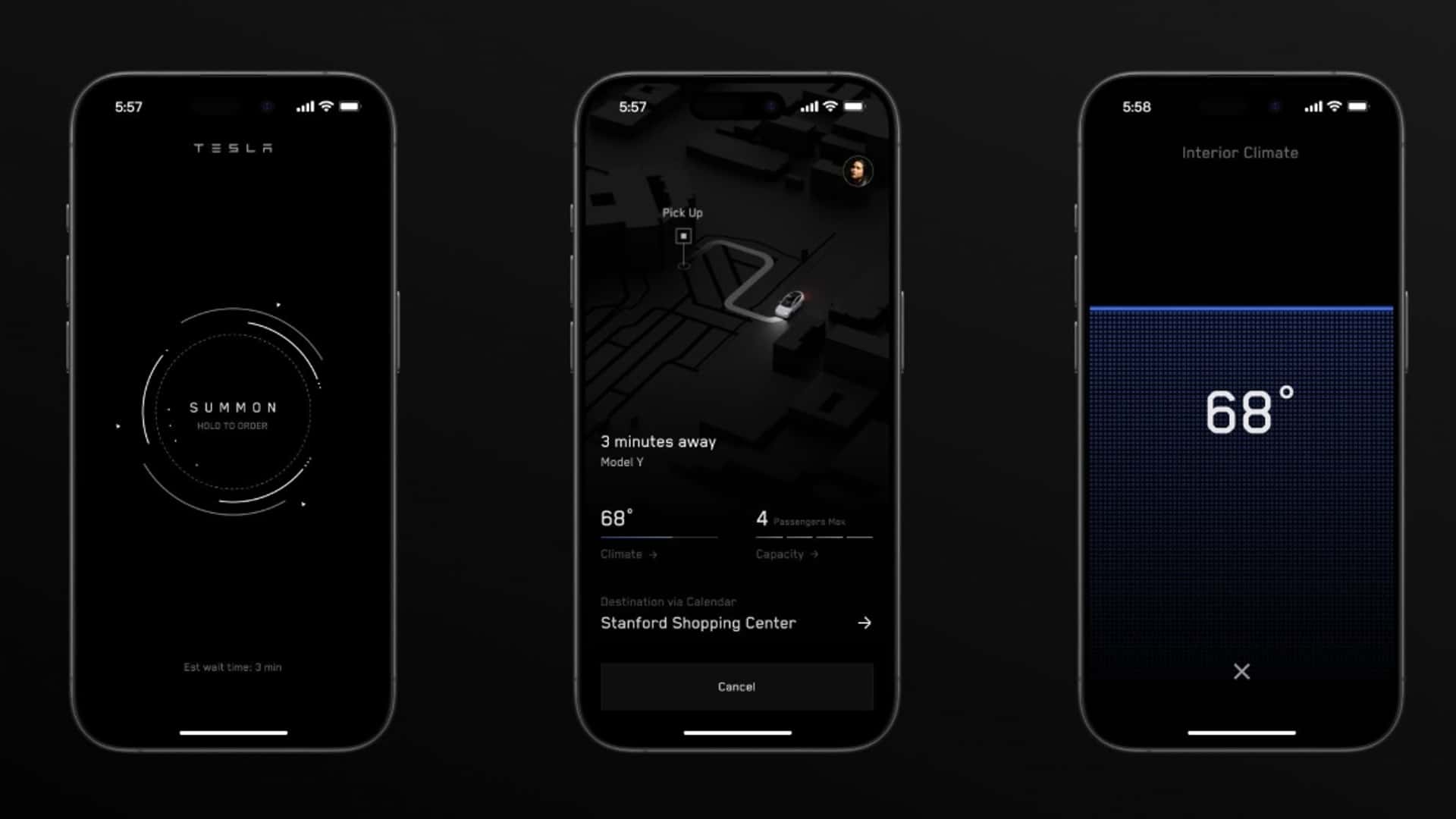
Accompanying these strategic announcements, Tesla also released preview renderings of what the ride-hailing functionality might look like when integrated into the existing Tesla application. These visual cues offered a glimpse into the user experience.
The renderings prominently featured a “Summon” button, which would presumably be the primary interface for users to request an autonomous taxi. One displayed screen indicated a temperature setting of 68 degrees, hinting at potential in-app climate control options for passengers before their ride commences. While these details are scant, they suggest a focus on user convenience and a seamless digital integration.
Addressing Investor Concerns and Future Timelines
The recent reports suggesting a deprioritization of a more affordable consumer vehicle in favor of robotaxis had fueled considerable uncertainty among investors regarding Tesla’s immediate product roadmap and future growth trajectory. The earnings call served, in part, to address these concerns.
During the call, Tesla clarified its position on new vehicle launches. The company stated it is accelerating the launch timing of “new vehicles, including more affordable models,” while indicating that the robotaxi offering would follow at a later stage. This suggests a recalibrated strategy that aims to deliver both mass-market accessibility and advanced autonomous mobility solutions.
The explicit mention of a ride-hailing business is largely seen as an effort to reassure the market that a concrete strategy underpins the robotaxi project, providing a long-term vision for revenue generation beyond traditional vehicle sales. This integration into the broader mobility landscape aims to unlock new economic avenues for the company.
The Road Ahead: Autonomy’s Unfulfilled Promises
The ambitious robotaxi plan, however, fundamentally relies on Tesla’s ability to achieve full self-driving capabilities – a significant technological hurdle that the company has yet to definitively clear. Despite years of development and substantial investments in its Full Self-Driving (FSD) feature, the system currently necessitates constant driver supervision and has been known to exhibit errors in various driving scenarios.
Elon Musk has historically made bold predictions regarding autonomous driving timelines. Notably, he famously proclaimed that Tesla would have one million robotaxis operational on the roads by 2020. This prior commitment, which ultimately went unfulfilled, serves as a crucial context for evaluating the current announcements.
Therefore, while the concept of a Tesla-operated autonomous taxi service presents an exciting future for electric mobility, the market and consumers alike remain cautious. The successful deployment of the Tesla robotaxi will be contingent not only on further technological advancements but also on robust regulatory frameworks, public acceptance, and the demonstrable reliability of the self-driving system in real-world conditions.
Frequently Asked Questions (FAQ)
What is Tesla’s robotaxi plan?
Tesla plans to launch a ride-hailing service featuring autonomous electric vehicles. It envisions a hybrid model, combining a company-owned fleet with participation from individual Tesla owners who can add their cars to the network for commercial use.
How will Tesla owners participate in the robotaxi fleet?
Owners will be able to voluntarily add or remove their autonomous Teslas from the fleet. They can also set specific parameters, such as allowing only friends and family, five-star rated users, or any passenger to use their vehicle for ride-hailing services.
What technology is Tesla using for its autonomous vehicles?
Tesla is focusing on a “vision-only architecture,” relying entirely on cameras and advanced end-to-end neural networks. These systems are trained on billions of miles of real-world driving data to achieve full self-driving capabilities.
When is the Tesla robotaxi expected to launch?
While an exact date remains unconfirmed, Tesla indicated that the robotaxi service would arrive after the accelerated launch of “new vehicles, including more affordable models.” The company is investing heavily in the necessary hardware and software ecosystems.
What are the main challenges for Tesla’s robotaxi ambitions?
The primary challenge is achieving truly full self-driving (FSD) capabilities, as the current FSD feature still requires driver supervision and experiences errors. Overcoming this technological hurdle, alongside regulatory approvals and public trust, is crucial for the plan’s success.
How is this plan addressing investor concerns?
The detailed announcement of a robotaxi service aims to reassure investors by outlining a clear long-term strategy for growth and revenue diversification. It provides a vision beyond traditional vehicle sales, highlighting a future in advanced mobility solutions.
Has Elon Musk made similar robotaxi predictions before?
Yes, Elon Musk famously predicted that Tesla would have one million robotaxis on the road by 2020. This prior ambitious timeline did not materialize, serving as a reminder of the complexities involved in deploying widespread autonomous mobility.