
Key Takeaways:
- Tesla has revealed more details about its planned robotaxi service during its first-quarter earnings call on April 23, 2024.
- CEO Elon Musk described the future service as a “combination of Airbnb and Uber,” integrating both company-operated autonomous vehicles and private Tesla owner cars.
- Tesla owners will have the flexibility to add or remove their vehicles from the fleet and set usage preferences, such as restricting access to friends, family, or highly-rated users.
- The company is investing heavily in “vision-only architecture with end-to-end neural networks” for full vehicle autonomy and the ride-hailing service.
- Despite past ambitious timelines for self-driving technology, Tesla is accelerating the launch of “new vehicles, including more affordable models,” with robotaxis expected later.
- The success of this strategy hinges on Tesla’s ability to achieve true, unsupervised full self-driving capabilities, an area where the company has faced historical challenges and criticism.
During its first-quarter earnings call on April 23, 2024, electric vehicle giant Tesla provided clearer insights into its highly anticipated robotaxi project. The announcement offers a glimpse into the automaker’s strategy for autonomous mobility, a pivot that has captured significant attention across the automotive industry.
While specific details remain somewhat limited, the company’s leadership outlined a novel operational model for its planned ride-hailing service. This development comes amidst intense scrutiny from analysts, investors, and enthusiasts eager for clarity on Tesla’s future trajectory in the self-driving sector.
Tesla’s Vision for Autonomous Mobility
The core of Tesla’s emerging strategy involves a multi-faceted approach to autonomous ride-hailing. The company articulated plans to not only operate a significant portion of the self-driving vehicles itself but also to integrate privately owned Tesla cars into its network.
This hybrid model aims to maximize fleet availability and leverage the existing large base of Tesla owners.
A Hybrid Ride-Hailing Model: Airbnb Meets Uber
Tesla CEO Elon Musk characterized the prospective service as a “combination of Airbnb and Uber.” This analogy suggests a dual operational structure.
Under this model, Tesla would deploy its own fleet of dedicated robotaxis, while simultaneously allowing individual Tesla owners to contribute their personal vehicles to the network.
Musk elaborated on the flexibility offered to owners, stating that they would be able to “add or subtract their cars from the fleet whenever they want.” Furthermore, owners could exercise granular control over who uses their vehicle, with options such as permitting use “only by friends and family, or only by five-star users or by anyone.”
This approach could potentially democratize access to autonomous ride-hailing, transforming private vehicles into revenue-generating assets when not in personal use. The concept aligns with broader trends in the sharing economy, extending the utility and economic value of personal transportation.
Technological Foundation: Vision-Only Architecture
Tesla’s first-quarter earnings report reinforced the company’s commitment to a specific technological pathway for achieving full vehicle autonomy. The report explicitly noted, “We have been investing in the hardware and software ecosystems necessary to achieve vehicle autonomy and a ride-hailing service.”
The electric vehicle manufacturer emphasized its belief that “a scalable and profitable autonomy business can be realized through a vision-only architecture with end-to-end neural networks, trained on billions of miles of real-world data.”
This vision-only approach, which relies solely on cameras and artificial intelligence without lidar or radar, has been a cornerstone of Tesla’s autonomous driving development for years. The reliance on extensive real-world data for training its neural networks is presented as a key differentiator, aiming to create robust and reliable self-driving capabilities.
Integrating Robotaxi Features into the Tesla Ecosystem
Further details from the earnings report confirmed that Tesla is actively developing the necessary software infrastructure. “We are currently working on ride-hailing functionality that will be available in the future,” the report stated.
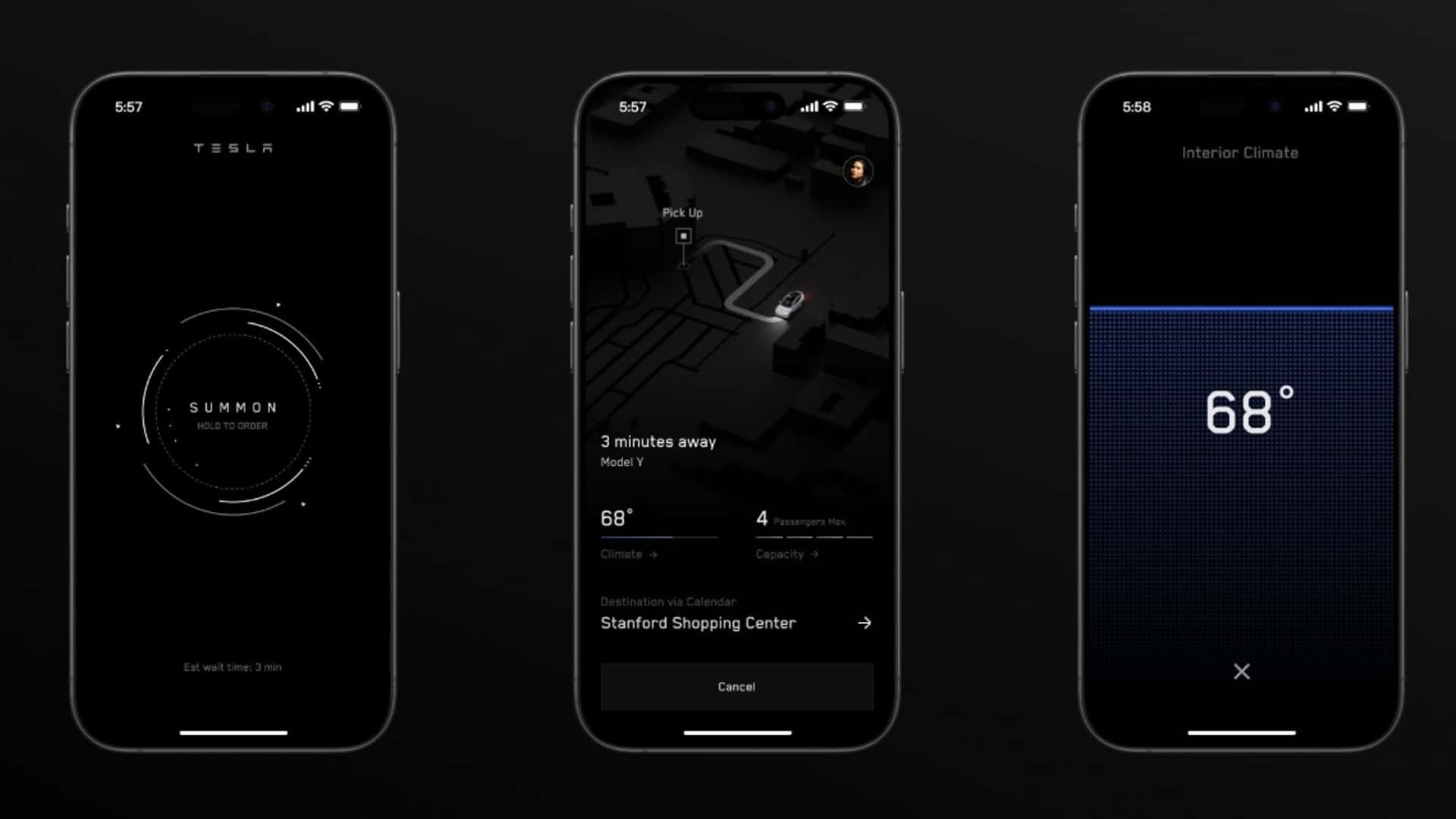
A preview of this functionality was also published, showcasing what the integration might look like within the existing Tesla mobile application. Renderings displayed a prominent “Summon” button, presumably for initiating a robotaxi request, akin to conventional ride-hailing apps.
One notable detail in the renderings was a display showing a temperature of 68 degrees, hinting at potential future features such as pre-setting climate control within the autonomous taxi before a passenger even enters the vehicle. These subtle indicators suggest an intuitive and user-centric design for the forthcoming service, enhancing the passenger experience.
Navigating Market Expectations and Production Priorities
The renewed emphasis on the Tesla robotaxi fleet comes at a crucial juncture for the company, following recent reports that stirred considerable debate within the automotive community.
Understanding this context is vital for interpreting Tesla’s current announcements regarding its autonomous strategy.
Addressing the “Cheaper Vehicle” Narrative
Earlier reports, particularly from Reuters, suggested that Tesla had potentially abandoned plans for a more affordable consumer vehicle to instead accelerate its robotaxi project. This sparked concerns among segments of the market expecting a broader entry-level offering from the EV pioneer.
During the earnings call, Tesla moved to clarify its production priorities. The company indicated that it is now accelerating the launch timing of “new vehicles, including more affordable models.” This statement aimed to reassure stakeholders about its commitment to diversified product lines.
Significantly, Tesla also indicated that a dedicated robotaxi vehicle would arrive at a later stage, suggesting a sequencing of new product introductions. This clarifies that while autonomous ride-hailing remains a strategic focus, it is part of a broader, phased rollout of new vehicle platforms.
The Broader Landscape of Autonomous Driving
Tesla’s aggressive pursuit of a commercial robotaxi service positions it firmly in the competitive landscape of autonomous driving. Companies worldwide are investing billions in developing self-driving technology, aiming to revolutionize urban mobility.
The successful deployment of a scalable and profitable Tesla robotaxi fleet could reshape the personal transportation sector, offering new revenue streams and potentially reducing urban congestion through optimized vehicle utilization. This ambition reflects a long-term strategic play by the company to dominate the future of mobility solutions.
The Path Forward: Challenges and Past Promises
While the vision for a Tesla robotaxi fleet is compelling, its realization is contingent upon overcoming significant technical and regulatory hurdles. The company’s journey in autonomous driving has been marked by both innovation and challenges, particularly concerning its Full Self-Driving (FSD) feature.
The Evolution of Full Self-Driving
A central pillar of Tesla’s autonomous ambitions is its Full Self-Driving (FSD) software. Despite its advanced capabilities, FSD currently requires constant driver supervision and has, on occasion, been reported to make mistakes.
This necessitates that drivers remain attentive and ready to intervene, underscoring that the technology has not yet achieved the fully autonomous, unsupervised driving capability required for a true robotaxi service.
The transition from a supervised driver-assist system to a fully autonomous, driverless operation represents a monumental engineering challenge. Tesla’s continued investment in its vision-only system and neural networks is aimed at bridging this gap, but the path to truly reliable and safe Level 4/5 autonomy is complex.
Historical Projections and Future Realities
Tesla’s grand pronouncements regarding autonomous capabilities are not new. CEO Elon Musk famously projected that the company would have 1 million robotaxis operating on the road by 2020. This ambitious timeline was not met, and the actual deployment of widespread autonomous vehicles is still years away.
This historical context informs the current reception of Tesla’s latest robotaxi announcements. While the idea of a Tesla robotaxi fleet is intriguing and potentially transformative, investors and the public are often advised to consider past timelines when evaluating future projections.
The updates from the first-quarter earnings call provide a more concrete outline of Tesla’s operational strategy and technological focus for its autonomous ride-hailing service. The company’s commitment to both company-owned and owner-contributed vehicles, backed by its vision-only AI, indicates a clear direction.
However, the successful deployment of a pervasive and safe Tesla robotaxi fleet ultimately hinges on achieving true, unsupervised full self-driving capabilities, a goal that continues to be a formidable challenge for the entire autonomous vehicle industry.
Frequently Asked Questions (FAQs)
What is Tesla’s latest plan for its robotaxi service?
Tesla plans a hybrid robotaxi service, combining company-owned autonomous vehicles with privately owned Teslas. Owners can opt-in/out and set usage preferences, making it a blend of a traditional ride-hailing service like Uber and a sharing platform similar to Airbnb, all powered by Tesla’s self-driving technology.
When can we expect the Tesla robotaxi fleet to launch?
While Tesla confirmed active development on ride-hailing functionality and autonomous vehicles, a specific launch date for the widespread robotaxi service was not provided. The company indicated that a dedicated robotaxi would arrive later, following the acceleration of other new, more affordable vehicle models.
How will Tesla owners participate in the robotaxi fleet?
Tesla owners will have the flexibility to add or subtract their vehicles from the robotaxi fleet as they wish. They can also define who can use their car, choosing options like only friends and family, highly-rated users, or any passenger, offering a personalized sharing experience.
What technology is Tesla using for its autonomous driving?
Tesla is investing in a “vision-only architecture” that relies solely on cameras and advanced artificial intelligence, specifically “end-to-end neural networks.” These systems are trained extensively on “billions of miles of real-world data” to develop robust and scalable self-driving capabilities.
Has Tesla made robotaxi promises before?
Yes, Tesla CEO Elon Musk famously predicted that the company would have 1 million robotaxis on the road by 2020. This target was not met, which highlights the significant technical challenges involved in achieving widespread, fully autonomous vehicle deployment.
What are the main challenges for Tesla’s robotaxi plans?
The primary challenge is achieving true, unsupervised Full Self-Driving (FSD) capabilities, as the current FSD feature requires active driver supervision. Overcoming regulatory hurdles, ensuring public trust in driverless technology, and scaling the operation effectively also pose significant obstacles for a successful Tesla robotaxi fleet.