
Key Takeaways / Summary Box
- Tesla officially confirmed its plans for a ride-hailing service during its first-quarter earnings call on April 23, 2024.
- CEO Elon Musk described the service as a hybrid of ‘Airbnb and Uber,’ allowing both Tesla-operated and owner-contributed vehicles.
- Owners will have control over when and by whom their vehicles are used within the Tesla robotaxi fleet.
- The company is investing heavily in hardware and software, focusing on a vision-only architecture and end-to-end neural networks for autonomy.
- While ride-hailing functionality is under development, a full robotaxi deployment remains a future prospect, with Tesla also accelerating plans for more affordable new vehicles.
- Skepticism persists regarding Tesla’s ability to deliver on full self-driving capabilities, given past timelines and the current state of its Full Self-Driving (FSD) feature.
Tesla’s Vision for Autonomous Mobility Takes Center Stage Amidst Q1 Earnings Call
During its first-quarter earnings call on April 23, 2024, electric vehicle giant Tesla provided significant new details regarding its long-speculated entry into the autonomous ride-hailing market. The company confirmed it is actively developing a comprehensive strategy for a Tesla robotaxi fleet, aiming to redefine urban mobility with a novel business model.
The announcement offered a clearer picture of Tesla’s ambitions, which have been a subject of intense scrutiny from analysts, investors, and automotive enthusiasts alike. This strategic pivot comes as the company navigates a dynamic period marked by shifting market expectations and evolving technological advancements in self-driving.
The Dual-Layered Robotaxi Model
Elon Musk, Tesla’s CEO, elaborated on the proposed operational framework for the autonomous service, likening it to a blend of established platforms. He stated that the system would function as a “combination of Airbnb and Uber,” indicating a hybrid approach to fleet management.
This model suggests that Tesla will not only operate a substantial portion of its own self-driving taxis but will also integrate vehicles owned by individual Tesla customers. This distributed network could potentially allow for rapid scaling and increased service availability across various regions.
Empowering Tesla Owners in the Fleet
A key aspect of this innovative strategy is the proposed involvement of existing Tesla owners. Musk outlined a flexible system where owners would possess significant control over their vehicles’ participation in the Tesla robotaxi fleet.
Owners would be able to “add or subtract their cars from the fleet whenever they want,” offering unprecedented flexibility. Furthermore, customization options would extend to user selection, as owners “can decide if they want to only let the car be used by friends and family, or only by five-star users or by anyone.” This level of owner control could differentiate Tesla’s offering from conventional ride-sharing services.
Technological Foundation for Autonomy
Tesla’s first-quarter earnings report provided additional insights into the underlying technological investments supporting this ambitious ride-hailing initiative. The company reiterated its commitment to developing the requisite hardware and software ecosystems essential for achieving full vehicle autonomy and a functional ride-hailing service.
Central to Tesla’s approach is its belief that “a scalable and profitable autonomy business can be realized through a vision-only architecture with end-to-end neural networks, trained on billions of miles of real-world data.” This statement underscores Tesla’s reliance on camera-based systems and advanced artificial intelligence, eschewing other sensor modalities like lidar, a common practice among some competitors in the autonomous vehicle space.
App Integration and User Experience
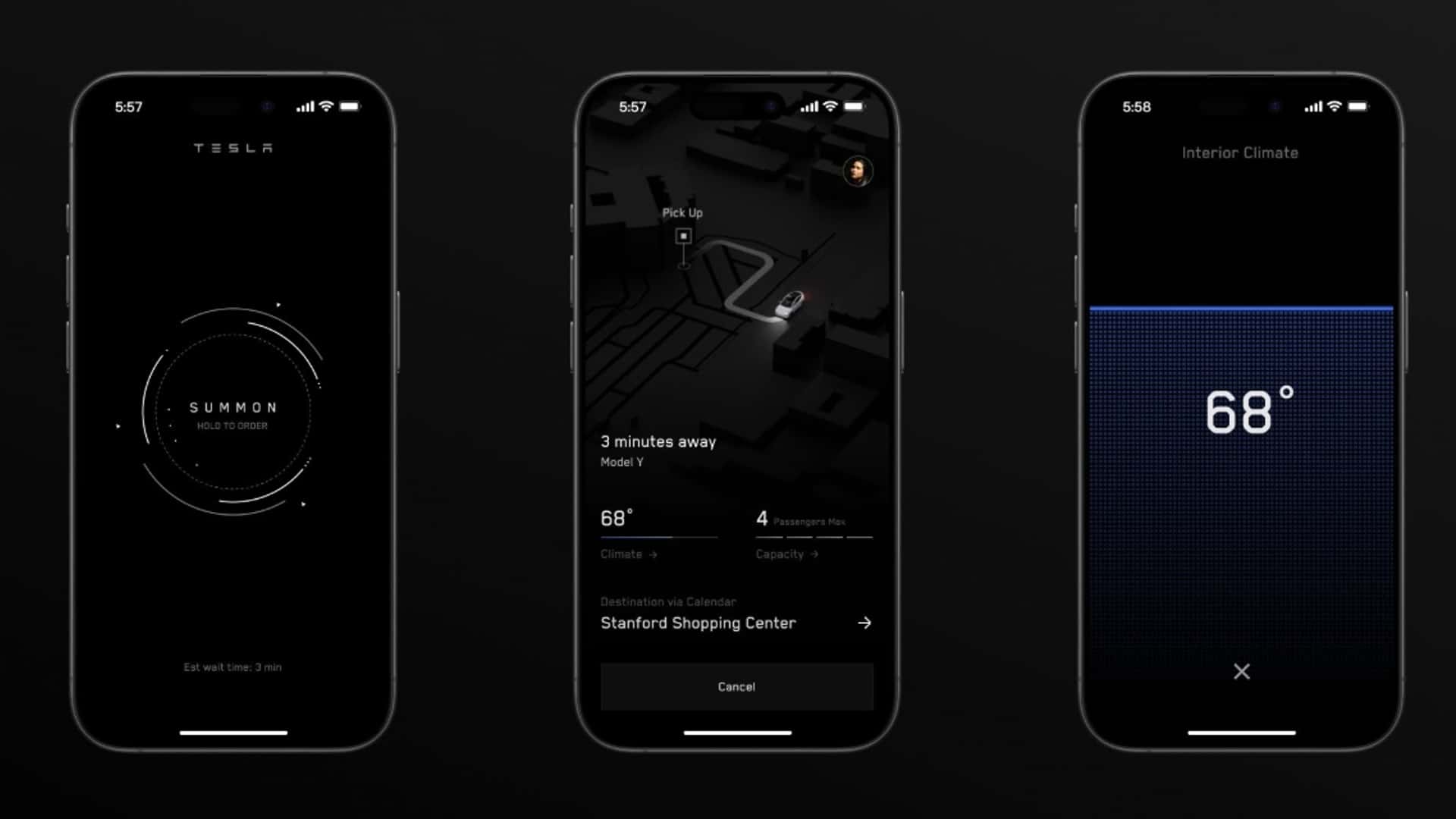
To provide a tangible glimpse into the future, Tesla also published a preview of how its ride-hailing functionality might be integrated into the existing Tesla app. Renderings displayed a prominent “Summon” button, presumably designed for users to hail an autonomous taxi with ease.
Another screen within the preview showed a temperature setting of 68 degrees, hinting at potential in-app climate control capabilities for passengers. While specific details remain scant, these visual cues suggest a focus on seamless user interaction and personalized comfort within the autonomous ride experience.
Strategic Context and Market Dynamics
The latest announcements follow a period of considerable speculation, particularly after a *Reuters* report suggested Tesla had reportedly shelved plans for a more affordable consumer vehicle to prioritize its robotaxi project. This report had generated significant uncertainty regarding Tesla’s immediate product roadmap and future growth trajectory.
However, Tesla’s recent earnings call served to clarify some of these ambiguities. The company stated it is now “accelerating the launch timing of new vehicles, including more affordable models,” while indicating that a dedicated robotaxi product would arrive at a later stage. This revised timeline aims to assuage investor concerns by demonstrating a balanced approach to both consumer vehicle expansion and long-term autonomous mobility solutions.
The Persistent Challenge of Full Self-Driving
Despite the grand pronouncements, the successful deployment of a Tesla robotaxi fleet hinges critically on the company’s ability to deliver on its long-standing promises of full self-driving capabilities. This remains a significant hurdle, as Tesla’s current Full Self-Driving (FSD) feature, despite its advanced nomenclature, still mandates total driver supervision and has been documented to exhibit errors.
Historically, CEO Elon Musk has made ambitious projections regarding autonomous technology, including his famous claim in 2019 that Tesla would have 1 million robotaxis operational by 2020. These past declarations serve as a critical reminder for observers to temper expectations with a dose of realism when evaluating the company’s ambitious autonomous driving timelines.
Future Outlook and Industry Impact
The concept of a Tesla-operated autonomous taxi service is not entirely new, having been a part of Musk’s long-term vision for the company for several years. The recent detailed statements, however, indicate a more concrete, albeit still distant, plan for commercialization.
Should Tesla succeed in deploying a functional and scalable Tesla robotaxi fleet, it could profoundly disrupt the traditional automotive and ride-hailing industries. The integration of electric vehicles with autonomous technology promises not only enhanced convenience but also significant environmental benefits and potential cost efficiencies in urban transportation.
The journey from current FSD capabilities to a fully autonomous, driverless ride-hailing service is fraught with technological, regulatory, and public acceptance challenges. Tesla’s continued investment and iterative development will be closely watched by stakeholders across the global automotive landscape.
FAQ Section
What is Tesla’s robotaxi fleet plan?
Tesla plans to launch a ride-hailing service that combines company-operated autonomous vehicles with privately-owned Tesla cars. CEO Elon Musk described it as a hybrid model akin to ‘Airbnb and Uber,’ offering flexibility for owners to contribute their vehicles and set usage preferences.
When will Tesla’s robotaxi service be available?
While ride-hailing functionality is under active development, Tesla has indicated that the full deployment of its robotaxi fleet is a future prospect. The company confirmed it is also accelerating the launch of more affordable new vehicles alongside the robotaxi project, suggesting the latter is further down the timeline.
How will Tesla owners participate in the robotaxi fleet?
Tesla owners will have the option to add or remove their vehicles from the robotaxi fleet at their discretion. They will also be able to specify usage parameters, such as allowing access only to friends and family, highly-rated users, or the general public, providing a high degree of control.
What technology is Tesla using for its autonomous vehicles?
Tesla is investing in a vision-only architecture, relying on cameras and end-to-end neural networks for its autonomous driving technology. This system is being trained on billions of miles of real-world driving data to achieve scalable and profitable vehicle autonomy without the use of lidar or radar.
What are the main challenges for Tesla’s robotaxi plans?
The primary challenge remains achieving true full self-driving capabilities, which Tesla has pursued for years without fully realizing it. The current Full Self-Driving (FSD) feature requires constant driver supervision. Regulatory approvals, public trust in autonomous technology, and competition from other AV developers also present significant hurdles.
How does this plan affect Tesla’s other vehicle development?
Contrary to earlier reports suggesting a sole focus on robotaxis, Tesla clarified it is accelerating the launch of both new, more affordable consumer vehicles and developing the robotaxi. This indicates a dual strategy to expand its market presence while pursuing long-term autonomous mobility solutions, balancing immediate consumer demand with future innovations.