
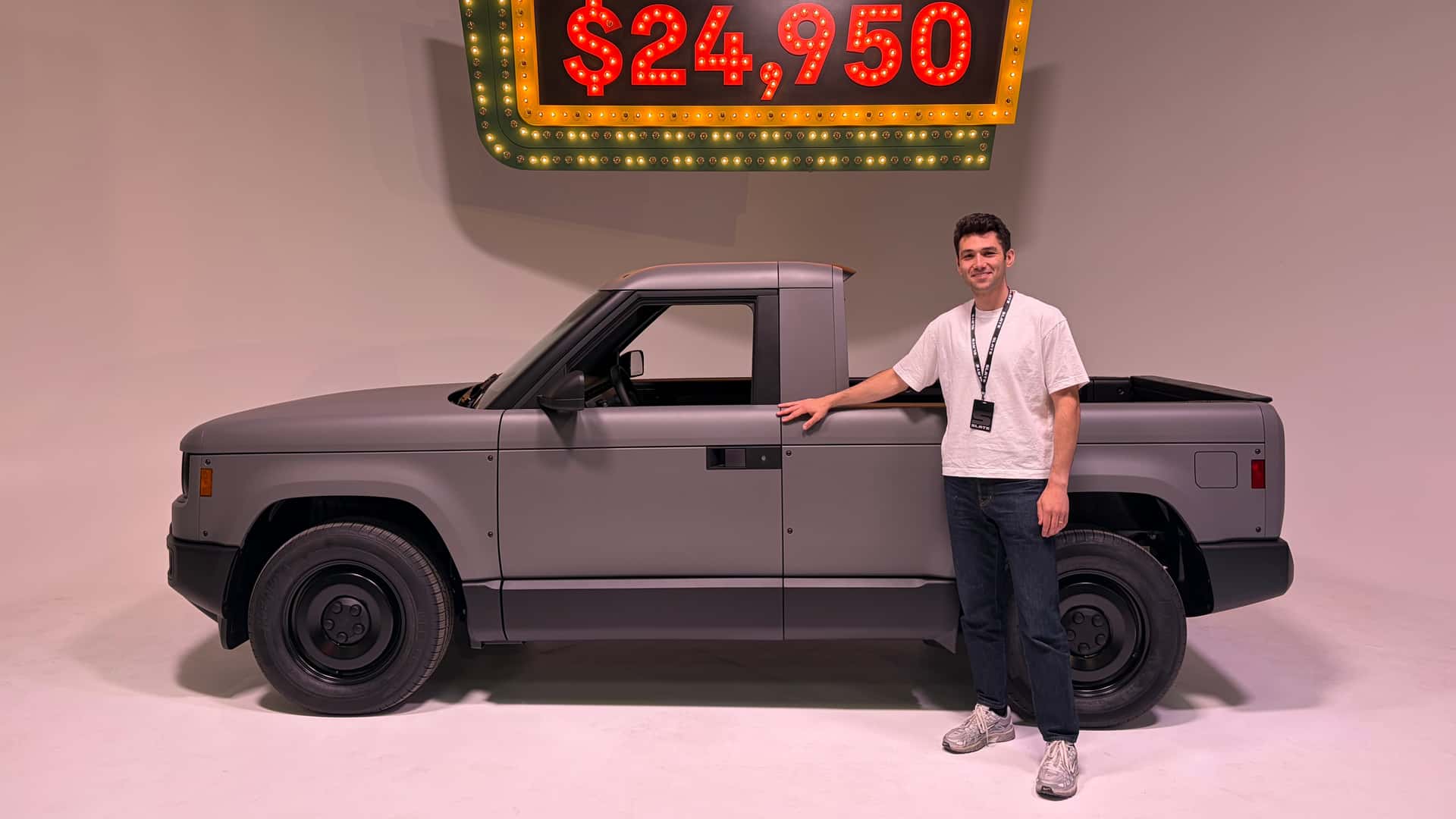
As the electric vehicle (EV) market continues its rapid expansion, new contenders are emerging with strategies to capture diverse segments. Among them, the Slate Truck, an unconventional electric pickup, has generated considerable buzz, primarily due to its aggressive price point of $24,950 and a promised range of 205 miles. With preorders now open and production slated to commence in Indiana during the fourth quarter, the vehicle is drawing closer to American consumers. However, a significant question looms: does its minimalist design and utilitarian interior, featuring amenities like manual windows, compromise its appeal despite the attractive pricing?
To address this crucial query, a recent in-person evaluation of the Slate Truck’s interior, ride quality, and overall feel was conducted in Los Angeles. While the vehicle had been previously unveiled over a year ago, the current iterations showcased a noticeably more refined finish, offering an enhanced opportunity for a thorough assessment.

Key Takeaways:
- The Slate Truck enters the market at an accessible price of $24,950 with a 205-mile range, positioning it as a budget-friendly electric pickup.
- Its compact dimensions, approximately two feet shorter than a Ford Maverick, contribute to a unique, throwback aesthetic reminiscent of older utility trucks.
- The interior is notably minimalist, dominated by hard gray plastic, and eschews modern touchscreens for physical controls and manual windows.
- Despite its basic nature, the cabin offers surprising roominess for occupants over six feet tall and provides practical storage solutions.
- On the road, the Slate Truck delivers a punchy acceleration thanks to its 181-horsepower rear-mounted motor and a surprisingly comfortable ride quality.
- Initial market reception has been strong, with over 10,000 preorders logged within hours of availability, indicating significant consumer interest in an affordable, no-frills EV pickup.
A Closer Look at the Slate Truck’s Design and Dimensions
One of the most immediate aspects distinguishing the Slate Truck from its contemporaries is its remarkably compact footprint. Measuring approximately two feet shorter than a Ford Maverick, the vehicle evokes a sense of nostalgia, recalling the dimensions and straightforward utility of classic pickups such as older Toyota Tacomas or Ford Rangers. This smaller size not only contributes to a distinctive visual identity but also potentially enhances maneuverability in urban environments and tight spaces, areas where larger modern trucks often struggle.
The design philosophy behind the Slate Truck is overtly utilitarian. Its boxy silhouette and unembellished form convey a clear emphasis on functionality over stylistic extravagance. Riding on unassuming steel wheels, the vehicle intentionally foregoes typical automotive flourishes, presenting a rugged and honest aesthetic. Despite this lack of overt styling, the Slate Truck possesses a notable presence and a handsome, almost toy-like quality, scaled up to life-size. This simple, purposeful design might appeal to a segment of buyers seeking authenticity and practicality.

Inside the Cabin: A Study in Simplicity
The interior of the Slate Truck is arguably its most talked-about feature, or rather, its deliberate lack thereof. Upon entry, facilitated by large, user-friendly rectangular door handles, one is greeted by a cabin that shuts with a reassuring thud—a detail often unexpected from an entry-level vehicle. The initial impression inside is one of striking austerity. The predominant material throughout the cabin is hard gray plastic, featuring a subtle texture. While there is a slight visual contrast achieved by using lighter materials for the door panels and dashboard, the overall aesthetic is undeniably sparse, presenting a stark contrast to the more intricate designs found even in a base model Ford Maverick, which commands a slightly higher price point.
Soft-touch surfaces are conspicuously absent, underscoring the Slate Truck’s commitment to basic utility. The steering wheel offers a minimal amount of give, but the cabin largely comprises rigid components. However, this minimalist approach does not equate to a complete lack of fundamental amenities. For instance, a true center console is available as an optional extra for $250, but a molded plastic insert between the seats provides essential cupholders and open storage. A simple glovebox is standard, though a locking mechanism is an additional cost. Crucially, tactile, easy-to-operate knobs for climate controls are integrated, a design choice necessitated by the absence of a central touchscreen. The technological interface is limited to a small screen positioned behind the steering wheel, which displays essential information such as speed and provides a feed for the backup camera.
Customization and Practicality for the Slate Truck
While the base Slate Truck is, without question, austere, a significant aspect of its appeal lies in its extensive customization options. The manufacturer offers a comprehensive array of accessories, allowing buyers to tailor the vehicle to their specific needs and preferences. This approach positions the Slate Truck not as a one-size-fits-all solution, but as a customizable platform that can evolve with the owner’s requirements, potentially mitigating the initial impression of a stripped-out vehicle.
Despite the minimalist interior, the cabin surprises with its generous spatial characteristics. Individuals standing over six feet tall report ample headroom and legroom in the front seats, without feeling constrained or having their knees press against the dashboard. Furthermore, practical storage space is available behind the seats, suitable for items like backpacks. Access to the rear seating area, particularly with the optional $5,000 SUV kit, is facilitated by a cleverly designed front seat that slides significantly forward, enhancing ingress and egress. The rear seat itself is unexpectedly comfortable, contributing to the overall practicality of the Slate Truck for diverse applications.
On the Road: Performance and Comfort Dynamics
The driving experience in the Slate Truck offers several notable attributes. During a brief approximately 10-minute test ride, accompanied by a Slate engineer, the vehicle demonstrated a surprisingly punchy and quick response. While the inherent advantage of instant, low-end torque is characteristic of all electric vehicles, the Slate Truck’s acceleration felt particularly spirited, defying expectations often associated with its modest price point and specifications. Powered by a rear-mounted motor generating 181 horsepower, its performance is likely to exceed the perceptions of many prospective buyers.
Beyond acceleration, the ride quality proved to be robust and composed. It was not characterized by excessive plushness, nor was it unduly harsh. The Slate Truck capably absorbed most road imperfections, delivering a generally comfortable journey. A contributing factor to this comfort was the design of the seats themselves, which were found to be adequately soft and supportive. This combination of responsive performance and a stable, comfortable ride positions the Slate Truck as a capable and surprisingly refined vehicle for its segment, challenging the notion that a budget-friendly EV pickup must compromise on essential driving dynamics.
Market Reception and Future Prospects for the Slate Truck
The viability of the Slate Truck in the American automotive landscape remains a subject of considerable discussion. The balance between its highly competitive price, utilitarian design, and customizable nature is a unique proposition. However, initial market indicators suggest a significant level of consumer enthusiasm. Within mere hours of preorders becoming available, the company recorded an impressive figure of over 10,000 reservations. This rapid uptake underscores a palpable demand for an affordable, straightforward electric pickup, potentially tapping into a segment of buyers underserved by the current, often premium-priced, EV truck offerings.
The decision to employ Lithium Iron Phosphate (LFP) cells in its battery strategy also highlights a focus on cost-efficiency and durability, further enhancing its value proposition. Whether the Slate Truck can sustain this momentum and translate early interest into long-term market success will be a critical observation point for the evolving EV industry. Its ability to carve out a niche by offering an authentic, no-frills electric utility vehicle could set a new benchmark for affordability in the electric pickup segment.
Frequently Asked Questions (FAQ) about the Slate Truck
What is the starting price of the Slate Truck?
The Slate Truck is priced starting at $24,950. This aggressive price point aims to make electric pickup ownership accessible to a broader range of consumers, positioning it as one of the most affordable electric vehicles in the utility segment.
What is the estimated driving range of the Slate Truck?
The Slate Truck is specified to offer an estimated driving range of 205 miles on a single charge. This range is considered suitable for various daily tasks and light-duty commercial applications, catering to a segment focused on practical utility.
When is the Slate Truck expected to begin production?
Production for the Slate Truck is scheduled to commence in the fourth quarter in Indiana. This timeline indicates that the vehicle will soon begin making its way to customers who have placed preorders.
What are some key features of the Slate Truck’s interior?
The interior of the Slate Truck is characterized by its minimalist design, featuring hard gray plastic, manual windows, and tactile climate control knobs instead of a touchscreen. It includes basic amenities like cupholders and a small digital display for essential vehicle information.
How does the Slate Truck perform on the road?
Despite its modest 181 horsepower from a rear-mounted motor, the Slate Truck offers surprisingly punchy acceleration and a solid, comfortable ride quality. It effectively absorbs road imperfections, making for a generally pleasant driving experience.
Can the Slate Truck be customized?
Yes, a key aspect of the Slate Truck’s offering is its extensive list of accessories, allowing for significant customization. Buyers can add various features and kits, such as an SUV kit to create a rear seating area, to tailor the vehicle to their specific needs and preferences.
What is the initial market response to the Slate Truck?
The initial market response has been overwhelmingly positive. The company reported over 10,000 preorders within the first few hours of availability, demonstrating strong consumer interest in an affordable and utilitarian electric pickup option.