
Key Takeaways / Summary (TL;DR):
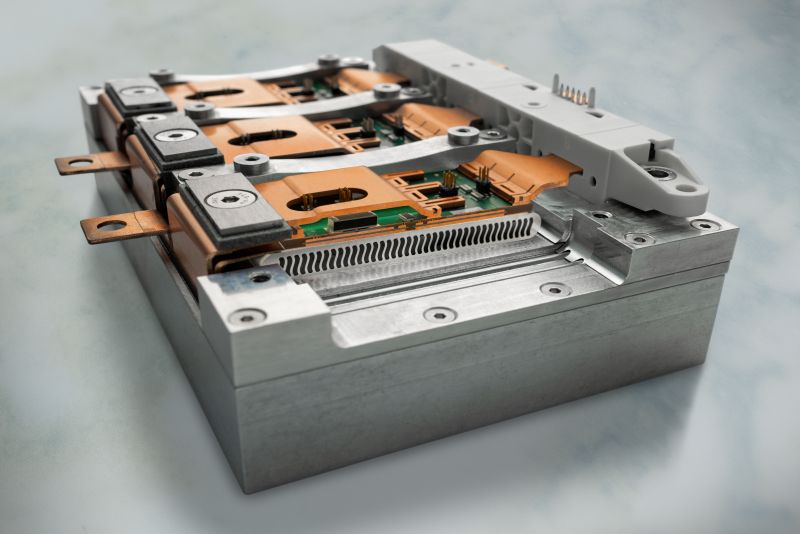
Fraunhofer IZM, in collaboration with Mitsubishi Heavy Industries, has developed a groundbreaking 500-kW silicon carbide (SiC) inverter that sets a new industry standard for electric vehicle (EV) drives. This compact unit, fitting into a mere 1-liter volume, achieves a peak efficiency exceeding 99%. Designed for 800 V DC systems, it delivers 500 A RMS per phase. The inverter integrates embedded SiC MOSFETs, an innovative flat extruded aluminum heat sink, laser-welded busbars, and custom NanoLam DC-link capacitors. These combined advancements result in an exceptional power density, outperforming current top systems by 2.5 times and common alternatives by five times, promising a transformative impact on future electric vehicle performance and design.

Revolutionising Electric Vehicle Power Electronics
The push for greater efficiency, extended range, and faster charging in electric vehicles (EVs) continues to drive innovation in power electronics. Central to an EV’s powertrain is the inverter, a critical component that converts direct current (DC) from the battery into alternating current (AC) to power the electric motor. Achieving high efficiency and power density in this device is paramount for optimizing overall vehicle performance.
In a significant breakthrough, Fraunhofer IZM has engineered a 500-kW inverter that redefines the benchmarks for power density and efficiency. Developed for Mitsubishi Heavy Industries, this pioneering unit is specifically designed for 800 V DC drives, a voltage class increasingly adopted in high-performance EVs for enhanced charging speeds and reduced current losses.
This remarkable SiC inverter for electric vehicles is capable of delivering 500 A RMS per phase, all while occupying an astonishingly small volume of just 1 liter. This translates to an unparalleled power density of 500 kVA per liter, alongside a peak efficiency that surpasses 99%. Such figures represent a substantial leap forward in the field of electric vehicle engineering.

The Core Innovation: A Four-Pillar Approach to Efficiency
Fraunhofer IZM’s unprecedented achievements in this SiC inverter for electric vehicles stem from a meticulously integrated design strategy, built upon four distinct yet highly synergistic technological approaches. Each element has been optimized to minimize losses, enhance thermal management, and reduce the overall physical footprint.
1. Embedded Silicon Carbide MOSFETs and Topology
A cornerstone of this revolutionary design is the innovative approach to power modules. Fraunhofer IZM engineers adopted a two-level half-bridge topology, dedicating one module per phase. Each module integrates twelve cutting-edge silicon carbide (SiC) MOSFETs, which are directly embedded onto the printed circuit board (PCB).
This embedding technique is crucial. By eliminating the conventional component height associated with discrete packages, it drastically reduces parasitic inductance. High parasitic inductance can lead to voltage overshoots and increased switching losses, hindering overall efficiency in a high-performance SiC inverter for electric vehicles.
To further refine performance, an RC snubber circuit is strategically placed between each module and the DC-link capacitor. This vital addition helps dampen oscillations, ensuring smoother operation and enabling the MOSFETs to switch at their physical limits. Faster switching directly translates to lower energy losses and consequently, reduced cooling demands.
The result is an exceptionally low effective inductance of approximately 1 nanohenry. This precision engineering allows the SiC MOSFETs to operate with unprecedented speed and efficiency, making the inverter highly responsive and power-dense for advanced electric vehicles.
2. Advanced Thermal Management System
Effective thermal management is critical for the reliability and longevity of any high-power electronic device, especially a compact SiC inverter for electric vehicles operating at 500 kW. The Fraunhofer IZM team developed an innovative cooling solution to handle the thermal demands of such a power-dense system.
The second key approach involves a flat, extruded aluminum heat sink positioned directly beneath the three power modules. This heat sink is ingeniously designed with more than 40 thin, slightly corrugated channels. This intricate internal geometry significantly increases the surface area available for heat exchange with the coolant.
A notable advantage of this design is that the entire heat sink is produced in a single extrusion step. This manufacturing efficiency not only minimizes production costs but also contributes significantly to the inverter’s compact form factor, aligning perfectly with the goal of a 1-liter package.
3. Optimized Busbar Connections for Reduced Inductance
The third pillar of this high-efficiency design focuses on the busbar connections, which are crucial for conducting high currents with minimal losses and parasitic effects. Conventional busbar connections often rely on screws, which can introduce unwanted space and increase inductance.
Addressing these limitations, Fraunhofer IZM engineers meticulously formed the contacts of the busbars to facilitate direct laser-welding onto the circuit board. Wiljan Vermeer of Fraunhofer IZM’s Power Electronic Systems group explained the strategic advantage: “The contacts of the busbars were formed just so that we could laser-weld them directly onto the circuit board. That means we could get rid of screws that would not only eat up valuable space but increase inductance as well.”
Further refining this approach, the two input busbars are arranged vertically and in close proximity. This deliberate positioning allows their respective magnetic fields to partially cancel each other out, thereby further reducing the overall parasitic inductance within the SiC inverter for electric vehicles.
4. Next-Generation DC-Link Capacitors
The fourth critical element involves the DC-link capacitors, components vital for smoothing voltage ripples and providing local energy storage. Collaborating with PolyCharge, the Fraunhofer IZM team integrated cutting-edge NanoLam capacitors, specifically configured to meet the demanding requirements of this high-performance application.
These specialized capacitors are strategically arranged alongside the busbars, contributing to an impressive total DC-link inductance of just 2 nH with a capacitance of 300 microfarads. NanoLam capacitors, while offering high energy density and compactness, typically produce higher thermal losses compared to conventional types.
To mitigate this challenge, the team implemented copper contacts for enhanced heat dissipation. Additionally, the entire capacitor unit is seamlessly integrated into the casing directly below the aluminum cooler. This intelligent thermal integration ensures that the operating temperature of the capacitors is limited to 130 °C, well within their maximum specified temperature of 150 °C, thereby guaranteeing long-term reliability for the SiC inverter for electric vehicles.
Setting New Standards in Power Density and Performance
The culmination of these four synergistic design approaches has yielded a SiC inverter for electric vehicles that delivers exceptional performance. Fraunhofer IZM asserts that the resulting unit significantly outperforms existing alternatives in the market, demonstrating its groundbreaking nature.
Specifically, the new inverter exceeds common inverter alternatives by five times in terms of power density. Furthermore, it outpaces current top-tier systems by a factor of 2.5. These metrics underscore a monumental achievement in compact power electronics, poised to redefine electric vehicle powertrain design.
The implications for the EV industry are substantial. A more compact, lighter, and vastly more efficient SiC inverter for electric vehicles can lead to smaller battery packs for the same range, or significantly extended range for existing battery sizes. It also contributes to higher power delivery for superior acceleration and potentially faster charging capabilities due to reduced thermal constraints.
Looking Ahead: Global Presentation and Industry Impact
This innovative SiC inverter for electric vehicles is not just a laboratory marvel; it represents a tangible advancement ready for industry adoption. The details of this breakthrough technology are set to be unveiled to a global audience.
Wiljan Vermeer of Fraunhofer IZM will formally present the new inverter at the prestigious PCIM Europe event, scheduled to take place in Nuremberg from June 9–11. This presentation will offer a deeper insight into the engineering marvel and its potential to shape the next generation of electric mobility solutions.
This development by Fraunhofer IZM and its partners marks a pivotal moment in the evolution of electric vehicle technology, pushing the boundaries of what is possible in power electronics and paving the way for even more efficient, powerful, and sustainable transportation.
Source: Fraunhofer IZM
Frequently Asked Questions (FAQ)
What is a SiC inverter for electric vehicles and why is it important?
A SiC (Silicon Carbide) inverter converts DC battery power to AC for EV motors, using SiC semiconductors. SiC offers superior performance over traditional silicon at high temperatures and frequencies, leading to higher efficiency, smaller size, and lighter weight in electric vehicles. This directly improves range, charging speed, and overall vehicle performance.
What makes Fraunhofer IZM’s new inverter so efficient and compact?
Its groundbreaking performance stems from four integrated approaches: embedded SiC MOSFETs on the PCB to reduce parasitic inductance, an innovative extruded aluminum heat sink for superior thermal management, laser-welded busbars for compact, low-inductance connections, and custom NanoLam DC-link capacitors that are highly integrated and thermally optimized.
What is parasitic inductance and why is it a challenge in power electronics?
Parasitic inductance refers to unintended inductance present in circuit components and traces. In high-frequency, high-current applications like EV inverters, it causes voltage overshoots, increased switching losses, and electromagnetic interference. Fraunhofer IZM’s design minimizes this through embedding, optimized busbars, and snubber circuits.
How does the new inverter compare to existing EV inverter technologies?
Fraunhofer IZM states their SiC inverter for electric vehicles significantly outperforms current systems. It achieves five times the power density of common inverter alternatives and is 2.5 times more power-dense than even the current top-tier systems available in the market. This sets a new benchmark for compact, high-power EV solutions.
What are NanoLam capacitors and why were they chosen for this application?
NanoLam capacitors are a type of film capacitor known for their high energy density and compact size, making them ideal for space-constrained applications. They were selected for this SiC inverter for electric vehicles to achieve high capacitance within the minimal volume, and were customized and thermally integrated to manage their higher inherent thermal losses effectively.
What are the benefits of an 800 V architecture in electric vehicles?
An 800 V architecture allows for significantly faster charging times and improved efficiency due to lower current flow for the same power output. This reduces heat generation and cable thickness, leading to lighter wiring and greater overall system efficiency. It is a key enabler for next-generation high-performance and long-range EVs.
When and where will this new inverter be presented?
The technical details and capabilities of this innovative SiC inverter for electric vehicles will be officially presented by Wiljan Vermeer of Fraunhofer IZM’s Power Electronic Systems group at the PCIM Europe trade fair. The event is scheduled to take place in Nuremberg from June 9–11.