
Key Takeaways:
- UK food wholesaler Bidfood has initiated the electrification of its Slough depot, installing an overhead charging system supplied by DC fast charger manufacturer Kempower.
- The project, designed and delivered by Erinion (a Scania group specialist), addresses the critical challenge of electrifying existing logistics hubs without sacrificing valuable ground space.
- The system, featuring four Kempower Control Units and Cable Arms, enables electric trucks to charge at up to 160 kW during standard loading times, supported by a single 600 kW Kempower Power Unit.
- This innovative solution provides a scalable blueprint for Bidfood’s wider fleet electrification plans, aligning with the UK government’s 2035/2040 HGV emissions targets.
Bidfood, a prominent UK food wholesaler, has taken a significant step towards decarbonising its extensive fleet by electrifying its Slough depot. The company has deployed an innovative overhead charging system from Kempower, a leading manufacturer of DC fast chargers, marking a crucial milestone in its transition to electric heavy goods vehicles (HGVs).

This strategic infrastructure upgrade at Bidfood’s Slough facility, which serves as a vital distribution hub for Greater London and the Thames Valley, underscores the increasing urgency for logistics operators to adapt to stricter emissions regulations and embrace sustainable transport solutions. The project was meticulously designed and executed by Erinion, a specialist in depot charging solutions within the Scania group and a key sales and service partner for Kempower.
UK’s Drive Towards Fleet Electrification
The electrification of commercial vehicle fleets in the United Kingdom is rapidly gaining momentum, propelled by ambitious government targets aimed at reducing road transport emissions. The UK government has mandated the phasing out of sales for new oil-burning HGVs weighing up to 26 tonnes by 2035, extending this ban to all new HGVs by 2040.
These stringent deadlines place considerable pressure on transport and logistics operators like Bidfood, who manage vast fleets across the country. Bidfood alone operates more than 1,200 trucks throughout the UK, highlighting the sheer scale of the electrification challenge and the imperative for practical, scalable charging solutions.
Overcoming Depot Electrification Challenges
One of the primary hurdles in electrifying existing logistics hubs is the inherent design of these facilities. Many depots were not originally conceived with the extensive spatial and power requirements of large-scale EV charging in mind. Traditional ground-mounted charging stations can occupy valuable yard space, disrupt operational workflows, or necessitate costly structural reconfigurations.
This is where innovative solutions like Kempower’s overhead charging infrastructure become indispensable. By leveraging vertical space, these systems allow electric trucks to charge efficiently during loading and unloading stops without encroaching on critical ground-level operational areas, thus preserving the depot’s existing footprint and operational efficiency.
Kempower’s Advanced Overhead Charging Solution at Slough
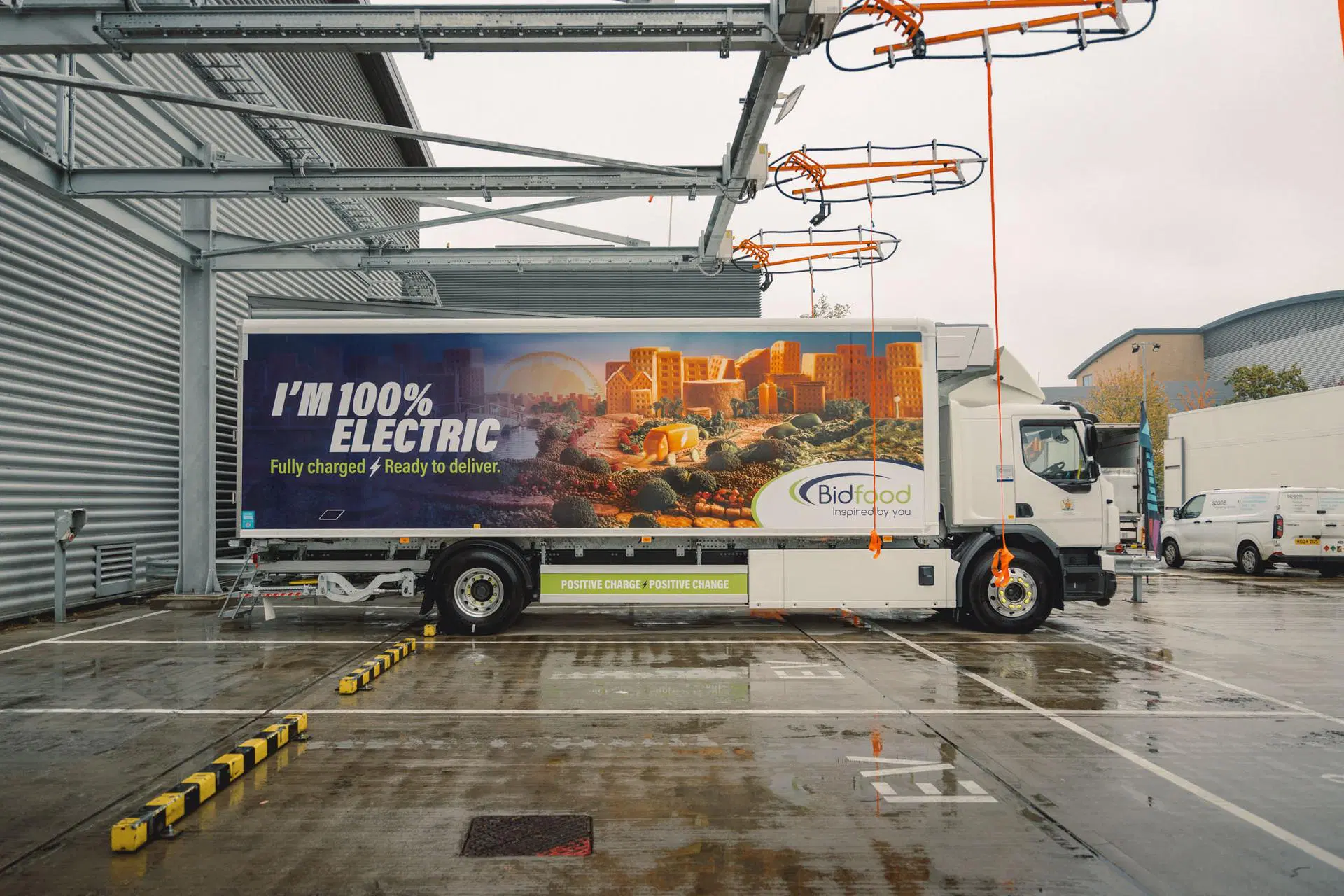
At Bidfood’s Slough depot, the initial phase of electrification focuses on accommodating two currently operational electric trucks. Kempower supplied the foundational infrastructure for four dedicated charging bays strategically positioned at the depot’s loading docks. This setup allows for immediate charging capabilities while providing room for future expansion.
The core of the system comprises four Kempower Control Units, specifically engineered for heavy-duty applications. These units are intelligently installed overhead using a robust gantry system. Complementing these are Kempower Cable Arms, which enable drivers to easily access the charging plugs from above, streamlining the connection process and enhancing safety.
Dynamic Power Management for Optimal Efficiency
The charging bays at Slough are powered dynamically by a single, high-capacity 600 kW Kempower Power Unit. This sophisticated power management system allows each Control Unit to deliver up to 160 kW of charging power. Such substantial power output is critical for commercial vehicle operations, ensuring rapid energy replenishment.
This configuration enables electric trucks to undergo significant recharges during typical loading windows, which often range from 45 minutes to two hours. The ability to charge efficiently during these inherent operational pauses eliminates the need for additional, dedicated charging stops, thereby maintaining Bidfood’s tight delivery schedules and operational profitability.
Industry Insights and Future Prospects
Faye Reeve, Head of Non-Inventory Procurement at Bidcorp UK, Bidfood’s parent company, highlighted the strategic importance of this infrastructure. “We have been exploring the transition of our fleet for some time, but it was important to find infrastructure and a setup that complemented our operations,” Reeve stated. “Our first charging system allows us to continue operating in the same way, just as efficiently and profitably as before, and it has given us a blueprint for the next phases of our electrification plan.”
This sentiment underscores the practical considerations fleet operators face: maintaining operational continuity and profitability while integrating new, sustainable technologies. The Slough project demonstrates a viable pathway for large-scale logistics firms.
Jack Smith, Erinion’s Country Manager for the UK, further emphasised the innovative approach and scalability of the solution. “Operators in the UK are asking: How do we charge our trucks without giving up yard space? Slough shows it can be done within an existing footprint,” Smith commented. He added, “We designed the gantry as a modular system so Bidfood can add charging bays as the fleet grows without starting over. We look forward to bringing that experience to more depots in the UK.”
A Modular and Scalable Electrification Blueprint
The modular design of the gantry system is a critical feature, offering Bidfood a future-proof solution. As the wholesaler’s electric truck fleet inevitably expands, additional charging bays can be seamlessly integrated without requiring a complete overhaul of the existing infrastructure. This inherent scalability minimises future disruption and capital expenditure, making the electrification process more manageable and cost-effective over the long term.
This project serves as a compelling case study for other logistics and commercial vehicle operators in the UK and beyond, demonstrating how sophisticated charging infrastructure can support the transition to electric fleets even in space-constrained, high-intensity operational environments. The collaboration between Bidfood, Kempower, and Erinion sets a precedent for sustainable transport within the food distribution sector.
The Broader Impact on Sustainable Logistics
The successful deployment of Kempower’s overhead charging infrastructure at Bidfood’s Slough depot is more than just a technological achievement; it represents a significant stride towards creating a more sustainable and resilient supply chain. By electrifying its operations, Bidfood contributes directly to reducing carbon emissions and improving air quality, particularly in urban areas served by its distribution network.
As the electric commercial vehicle market matures, such innovative charging solutions will be pivotal in accelerating the adoption of zero-emission trucks. They provide the necessary reliability, efficiency, and scalability that large-scale fleet operators demand, ensuring that the transition to electric vehicles is not only environmentally responsible but also economically viable.
FAQ Section
What type of charging system has Bidfood installed at its Slough depot?
Bidfood has installed an overhead DC fast charging system provided by Kempower. This system is designed to save ground space in busy logistics depots while efficiently charging electric heavy goods vehicles.
Who designed and delivered the EV charging project for Bidfood?
The electric vehicle charging project at Bidfood’s Slough depot was designed and delivered by Erinion, a specialist in depot charging solutions within the Scania group, and a strategic partner of Kempower.
What are the UK government’s targets for electrifying heavy goods vehicles (HGVs)?
The UK government aims to phase out sales of new oil-burning HGVs weighing up to 26 tonnes from 2035, and extend this ban to all new HGVs by 2040, driving fleet operators towards electrification.
How much charging power can the Kempower system deliver per bay?
The Kempower system at Bidfood’s depot is configured to deliver up to 160 kW of charging power per bay. The entire system is powered by a single 600 kW Kempower Power Unit, distributing power dynamically.
What is the key benefit of an overhead charging system for a logistics depot?
The primary benefit of an overhead charging system for a logistics depot is its ability to enable electric trucks to charge during loading stops without using valuable ground space for charging equipment, thereby preserving operational flow and efficiency.
Is the installed charging infrastructure scalable for future growth?
Yes, the gantry system supporting the overhead chargers is designed to be modular. This allows Bidfood to easily add more charging bays as its electric fleet expands, without needing to completely rebuild the infrastructure.