
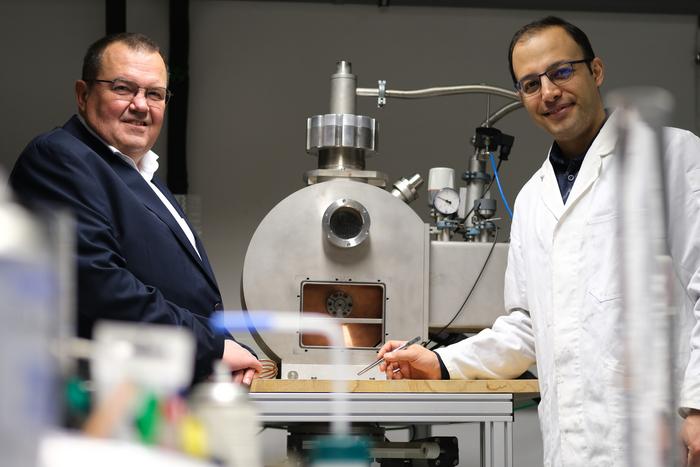
Researchers at Saarland University have developed a groundbreaking approach to electric motor design, utilizing 3D-printed metallic glass components to significantly reduce energy loss. This innovative technique targets the core issue of iron losses, a major inefficiency in conventional electric motors, by eliminating the crystalline structures that impede magnetic performance.
Innovating with Metallic Glasses in Electric Motors
The project centers on replacing the traditional coarse-grained crystalline iron alloys found in the stators and rotors of electric motors. Instead, the Saarland team is employing iron-rich amorphous alloys, commonly known as metallic glasses. These materials contain a high percentage of iron, ranging from 70% to 80%.

Professor Ralf Busch explained the fundamental problem with conventional motors: as magnetic fields repeatedly reverse direction, microscopic magnetic domains within the material’s crystal lattice are forced to reorient. This process generates significant friction and heat, leading to what are known as hysteresis losses.
In contrast, the metallic glasses developed by the researchers lack this crystalline microstructure. This absence of rigid crystal boundaries allows the magnetic regions to reorient much more freely and with less resistance. The researchers report that this enhanced mobility dramatically reduces iron losses and the associated heat generation within the motor.
Additive Manufacturing Enables Amorphous Component Production
A key aspect of this innovation is the ability to produce these specialized materials using additive manufacturing, specifically laser powder bed fusion. This advanced 3D printing technique involves melting fine metallic powder with a laser and building the component layer by layer.

The process allows for the creation of fully amorphous motor parts with layer thicknesses of approximately 50 micrometers. Crucially, this method avoids the formation of disruptive crystallites, ensuring the material retains its beneficial amorphous structure throughout the component. This precision in manufacturing is vital for achieving the desired magnetic properties.
The team has successfully identified three distinct alloy compositions that not only resist crystallization during processing but also meet the stringent requirements for both additive manufacturing and practical use in electric motors. This rigorous selection process ensures the viability and performance of the new components.
Potential Applications and Environmental Benefits
The implications of this research extend to a wide range of electric drive applications. The improved efficiency and reduced heat generation make these components particularly suitable for devices such as e-scooters, drones, and other small electric drives where size, weight, and energy consumption are critical factors.
Furthermore, this technological advancement offers a significant environmental advantage. The new alloys can be produced without relying on critical alloying elements like cobalt, a material often used in high-performance magnets but which faces supply chain and ethical concerns. This reduces reliance on scarce resources and promotes more sustainable manufacturing practices.
Scaling Up and Future Challenges
While the laboratory results are promising, the researchers acknowledge the next crucial phase involves scaling up the technology for industrial application. Professor Matthias Nienhaus highlighted the ongoing challenge: “The challenge now is to develop the process so that it works reliably in practice and at industrial scale.”
Successfully transitioning from laboratory prototypes to mass production requires further refinement of the manufacturing processes to ensure consistency, cost-effectiveness, and reliability at high volumes. This phase will likely involve close collaboration between research institutions and industry partners.
Project Funding and Industry Collaboration
This pioneering work is being conducted under the €3.5-million AM2SoftMag project. The initiative is generously funded by the European Innovation Council’s Horizon Europe Pathfinder Open program, underscoring the significant interest and investment in advancing next-generation electric motor technology.
Heraeus AMLOY, a key industry partner, is playing a vital role in the project by handling the specialized 3D printing of the magnetic components. This collaboration between academia and industry is essential for bridging the gap between research discoveries and real-world implementation, accelerating the adoption of these efficiency-boosting technologies in the electric vehicle sector and beyond.