
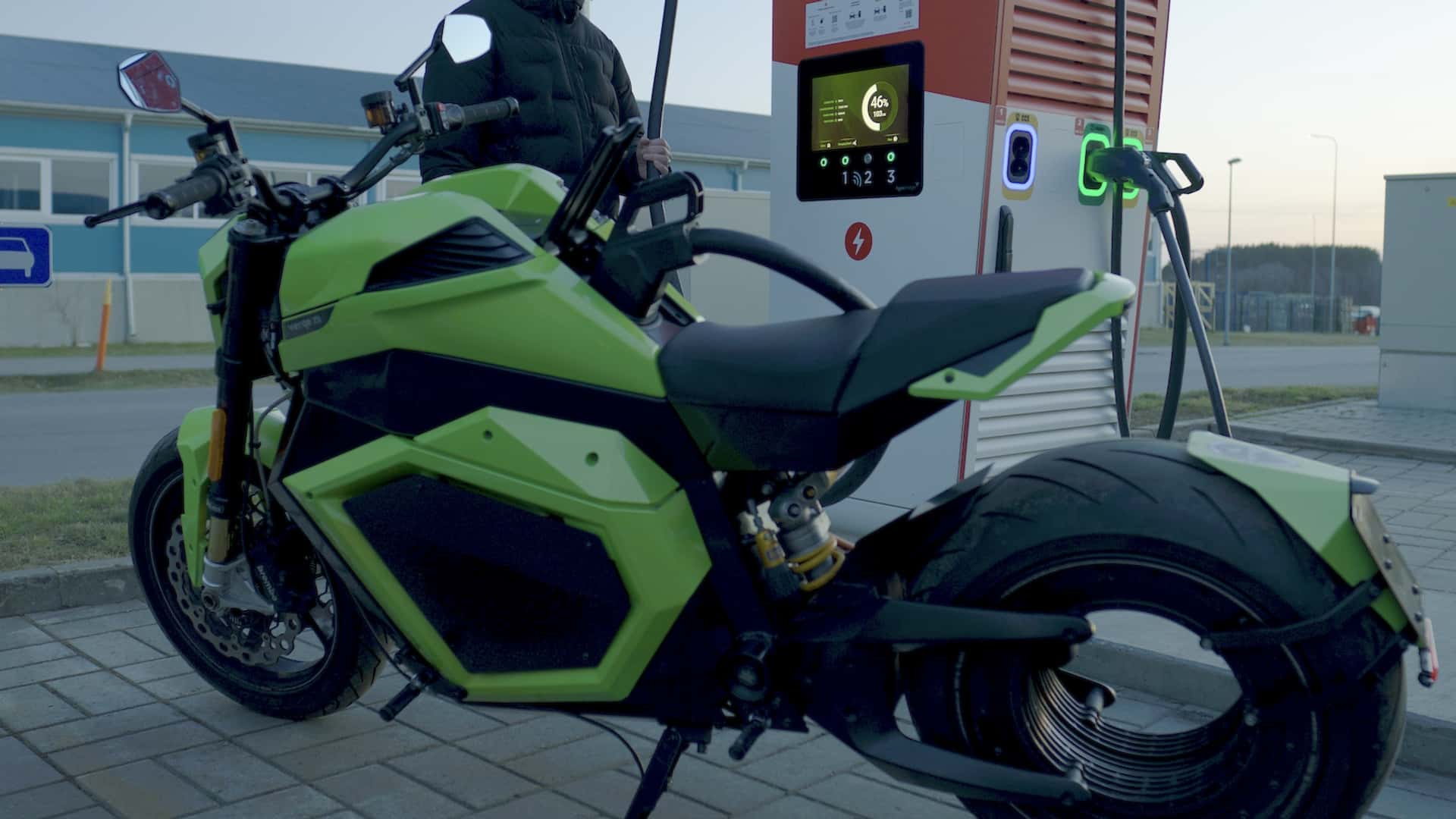
The ongoing saga of Donut Lab’s claimed solid-state battery breakthrough has entered a new phase, moving beyond controlled laboratory environments to a live charging demonstration on an actual electric vehicle. The Finnish startup is set to supply its innovative battery technology to Verge Motorcycles, with production packs slated for delivery starting this spring.
First Public Charging Test for Solid-State Technology
Previously, Donut Lab’s advancements were primarily showcased through tests on individual battery cells in a lab setting. However, a recent event saw a Verge TS Pro test vehicle, equipped with what is claimed to be an 18 kWh (nominal) solid-state battery pack, connected to a public DC fast-charging station. This demonstration offered the first glimpse into the battery’s performance outside the lab.
The Verge TS Pro is projected to achieve an estimated range of 217 miles on a full charge. The unique aspect of this solid-state battery, according to Donut Lab CEO Marko Lehtimaki, is its ability to achieve an “industry-defining 5C charging rate at the pack level, while only shockingly having air cooling.” A 5C charging rate theoretically allows a battery to reach full capacity in approximately 12 minutes, a significant acceleration compared to conventional charging times.
Understanding Charging Rates and Cooling Systems
To clarify the charging rate terminology, a 1C rate signifies a full charge within one hour. Consequently, a 5C rate implies a full charge in one-fifth of that time, or roughly 12 minutes. This rapid charging capability, especially when combined with a seemingly simple air-cooling system, sets Donut Lab’s technology apart from current industry standards.
Modern electric vehicles typically rely on sophisticated liquid cooling systems, often supplemented by air cooling, to manage the considerable heat generated during fast charging and intense performance. The claim of effective air cooling for a high-performance battery pack is notable, as it could simplify thermal management and potentially reduce vehicle weight and complexity.

Performance Metrics During the Charging Test
During the demonstration, the Verge TS Pro test mule began charging at a state of charge of 9%. It rapidly drew approximately 103 kilowatts (kW) of power. While modern electric cars in the U.S. can achieve higher charging speeds, exceeding 100 kW is a substantial figure for electric motorcycles, which often face packaging constraints that limit thermal management solutions.
The charging power of over 100 kW is also noteworthy for a relatively small battery pack compared to those found in cars. Smaller battery packs typically have fewer cells to distribute the charging current, making them more sensitive to high current loads which can impact lifespan. Packaging limitations and lower voltage systems are also common considerations for motorcycle batteries.
It is important to note that the observed 103 kW charging power is roughly half of the 200 kW peak power Donut Lab had claimed at CES. It remains unclear whether this difference is attributable to limitations of the charging station, the motorcycle’s architecture, or other factors.
The charging progress showed promising results: the motorcycle reached approximately 50% state of charge in just five minutes, adding about 7 kWh of energy. By the 12-minute mark, it had reached 80% state of charge, having gained roughly 13 kWh in total. Donut Lab emphasized that this was achieved solely with air cooling, utilizing two fans directed over heat sinks on either side of the battery pack.
Comparison with Conventional EV Charging Speeds
For comparative purposes, a similarly sized lithium-ion battery pack in the previous generation of the Verge TS Pro reportedly takes around 35 minutes to charge from 0% to 80%, according to independent assessments. Similarly, the LiveWire One, Harley-Davidson’s electric motorcycle, requires about 40 minutes to reach 80% state of charge when using a fast charger.
If Verge Motorcycles can replicate these charging speeds in its production models, it could provide a significant competitive advantage in the rapidly evolving electric motorcycle market. The potential for rapid recharging could alleviate range anxiety and improve the overall user experience for electric two-wheelers.
Lingering Questions and Future Prospects
Despite these encouraging real-world charging demonstrations, several critical questions surrounding Donut Lab’s technology persist. The company continues to be guarded about the specific chemistry of its solid-state battery. Furthermore, concrete evidence or validation for the ambitious claim of 100,000 charging cycles remains elusive.
Donut Lab initially garnered significant attention at CES with claims of 400 watt-hours per kilogram (Wh/kg) energy density and the elimination of rare-earth materials. However, these assertions faced skepticism from industry experts and executives due to a perceived lack of verifiable proof, patents, or independent validation results. While the company has since released some third-party test data, it has not yet conclusively confirmed the battery chemistry as truly solid-state or substantiated the claimed energy density figures.
Previous lab tests did demonstrate rapid charging capabilities and the survival of single cells at high temperatures (100 degrees Celsius), also confirming it was not a supercapacitor. Yet, these tests were conducted at the cell level, not the pack level on a vehicle, leaving room for questions about scalability and real-world integration.
The company has acknowledged that the Verge test motorcycle may not represent the final production version. “Verge is doing system-level optimization and fine-tuning the charge profile on this new battery pack,” Lehtimaki stated. This suggests that further adjustments are being made to ensure optimal performance and longevity.
As deliveries of Verge Motorcycles are set to commence soon, the industry and potential customers will be watching closely. It is anticipated that curious owners and independent testers may eventually disassemble the motorcycles to gain a clearer understanding of the internal technology, potentially shedding light on the remaining uncertainties surrounding Donut Lab’s solid-state battery.