
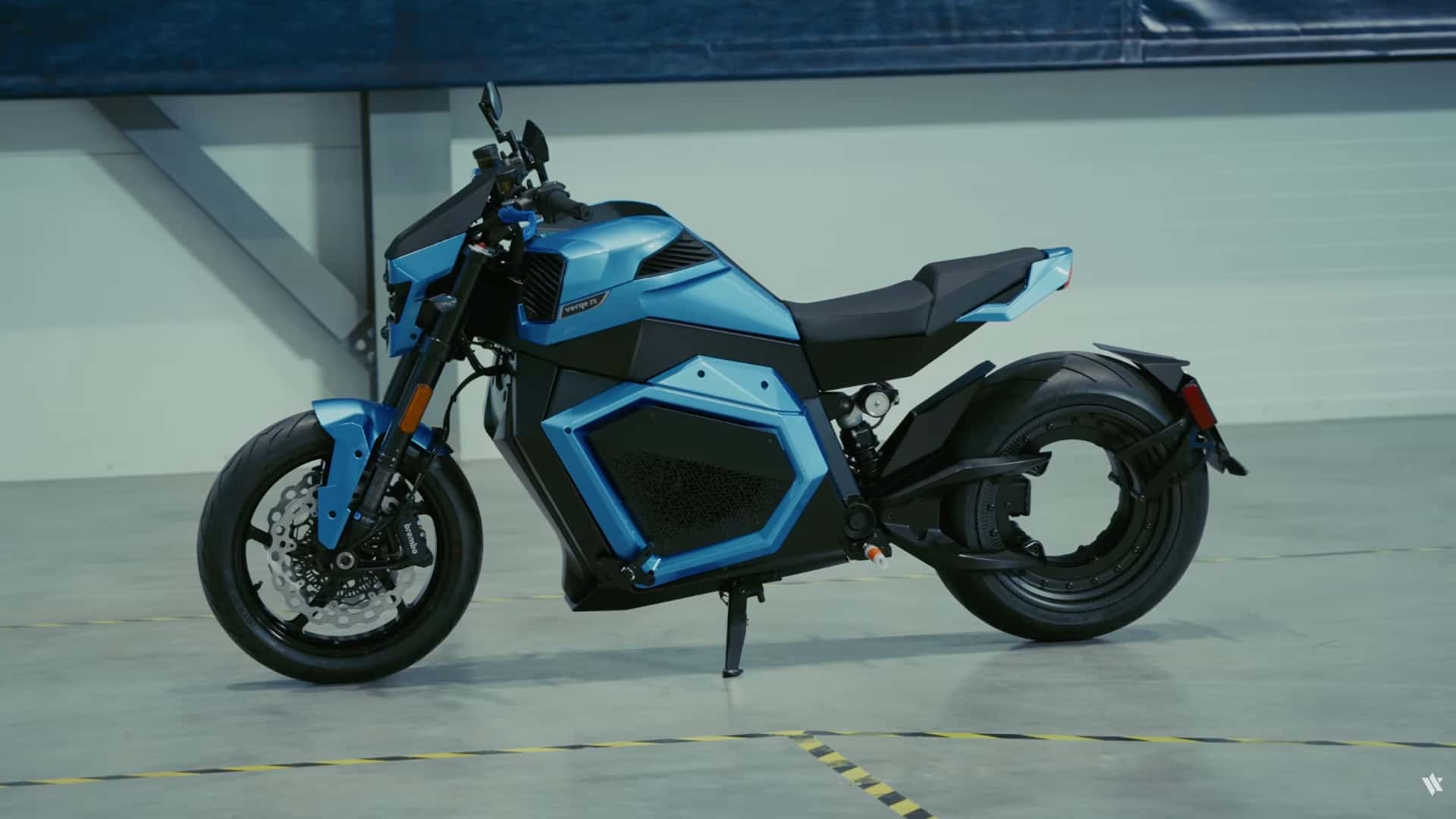
Estonian manufacturer Verge Motorcycles has announced the commencement of production for what it asserts is the world’s first motorcycle powered by an all-solid-state battery. This landmark vehicle, the second-generation TS Pro, integrates advanced solid-state battery technology developed by Finnish startup Donut Lab, marking a potentially pivotal moment in the evolution of electric vehicles.
Should these claims be substantiated, the Verge Motorcycles TS Pro would not only represent a significant breakthrough for the two-wheeler segment but would also stand as the inaugural production electric vehicle of any kind to feature an all-solid-state battery pack. This development could herald a new era for electric mobility, addressing long-standing challenges associated with conventional lithium-ion batteries.

The Dawn of Solid-State Mobility
For years, solid-state battery technology has been lauded by researchers and industry experts as the ‘holy grail’ of energy storage. Its promise extends beyond mere incremental improvements, offering potential solutions to critical concerns such as range anxiety, extended charging times, and battery safety. The underlying principle of solid-state batteries, which replaces liquid electrolytes with solid ones, is expected to enhance energy density, improve longevity through a greater number of charging cycles, and mitigate fire risks inherent in current battery designs.
The pursuit of viable solid-state battery technology has seen considerable investment and research from global automotive giants including Toyota, CATL, and Samsung. Despite intensive efforts, scaling production of these advanced batteries without encountering defects has proven to be extraordinarily difficult, preventing widespread commercialisation until now. This challenge underscores the significance of Verge Motorcycles’ and Donut Lab’s announcement, if their claims are fully realised.
Unpacking Solid-State Battery Technology
Traditional lithium-ion batteries rely on a liquid or gel electrolyte to transport ions between the electrodes. Solid-state batteries, by contrast, utilise a solid electrolyte, which offers several theoretical advantages. These include higher energy density, allowing for smaller, lighter battery packs that can store more power. Furthermore, the absence of flammable liquid electrolytes intrinsically enhances safety, a critical factor for both consumer confidence and regulatory approval.

Another compelling aspect of solid-state battery technology is its potential for a vastly extended cycle life, meaning batteries could endure tens of thousands of charge and discharge cycles before significant degradation. This would translate into vehicles with much longer operational lifespans and reduced environmental impact from battery replacement. Such advancements are crucial for the long-term sustainability and mass adoption of electric vehicles.
The Manufacturing Conundrum
Despite the immense promise, the path to commercialising solid-state batteries has been fraught with difficulties. Manufacturing at scale demands precision and consistency that have largely eluded developers. Issues such as maintaining interfacial contact between the solid electrolyte and electrodes, preventing dendrite formation, and ensuring cost-effective production have presented significant hurdles. These complexities explain why, despite various functional solid-state test beds—such as a Ducati reportedly powered by QuantumScape cells unveiled last year—no manufacturer has yet managed to sell a vehicle equipped with all-solid-state cells to the general public.
Verge Motorcycles’ Bold Leap
The announcement from Verge Motorcycles centres on their collaboration with Donut Lab, a Finnish startup that made waves at CES earlier this year. Donut Lab had claimed to have developed the world’s first production-ready all-solid-state battery, presenting figures that, at the time, appeared to be revolutionary. These included an energy density of 400 Wh/kg, an astonishing 100,000 charging cycles, zero reliance on rare-earth materials, and the ability to achieve a full charge in a mere five minutes.
Donut Lab’s Ambitious Claims
To contextualise Donut Lab’s initial assertions, the most advanced mainstream electric vehicle batteries currently available typically offer an energy density in the range of 200-250 Wh/kg. Even cutting-edge electric cars from manufacturers like BYD in China, known for their megawatt charging capabilities, do not achieve a full 0-100% charge in just five minutes. Such stark differences naturally led to immediate skepticism from industry experts, particularly given the lack of independent data to support Donut Lab’s initial pronouncements.
Following the initial skepticism, Donut Lab has since released some independent test results. However, these results have not disclosed crucial details regarding the battery’s underlying chemical composition or its precise cycle life performance, leaving certain key aspects of the technology’s viability unconfirmed. Nevertheless, Donut Lab had committed to having its cells integrated into production motorcycles by the close of the first quarter, a timeline Verge Motorcycles appears to have met with the TS Pro.
Performance and Market Positioning of the TS Pro
The new Verge TS Pro will be available in two distinct variants, each designed to cater to different range requirements while showcasing the purported benefits of the solid-state battery technology. Both variants integrate the company’s signature hubless rear-wheel motor, a distinctive design element that contributes to its unique aesthetic and performance characteristics.
Range, Charging, and Power
The Standard Battery version of the TS Pro features a 20.2 kWh capacity, with 17 kWh being usable, providing a manufacturer-estimated range of 217 miles. For riders seeking extended travel capabilities, the Large Battery variant steps up to a formidable 33.3 kWh capacity, with 30 kWh usable, translating to an impressive estimated range of 370 miles. While the range of the standard pack is comparable to its predecessor, the first-generation lithium-ion model, the significant distinction of the second-gen bike lies in its purported charging speed.
The first-generation TS Pro could charge from 20% to 80% in approximately 35 minutes. The new solid-state powered model promises a drastically reduced charging time, achieving a 10% to 80% charge in roughly 12 minutes. This remarkable improvement is underpinned by Verge’s claim of a peak charging rate of 200 kW, a figure that is unusually high for a motorcycle with a relatively compact battery pack. If this performance is validated in real-world testing scenarios, it would indeed mark a genuinely impressive leap forward in electric motorcycle charging infrastructure and convenience.
Beyond range and charging, the performance specifications of the TS Pro are equally compelling on paper. Both variants are capable of delivering a substantial 737 pound-feet of torque, courtesy of the innovative hubless rear-wheel motor. This robust power delivery enables the motorcycle to accelerate from 0 to 60 miles per hour in a swift 3.5 seconds, placing it firmly in the realm of high-performance electric motorcycles.
Pricing and Availability
The Verge TS Pro will carry a starting price of $29,990 in the U.S., exclusive of applicable taxes and fees. Opting for the larger battery variant will incur an additional cost of $5,000, bringing the price up for extended range capabilities. A reservation fee of $100 is required to secure an order for this groundbreaking electric motorcycle. Verge Motorcycles communicated in February that deliveries for early reservation holders were scheduled to commence in the first quarter of the year. For new orders placed currently, customers can anticipate a waiting period stretching until the end of the year, reflecting the strong interest and production ramp-up for this novel vehicle.
Industry Scrutiny and Future Prospects
The electric vehicle industry, particularly the segment focused on advanced battery technology, remains keenly observant of these developments. The claims made by Verge Motorcycles and Donut Lab, while ambitious, hold the potential to redefine expectations for EV performance and practicality. However, the lack of complete transparency regarding Donut Lab’s battery chemistry and full cycle life data means that the broader industry and consumers alike will be looking for further independent verification.
The forthcoming real-world usage and independent testing of customer bikes will be crucial in validating the impressive performance figures and technological claims. Such verification is essential to build lasting trust and confidence in this novel solid-state battery technology. The successful deployment and sustained performance of the Verge TS Pro could catalyse a broader shift towards solid-state solutions across the entire electric vehicle market, from motorcycles to passenger cars and beyond.
As Verge Motorcycles begins to roll out its solid-state electric motorcycle, the world watches with anticipation. The integration of solid-state battery technology into a production vehicle represents a significant milestone, one that could profoundly impact the future trajectory of electric mobility. The coming months will undoubtedly provide more clarity on whether this bold claim truly ushers in the ‘holy grail’ of battery technology for the mass market.