
Key Takeaways:
- Toyota’s Woven City, near Mount Fuji, is an innovative ‘living laboratory’ dedicated to testing future mobility and smart city technologies.
- Six years after its announcement, the city has opened its first phase, currently inhabited by 100 Toyota-affiliated ‘Weavers’.
- Despite its futuristic vision, Woven City is acknowledged by Toyota as a work in progress, experiencing early operational glitches in infrastructure and robotics.
- The initiative aims to develop and integrate autonomous vehicles, delivery robots, advanced urban infrastructure, and sustainable energy solutions like virtual power plants (VPPs).
- Woven City serves as a critical ‘proving ground’ for Toyota to transition from a car manufacturer to a comprehensive mobility company, fostering innovation across diverse sectors.
A Glimpse into Tomorrow: Toyota’s Smart City in Development
Toyota’s ambitious venture into urban innovation, Woven City, near Japan’s iconic Mount Fuji, has recently opened its doors, revealing a complex tapestry of cutting-edge technology and real-world challenges. Conceived as a ‘proving ground for mobility,’ this living laboratory aims to accelerate the development of autonomous systems, robotics, and smart infrastructure designed to enhance daily life.
The journey, however, is not without its initial hurdles. Early operational issues, candidly shared by company leadership, illustrate the inherent complexities of building a city from the ground up. These include instances where a traffic light remained red for an unexpected half-hour, city lights inexplicably activated in the dead of night, and a robot requiring manual intervention after becoming stuck.
Daisuke Toyoda, a senior vice president at Woven by Toyota, the carmaker’s mobility technology division, and son of Toyota Chairman Akio Toyoda, openly acknowledged these developmental snags. This transparency underscores Toyota’s commitment to iterative development, embracing challenges as integral to the innovation process within the Toyota Woven City project.
Six years after Chairman Akio Toyoda first announced the vision for this futuristic urban environment, a small community now resides and works within its initial phase. Here, they are actively testing and refining technologies that could shape Toyota’s future trajectory, alongside exploring concepts that may not ultimately see widespread adoption.
During a recent exclusive visit, Toyota offered non-Japanese journalists their first opportunity to witness the evolving landscape of Woven City, offering insights into its current state and future aspirations.
Woven City: A Nascent Community and Innovation Hub
Upon initial observation, Woven City presents a facade of pristine, uniform, and distinctly futuristic architecture. Yet, its most striking characteristic is its quietude. The absence of bustling activity, vehicle traffic, or significant human presence was notable, a factor potentially influenced by inclement weather during the visit.
This relative emptiness is also a reflection of the city’s nascent stage. Toyota has confirmed that an initial group of 100 ‘Weavers’ currently inhabits the city, comprising 50 households, all affiliated with the automotive giant. Situated approximately a 90-minute drive from Tokyo, the first phase of Woven City encompasses several buildings spread across an area equivalent to a few city blocks.
A second phase of expansion is presently underway, with plans for Woven City’s footprint to eventually grow more than tenfold, supporting a projected population of around 2,000 residents. This incremental growth strategy allows for continuous testing and refinement of the integrated technologies within the Toyota Woven City ecosystem.
The Inventor Garage: Cultivating Diverse Innovations
Woven City functions both as a specialized proving ground and an expansive idea-incubator. A significant component of this dual purpose is the ‘Inventor Garage,’ a repurposed former Toyota factory building. This dedicated maker space provides companies collaborating on Woven City projects with the facilities to develop and fine-tune their products.
Insights gleaned from participant booths revealed a broad spectrum of innovations. Many projects are directly pertinent to mobility, such as Toyota supplier Denso’s work on wireless EV charging, with plans to test roads featuring embedded induction charging. A Toyota subsidiary is advancing ‘Cocomo,’ a sidewalk delivery robot learning autonomous navigation within Woven City and other environments.
Other ‘Inventors’ are exploring compact hydrogen fuel cells, with aspirations for Weavers to test a hydrogen-powered e-bike prototype. Joby Aviation, the electric vertical take-off and landing (eVTOL) firm backed by Toyota, has also recently joined the initiative, showcasing the diverse applications of future mobility concepts within the Toyota Woven City framework.
Intriguingly, not all projects directly involve automotive or transportation technologies. The city hosts a vending machine company, reflecting Japan’s cultural affinity for automated retail solutions. Ramen giant Nissin Foods is developing new food concepts for resident testing, while another firm is leveraging AI to optimize karaoke song selection, demonstrating the holistic approach to smart city living.
Woven City: A Proving Ground for Next-Generation Mobility
At its core, Toyota Woven City is meticulously designed as a ‘proving ground for mobility,’ a concept articulated by Daisuke Toyoda and other executives. Unlike conventional vehicle test tracks, this environment focuses on integrating advanced technologies into a living urban fabric. This strategic approach extends beyond individual vehicle performance to encompass interconnected systems.
Toyota’s ambitious objective of achieving a world with ‘zero accidents’ is recognized as unattainable through vehicle technology alone. While autonomous driving systems are also undergoing testing on public roads, John Absmeier, CTO of Woven by Toyota, explained the unique advantage of the smart city environment. He stated, “In the city, in particular, the infrastructure is what we can get access to. We can control, we can test, we can develop new ideas around it. And that’s the biggest difference or opportunity that we have here in the city.”
Every intersection within Woven City is equipped with multiple cameras, feeding data into the sophisticated Woven City AI Vision Engine. This system enables Toyota to test predictive safety mechanisms, such as alerting approaching drivers to pedestrians entering an intersection unexpectedly. These real-time safety tests are actively underway.
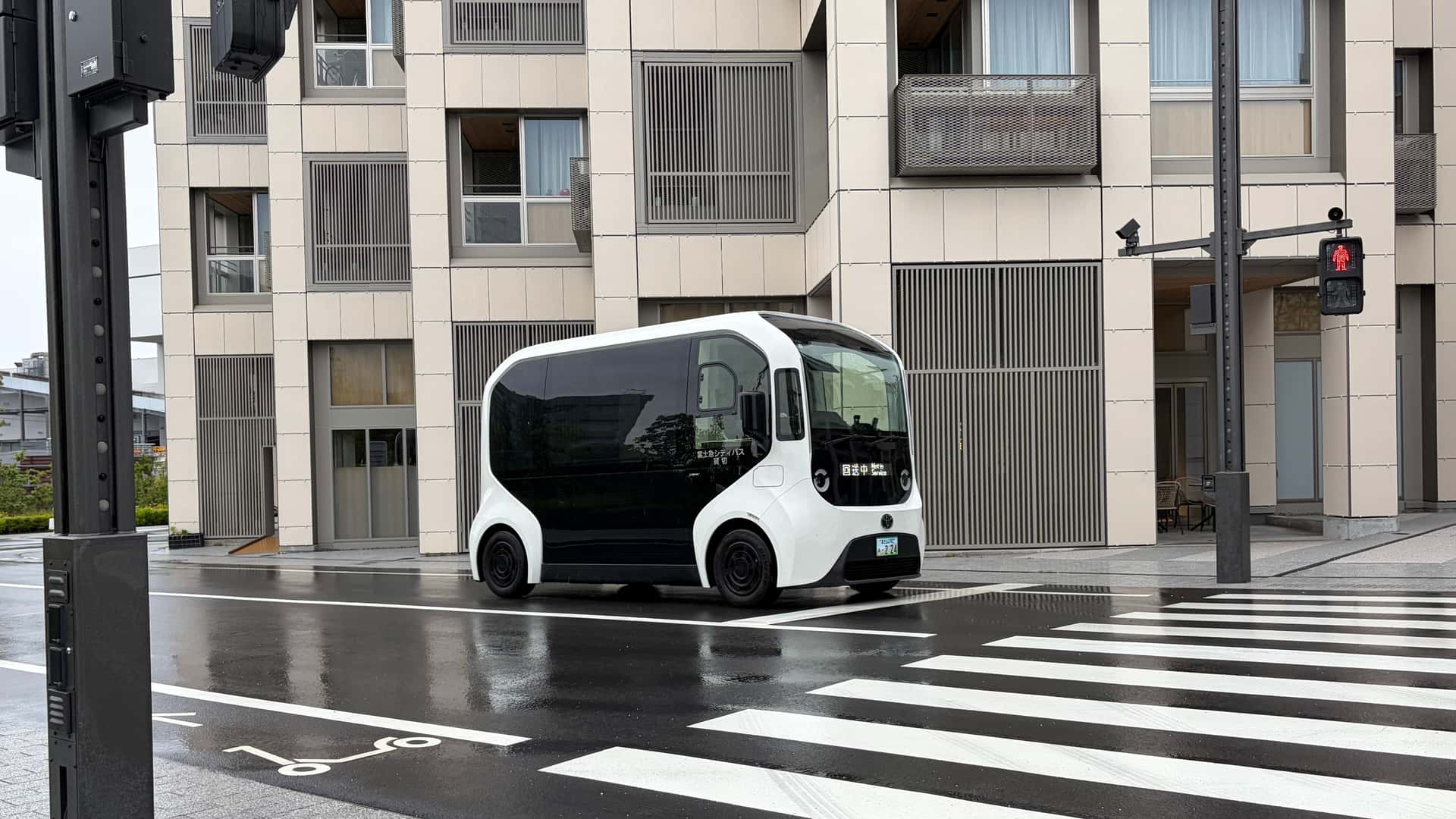
The city’s internal transit system utilizes bubbly e-Palette buses, currently human-driven, with plans for future autonomous operation. Traffic signals are programmed to prioritize pedestrians, detecting their presence before sensing approaching vehicles, although this feature is still under development.
Robotics, Micromobility, and Sustainable Energy Integration
A key aspect of Toyota Woven City involves the deployment of various robotic and micromobility solutions. While the ‘Cocomo’ delivery robots were not observed during the visit, other autonomous units like Toyota’s Guide Mobi were showcased.
The Guide Mobi is a robust, three-wheeled robot outfitted with a comprehensive sensor array, designed to imbue any vehicle with driverless capabilities. Within Woven City, these robots facilitate a car-sharing service, towing Toyota bZ4X crossovers from a parking garage to the curb. Weavers can summon a vehicle via an app, and a Guide Mobi wirelessly connects to the car’s braking, steering, and acceleration systems from approximately 10 feet ahead to deliver it. A demonstration, though featuring a human monitor and displaying some initial driving imperfections, illustrated the practical potential for applications like robo-valets.
Package delivery for residents also relies on automation. Delivery trucks are restricted from entering the city, instead depositing packages at an underground logistics center. From there, wheeled robots transport items through subterranean tunnels to centralized lockers within each building. Toyota also plans to introduce helper robots into Weavers’ homes, enabling them to learn household tasks like dishwashing and laundry in authentic living environments.
For personal urban transit, residents have access to the ‘Swake,’ another Toyota innovation. These three-wheeled scooters offer enhanced stability, a spacious platform for both feet, and a unique butt pad for leaning, providing a comfortable and secure micromobility solution. Despite a temporary halt in service due to weather conditions, an indoor demonstration suggested their potential as a user-friendly alternative for individuals less comfortable with traditional two-wheeled scooters or bicycles.
Beyond transportation, Woven City incorporates sustainable energy solutions, notably an EV-powered virtual power plant (VPP). A dedicated parking garage houses 50 city-owned electric vehicles capable of feeding power back into the city grid through bidirectional charging. Representatives from Woven City indicated that this setup could reduce the city’s peak power demands by 5-10%. Currently in a proof-of-concept stage, this VPP technology is envisioned as a viable solution for industrial sites with substantial company-owned vehicle fleets.
The Future Vision for Toyota: A Mobility Company
Like many established automotive manufacturers, Toyota is undergoing a profound transformation to adapt to the future landscape of mobility. This Japanese industrial giant must navigate an increasingly competitive market, contending with rapidly advancing Chinese carmakers, Silicon Valley-inspired startups like Tesla and Rivian, and the potential for self-driving technologies to fundamentally alter the necessity of personal car ownership.
Toyota’s historical trajectory, evolving from loom manufacturing at the turn of the last century to becoming the world’s largest car manufacturer, provides context for its current strategic pivot. The ‘woven’ terminology itself harks back to these origins, symbolizing an intricate integration of technology and community.
The challenge now for Toyota is to redefine itself as a comprehensive mobility company, a process of discovery that Woven City is central to. The sheer breadth of ideas and technologies being explored within this controlled environment suggests a concerted effort to understand and shape what ‘mobility’ will entail in the decades to come.
While the path to a fully integrated, seamlessly functioning smart city like Toyota Woven City will undoubtedly involve further developmental adjustments, this living laboratory serves as a vital testbed. It is through such ambitious initiatives, and the diligent resolution of early ‘teething issues,’ that Toyota aims to forge answers for its future role in a world increasingly driven by intelligent, interconnected solutions.
FAQ Section
What is Toyota Woven City?
Toyota Woven City is an experimental smart city and ‘living laboratory’ situated near Mount Fuji, Japan. It is designed to be a fully connected ecosystem where cutting-edge technologies like autonomous vehicles, robotics, AI, and sustainable energy solutions are tested and developed in a real-world environment. It aims to showcase future urban living and mobility.
Who lives in Woven City currently?
Currently, the initial phase of Woven City is inhabited by an initial group of 100 residents, referred to as ‘Weavers.’ These individuals belong to 50 households, all of whom are affiliated with Toyota. The population is expected to grow to around 2,000 as the city undergoes further expansion.
What kinds of technologies are being tested there?
Woven City is testing a wide array of technologies, including infrastructure-integrated autonomous driving systems with an AI Vision Engine, delivery robots like Cocomo, personal mobility devices such as the three-wheeled Swake scooter, and ‘Guide Mobi’ robots for vehicle delivery. It also explores wireless EV charging, compact hydrogen fuel cells, and virtual power plants (VPPs) using bidirectionally charging EVs.
What is the ‘Inventor Garage’?
The ‘Inventor Garage’ is a maker space within Woven City, housed in a former Toyota factory building. It serves as a hub where various companies and innovators can develop, tinker with, and test their products and concepts related to mobility and smart living. Projects range from transportation solutions to food concepts and AI applications.
Why is Toyota building a smart city?
Toyota is building Woven City to transition from being solely a car manufacturer to a comprehensive ‘mobility company.’ The city acts as a controlled environment to experiment with technologies that could lead to ‘zero accidents,’ develop new urban solutions, and integrate diverse innovations. It’s a strategic move to adapt to the evolving tech landscape and future demands of urban living.
What challenges has Woven City faced?
As a developing urban laboratory, Woven City has experienced initial operational challenges, openly shared by Toyota officials. These include glitches such as a traffic light malfunctioning, city-wide lights turning on unexpectedly, and a robot becoming stuck. These issues are seen as part of the learning process for refining complex integrated systems.
What is the long-term vision for Woven City?
The long-term vision for Woven City is to expand its physical footprint significantly and grow its population to approximately 2,000 residents. It aims to become a fully operational, integrated smart city that continually tests and refines advanced mobility, robotics, and sustainable living solutions, providing a blueprint for future urban development globally.