
Key Takeaways
- Tesla CEO Elon Musk unveiled details about the company’s future robotaxi service during the Q1 earnings call, describing it as a “combination of Airbnb and Uber.”
- The plan involves Tesla operating its own fleet of autonomous vehicles, with existing Tesla owners having the option to integrate their cars into the ride-hailing service.
- Owners will gain flexibility, deciding when their vehicles join the fleet and specifying user access, from friends and family to five-star rated customers or the general public.
- Tesla’s official first-quarter earnings report affirmed substantial investment in hardware and software ecosystems to achieve vehicle autonomy and a scalable ride-hailing business.
- The company reiterated its commitment to a “vision-only architecture with end-to-end neural networks, trained on billions of miles of real-world data” for achieving profitability.
- This strategic shift comes amidst reports of prioritizing robotaxis over a previously planned cheaper consumer vehicle, although Tesla also announced accelerating the launch of “new vehicles, including more affordable models.”
- The success of this ambitious **Tesla Robotaxi Fleet** hinges on the full realization of its self-driving technology, a goal that has faced delays and challenges with its existing Full Self-Driving (FSD) feature.
During its first-quarter earnings call on April 23, 2024, Tesla provided its most explicit insights yet into its ambitious plans for a self-driving **Tesla Robotaxi Fleet**. Addressing persistent inquiries from analysts, investors, and enthusiasts, CEO Elon Musk outlined a futuristic ride-hailing service designed to blend elements of peer-to-peer sharing with a professionally managed network.
The announcement seeks to clarify the electric vehicle manufacturer’s strategic direction, particularly following recent reports suggesting a pivot towards autonomous ride-sharing as a top priority. While many specifics remain under wraps, the company has begun to paint a clearer picture of how this groundbreaking venture might operate.
Unveiling the ‘Airbnb and Uber’ Concept for Autonomous Mobility
Elon Musk, a prominent figure in the automotive and technology sectors, elaborated on the dual-pronged approach for the forthcoming **Tesla Robotaxi Fleet**. He articulated a model where Tesla would manage a significant portion of the autonomous taxi fleet directly, ensuring operational standards and technological integration.
Complementing this, individual Tesla owners would be empowered to participate in the network, turning their personal vehicles into revenue-generating assets. Musk’s vision allows these owners to “add or subtract their cars from the fleet whenever they want.” This flexibility is intended to offer a dynamic supply of vehicles based on demand and owner availability.
Further enhancing owner control, Musk stated that “they can decide if they want to only let the car be used by friends and family, or only by five-star users or by anyone.” This tiered access mechanism introduces a novel dimension to ride-sharing, granting owners unprecedented autonomy over how their vehicles are utilized within the **Tesla Robotaxi Fleet** ecosystem.
The CEO succinctly encapsulated this innovative framework, advising stakeholders to “think of it like a combination of Airbnb and Uber.” This analogy suggests a blend of private asset sharing, akin to Airbnb’s accommodation model, with the on-demand service and operational scale of a ride-hailing giant like Uber.
Official Confirmation from Q1 Earnings Report
Reinforcing Musk’s statements, Tesla’s first-quarter earnings report provided official confirmation of the company’s commitment to the ride-hailing initiative. The report explicitly noted that Tesla is “currently working on ride-hailing functionality that will be available in the future.” This signals a concrete development pathway for the service, moving beyond mere conceptual discussions.
The report further detailed the foundational investments underpinning this ambitious project. “We have been investing in the hardware and software ecosystems necessary to achieve vehicle autonomy and a ride-hailing service,” the company stated. This comprehensive investment underscores Tesla’s dedication to building a robust infrastructure capable of supporting a widespread autonomous operation.
Central to Tesla’s strategy for achieving fully autonomous capabilities is its reliance on advanced technological paradigms. The earnings report highlighted the company’s belief that “a scalable and profitable autonomy business can be realized through a vision-only architecture with end-to-end neural networks, trained on billions of miles of real-world data.” This commitment to a camera-centric approach, leveraging extensive real-world driving data, forms the technological backbone for the future **Tesla Robotaxi Fleet**.
Glimpses into Future Functionality: The Tesla App
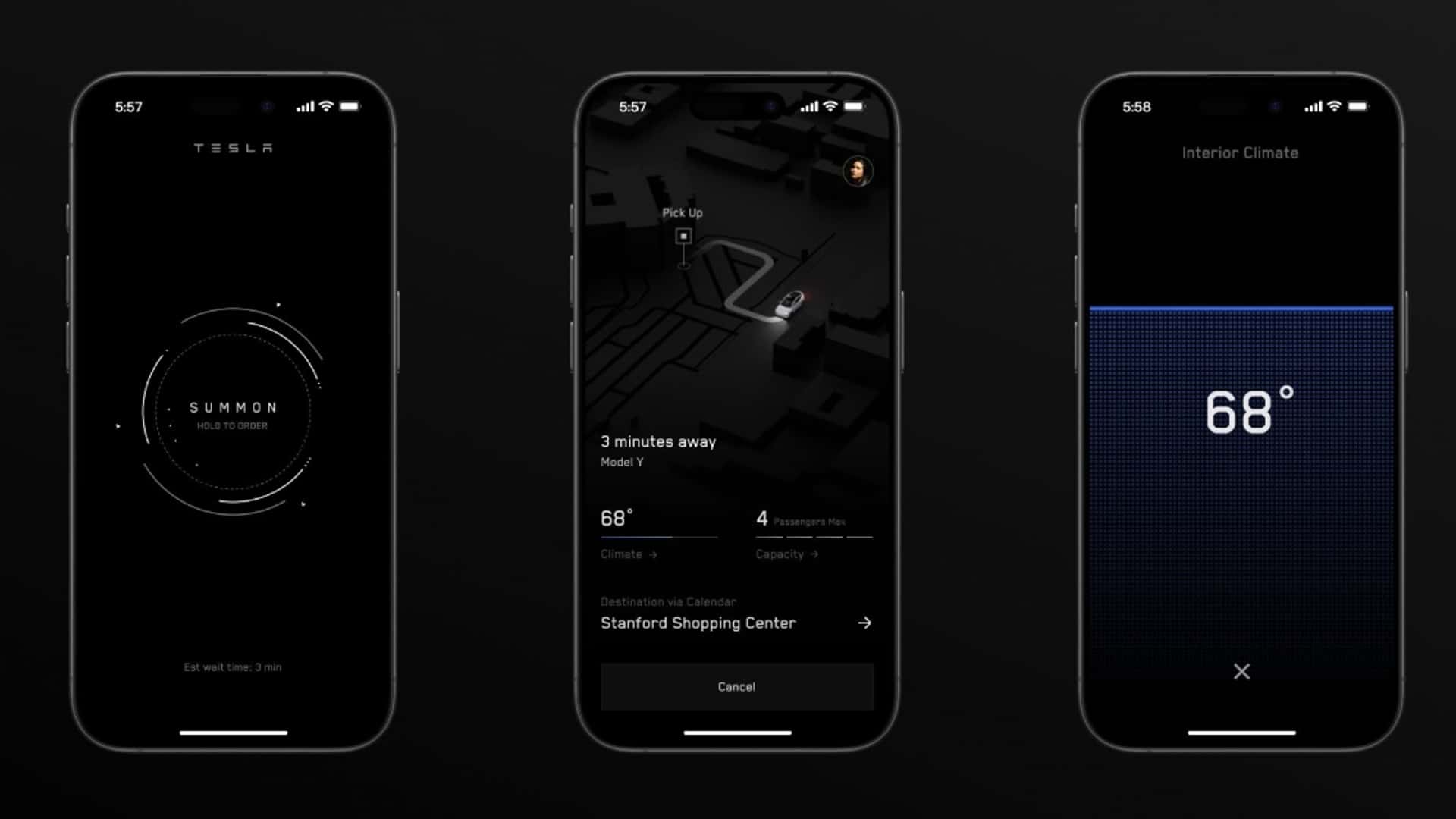
Accompanying the announcements, Tesla also released a preview of what the integrated ride-hailing functionality might look like within its existing mobile application. The renderings showcased a prominent “Summon” button, which is expected to be the primary interface for users to request an autonomous taxi.
One particular screen in the preview displayed a temperature reading of 68 degrees, hinting at potential user control over in-vehicle climate settings before or during a ride. While these details are currently scant, they offer a preliminary look at the user experience Tesla envisions for its future autonomous ride-hailing service.
Strategic Context: Robotaxis Amidst Shifting Priorities
The emphasis on the **Tesla Robotaxi Fleet** arrives at a critical juncture for the company. Recent reports from *Reuters* had indicated that Tesla might have shelved plans for a more affordable consumer vehicle, instead prioritizing the robotaxi project. This news sparked considerable speculation and uncertainty among investors and the broader market regarding Tesla’s immediate product roadmap and long-term growth strategy.
During the Q1 earnings call, Tesla addressed these concerns by stating its intention to accelerate the launch timing of “new vehicles, including more affordable models.” This suggests a revised strategy where both more accessible consumer vehicles and the robotaxi service will be pursued, albeit with the robotaxi potentially arriving later in the development cycle.
The mention of a comprehensive ride-hailing business appears to be a strategic move designed to reassure investors. It aims to demonstrate a clear and potentially lucrative future beyond just manufacturing electric vehicles, highlighting a new avenue for recurring revenue and market expansion through advanced mobility services.
The Road Ahead: Challenges and Past Promises
Despite the grand vision for the **Tesla Robotaxi Fleet**, its successful deployment hinges entirely on Tesla’s ability to deliver on its long-standing promise of fully autonomous driving. The company’s Full Self-Driving (FSD) feature, currently available as a costly add-on, still necessitates active driver supervision and has, on occasion, exhibited operational imperfections.
Elon Musk has historically made ambitious predictions regarding autonomous capabilities, famously declaring in 2019 that Tesla would have one million robotaxis operational by 2020. This timeline proved to be significantly optimistic, highlighting the considerable technical and regulatory hurdles involved in achieving Level 5 autonomy, where a vehicle can operate completely without human intervention under all conditions.
The journey towards a fully functional and legally deployable **Tesla Robotaxi Fleet** is complex, requiring not only technological breakthroughs but also navigating intricate regulatory landscapes and public acceptance. The company’s past trajectory with FSD serves as a reminder that such proclamations, while indicative of future aspirations, should be assessed with a degree of caution given the inherent challenges of advanced autonomous systems.
As Tesla continues its investment in hardware and software ecosystems for vehicle autonomy, the world watches to see if this dual ‘Airbnb and Uber’ model for its robotaxi fleet can indeed revolutionize personal transportation and solidify the company’s position as a leader in future mobility solutions.
Frequently Asked Questions (FAQ)
What is Tesla’s robotaxi plan?
Tesla plans to launch a self-driving ride-hailing service, described by Elon Musk as a “combination of Airbnb and Uber.” It will involve both Tesla-operated autonomous vehicles and personal Tesla cars integrated into the network by their owners.
How will Tesla owners participate in the robotaxi fleet?
Tesla owners will have the option to add their vehicles to the robotaxi fleet, deciding when their car is available. They can also set preferences for who can use their vehicle, ranging from friends and family to five-star rated users or the general public.
What technology is Tesla using for its autonomous vehicles?
Tesla is investing in a “vision-only architecture” that uses cameras and “end-to-end neural networks.” This system is trained on billions of miles of real-world driving data to enable vehicle autonomy and support the future ride-hailing service.
What does the ‘Airbnb and Uber’ analogy mean for the robotaxi service?
The analogy suggests a hybrid model: Tesla will operate a core fleet like Uber, while individual owners can rent out their personal Teslas like properties on Airbnb, creating a decentralized supply of autonomous taxis.
When will the Tesla robotaxi service be available?
Tesla stated that the ride-hailing functionality “will be available in the future” and indicated that a robotaxi would arrive later than newly accelerated, more affordable vehicle models. Specific launch dates remain unconfirmed, but the company is actively working on the feature.
How does this plan relate to Tesla’s Full Self-Driving (FSD) feature?
The robotaxi plan is contingent on the full realization of Tesla’s self-driving technology. While the current FSD requires driver supervision, the robotaxi service will demand full autonomy without human intervention, representing a significant advancement beyond the current FSD capabilities.
Has Tesla made robotaxi promises before?
Yes, Elon Musk famously predicted that Tesla would have one million robotaxis on the road by 2020. This target was not met, indicating the complexities and challenges involved in developing and deploying truly autonomous vehicles on a large scale.
What impact could the robotaxi fleet have on Tesla’s business?
A successful **Tesla Robotaxi Fleet** could open up a significant new revenue stream for the company beyond vehicle sales, potentially transforming it into a major player in the mobility-as-a-service sector and enhancing its overall profitability and market valuation.