
Tesla has offered fresh insights into its ambitious robotaxi strategy, revealing plans for a ride-hailing service that combines company-operated autonomous vehicles with a unique owner participation model. During its first-quarter earnings call, CEO Elon Musk outlined a vision where individual Tesla owners could integrate their vehicles into a self-driving fleet, drawing parallels to a “combination of Airbnb and Uber.” This strategic pivot, heavily reliant on the Full Self-Driving (FSD) technology, aims to reassure investors amidst shifting production priorities, though significant technological hurdles and past missed deadlines remain pertinent considerations for the future of Tesla’s Robotaxi Plans.
Unveiling Tesla’s Robotaxi Plans: A Strategic Shift in Mobility
During a crucial first-quarter earnings call on April 23, 2024, Tesla provided its most detailed outline yet for its highly anticipated robotaxi service. The announcement comes at a pivotal time for the electric vehicle manufacturer, as analysts and investors have keenly sought clarity on the company’s strategic direction.
CEO Elon Musk elaborated on the foundational concept for Tesla’s Robotaxi Plans, describing a hybrid operational model. This vision integrates a core fleet of Tesla-owned autonomous vehicles with a crowdsourced component, allowing existing owners to participate.
A Hybrid Model: The “Airbnb and Uber” Analogy
Owner Participation at the Core of Tesla’s Robotaxi Plans
Musk articulated a future where individual Tesla vehicle owners could actively contribute to the ride-hailing network. He stated that owners would be able to “add or subtract their cars from the fleet whenever they want,” offering unprecedented flexibility.
This innovative approach extends to granular control over who utilizes their vehicles. Owners, according to Musk, “can decide if they want to only let the car be used by friends and family, or only by five-star users or by anyone.”
The CEO succinctly summarized this unique operational framework, encouraging listeners to “think of it like a ‘combination of Airbnb and Uber’.” This analogy underscores the blend of peer-to-peer sharing and professional ride-hailing services envisioned for Tesla’s Robotaxi Plans.
Technological Foundations for Autonomous Mobility
Software and Hardware Investments Detailed
The company’s first-quarter earnings report further solidified commitments to developing this autonomous future. The report explicitly noted that Tesla is “currently working on ride-hailing functionality that will be available in the future,” signalling active development.
Significant investments are being channeled into the necessary infrastructure. Tesla affirmed, “We have been investing in the hardware and software ecosystems necessary to achieve vehicle autonomy and a ride-hailing service,” indicating a comprehensive development strategy.
Central to “Tesla’s Robotaxi Plans” is a specific technological philosophy. The automaker believes that “a scalable and profitable autonomy business can be realized through a vision-only architecture with end-to-end neural networks, trained on billions of miles of real-world data.” This commitment to a camera-centric system, eschewing LIDAR, is a hallmark of Tesla’s approach.
Glimpse into the Future: The Tesla App Interface
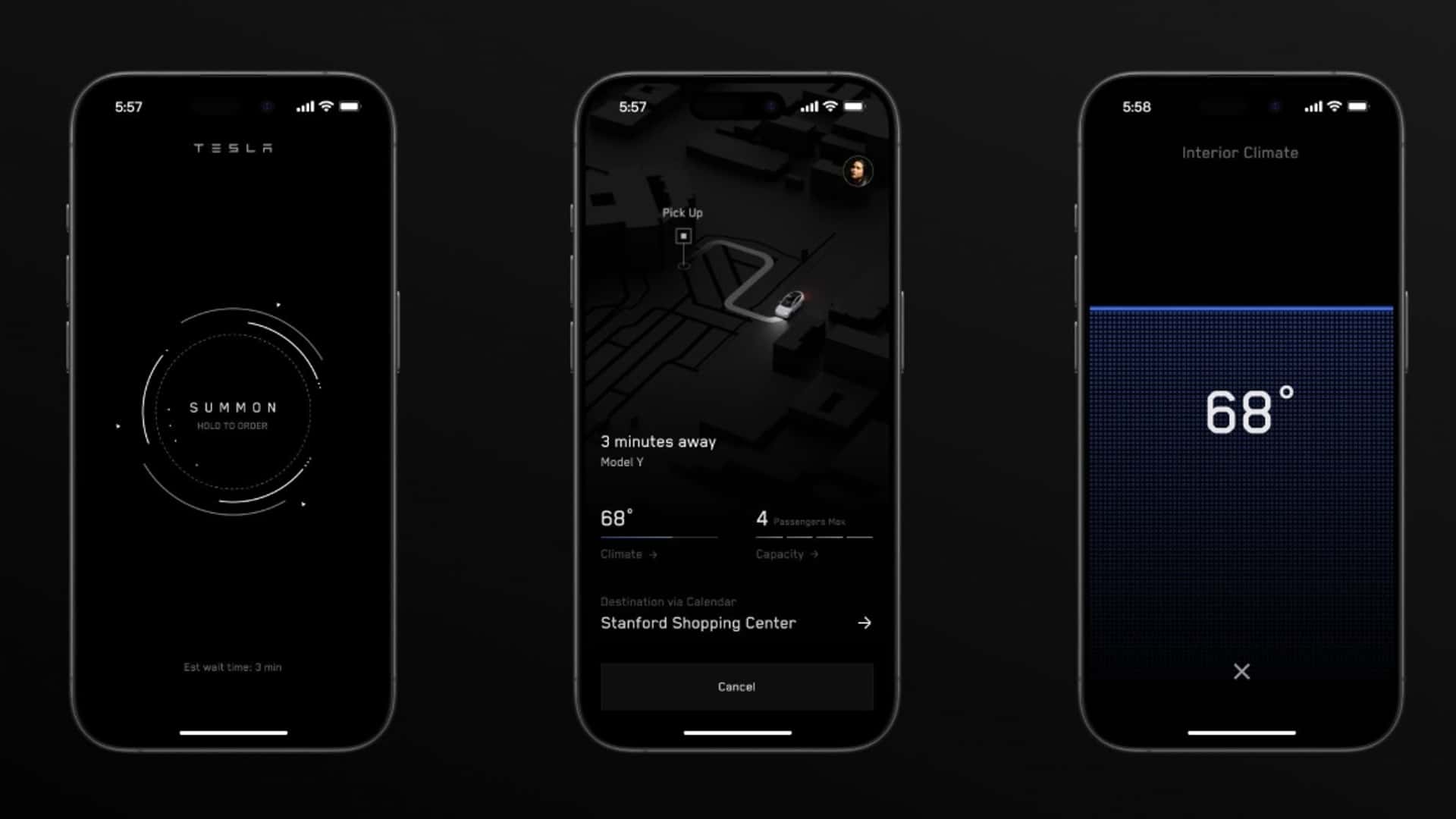
Accompanying the financial disclosures, Tesla also unveiled preliminary renderings showcasing how this ride-hailing functionality might be integrated into its existing mobile application. These visual cues offer an early look at the user experience.
The mock-ups reveal a prominent “Summon” button, which would presumably be the primary interface for ordering a self-driving taxi. Another screen displayed a temperature reading of “68 degrees,” suggesting potential features.
While details remain “scant,” this element hints at future customer control, such as the ability to pre-set climate settings within the robotaxi before it arrives. Such features could enhance the personalized experience central to Tesla’s Robotaxi Plans.
Strategic Repositioning and Investor Reassurance
The intensified focus on robotaxis follows a period of significant market speculation. Earlier reports from Reuters had indicated that Tesla might have shelved plans for a more affordable consumer vehicle, prioritizing the robotaxi project instead.
This initial report generated considerable “uncertainty swirling about the automaker’s future,” prompting questions from investors regarding the company’s long-term product roadmap and the timeline for robotaxi deployment. The market was seeking clarity on “what would a robotaxi business look like” and “when would the vehicle actually be ready to deploy.”
In response, Tesla moved to clarify its broader vehicle strategy during the earnings call. The company stated it is “accelerating the launch timing of ‘new vehicles, including more affordable models’,” while also indicating that the dedicated robotaxi model would arrive “later on.”
The strategic mention of a comprehensive ride-hailing business is largely perceived as a move to “assuaging investors,” signaling that a coherent, revenue-generating plan underpins the robotaxi initiative. It aims to restore confidence in the company’s trajectory and the viability of “Tesla’s Robotaxi Plans” as a core future driver.
The Path to Autonomy: Persistent Challenges and Historical Context
Addressing the Full Self-Driving Conundrum
Despite the ambitious declarations, the successful execution of “Tesla’s Robotaxi Plans” hinges entirely on the company’s ability to deliver truly self-driving vehicles. This has been a persistent point of contention and a source of ongoing skepticism within the industry.
Tesla’s existing advanced driver-assistance system, marketed as “Full Self-Driving (FSD),” has faced scrutiny. Despite its considerable cost, the feature currently “requires total driver supervision and regularly makes mistakes,” highlighting the significant gap between current capabilities and full autonomy.
Achieving Level 4 or Level 5 autonomous driving, which is requisite for a driverless robotaxi service, represents a formidable engineering challenge. The system must reliably navigate complex urban environments, react to unpredictable scenarios, and operate safely without human intervention.
A History of Lofty Promises
This isn’t the first instance where Elon Musk has outlined grand visions for a Tesla-operated autonomous taxi service. Notably, he “famously proclaimed that the company would have 1 million robotaxis on the road by 2020.”
However, that ambitious target was not met, leading to a degree of skepticism when new pronouncements are made. This historical context underscores the importance of carefully evaluating the feasibility and timelines associated with “Tesla’s Robotaxi Plans.”
Journalistic integrity dictates that while the potential of Tesla’s vision is acknowledged, previous unfulfilled promises must also be presented. This balanced perspective helps readers gauge the progress and challenges objectively.
The Broader Landscape of Autonomous Mobility
The development of “Tesla’s Robotaxi Plans” unfolds within a rapidly evolving global landscape of autonomous vehicle technology. Numerous companies worldwide are investing heavily in self-driving research, encountering both breakthroughs and significant obstacles.
Regulatory frameworks are still catching up to the pace of technological innovation, with different jurisdictions adopting varying approaches to the testing and deployment of autonomous vehicles. Public acceptance and trust also remain critical factors for widespread adoption of robotaxi services.
Tesla’s reliance on a “vision-only architecture” distinguishes its approach from many competitors who integrate a suite of sensors including LIDAR and radar. The success of this specific technological pathway is central to the viability of its ambitious ride-hailing goals.
Conclusion: An Ambitious Future Awaits “Tesla’s Robotaxi Plans”
Tesla’s latest revelations regarding its robotaxi service underscore an unwavering commitment to a future defined by autonomous mobility. The “Airbnb and Uber” hybrid model presents a novel approach to scaling a self-driving fleet, leveraging both company assets and individual owner participation.
While the vision for “Tesla’s Robotaxi Plans” is compelling, its realization is predicated on overcoming substantial technological hurdles related to achieving true full self-driving capabilities. Furthermore, the company will need to navigate regulatory complexities and build public confidence in driverless transport.
As development continues, stakeholders will closely monitor Tesla’s progress, balancing the excitement of innovation with a pragmatic assessment of the challenges ahead. The journey towards a widespread robotaxi service is undoubtedly complex, but Tesla appears determined to lead the charge.
Frequently Asked Questions (FAQ)
What are Tesla’s current robotaxi plans?
Tesla aims to launch a ride-hailing service that combines a company-operated fleet of self-driving vehicles with participation from individual Tesla owners. CEO Elon Musk described it as a “combination of Airbnb and Uber,” allowing owners to add or remove their cars and set usage parameters for friends, five-star users, or anyone.
When can we expect Tesla’s robotaxi service to launch?
While specific timelines remain fluid, Tesla’s first-quarter earnings report indicates that ride-hailing functionality “will be available in the future.” The company also mentioned accelerating the launch of “new vehicles, including more affordable models,” with the dedicated robotaxi expected to arrive “later on” after these new models.
How will Tesla’s robotaxi system work technologically?
Tesla is investing heavily in hardware and software ecosystems for autonomy. Its strategy focuses on a “vision-only architecture with end-to-end neural networks,” trained on billions of miles of real-world driving data. This camera-centric approach is central to achieving scalable and profitable self-driving capabilities for its robotaxi fleet.
Can current Tesla owners participate in the robotaxi fleet?
Yes, Elon Musk stated that Tesla owners would be able to “add or subtract their cars from the fleet whenever they want.” They will also have control over who uses their vehicle, with options to limit access to friends and family, five-star users, or open it up to the general public within the service.
What challenges does Tesla face in implementing its robotaxi plans?
The primary challenge is achieving true full self-driving (FSD) capability, as the current FSD feature still requires driver supervision and makes mistakes. Other hurdles include navigating complex regulatory environments for autonomous vehicles globally, building public trust in driverless technology, and scaling the infrastructure needed for a large-scale ride-hailing service.
Has Elon Musk made previous robotaxi promises?
Yes, Elon Musk has previously made ambitious statements regarding autonomous taxi services. Notably, he proclaimed in the past that Tesla would have 1 million robotaxis on the road by 2020. This target was not met, leading to a degree of historical skepticism surrounding new timelines and grand pronouncements.