
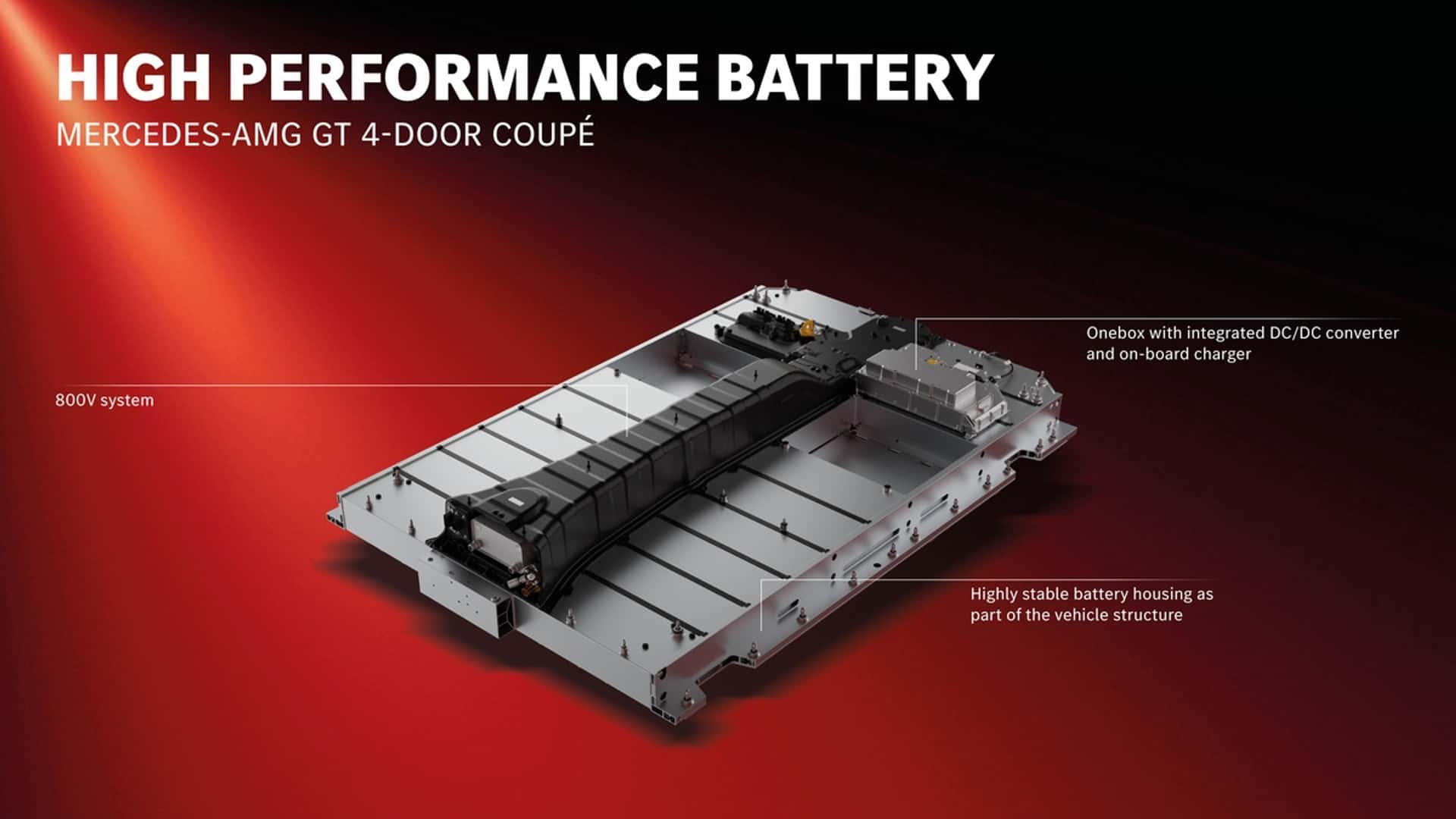
Electric vehicles (EVs) are rapidly evolving, with advancements in power and range often stealing headlines. However, the true crucible of EV performance lies beneath the surface, within the sophisticated EV battery technology that underpins these machines. Heat management, rapid charging, and sustained power delivery are critical challenges that automakers must address to push the boundaries of electric mobility. Mercedes-AMG has now unveiled its latest solution, the all-electric GT 4-Door Coupe, which showcases a suite of innovations designed to tackle these very issues head-on.
At its core, this super sedan integrates a terrifically over-engineered battery system, featuring silicon-anode cells and an advanced cooling architecture. These innovations promise to redefine expectations for high-performance EV battery technology, allowing for blistering charging speeds and formidable power output without compromising battery health.

Key Takeaways
- The Mercedes-AMG GT 4-Door Coupe features cutting-edge EV battery technology, including silicon-anode cells and a highly advanced thermal management system.
- This innovative setup enables ultra-fast charging, achieving an 80% charge from 10% in just 11 minutes, a benchmark for US-bound EVs.
- Silicon-graphite anodes enhance energy density to 298 Wh/kg and support high discharge rates for the vehicle’s 1,153 horsepower.
- An ‘over-engineered’ cooling loop, with a 20-kilowatt heat removal capacity, precisely manages the temperature of 2,660 individual battery cells.
- The adoption of slim, cylindrical cells and laser-welded aluminum casing further optimizes heat dissipation and battery performance.
The Mercedes-AMG GT: A New Era of Electric Power
The latest iteration of the Mercedes-AMG GT 4-Door Coupe marks a significant departure from its V8-powered predecessors, embracing an all-electric powertrain. This shift positions it at the forefront of luxury electric super sedans, boasting an astonishing 1,153 horsepower and a peak charging power of 600 kilowatts. Such formidable specifications are not merely about raw power; they are a testament to the sophisticated EV battery technology residing within.
With a usable battery capacity of 106 kilowatt-hours, the AMG GT promises an impressive range of up to 700 kilometers (approximately 434 miles) on the European WLTP cycle. This translates to well over 300 miles of comparable range under the more stringent U.S. EPA cycle. Upon its arrival in the U.S. later this year, it is projected to be the fastest-charging electric vehicle in the market, capable of reaching an 80% charge from 10% in an astounding 11 minutes.
Silicon Anodes: Revolutionising EV Battery Technology
Central to the AMG GT’s exceptional charging capabilities is the adoption of silicon anode technology. The anode, a fundamental component of any battery cell, dictates both the energy storage capacity and the speed at which a battery can charge. Historically, battery manufacturers have relied on graphite anodes, prized for their stability and energy density.

However, the global EV battery landscape faces growing concerns regarding the supply chain dominance of China in graphite and the environmental footprint of graphite mining. In response, automakers are increasingly integrating silicon-graphite anodes as an intermediate solution. The ultimate objective remains the complete eradication of graphite, either through the use of 100% silicon or advanced synthetic graphite alternatives.
Mercedes-AMG is not an outlier in this pursuit. Several industry leaders and startups, including General Motors, Group14, and Sila, are actively developing silicon anodes. It is important to note that, despite its promise, silicon anode technology remains a niche application. While commercially available in limited volumes, it has yet to achieve the cost-effectiveness and scalability required to displace traditional graphite anodes across the mass market.
In the AMG GT, the silicon-containing anode contributes to a cell-level energy density of 298 watt-hours per kilogram. This figure places it at the upper echelon of currently available automotive-grade lithium-ion cells. Complementing this, the cathode incorporates a blend of nickel, cobalt, manganese, and aluminum (NCMA), a composition historically associated by automakers with extended range and superior energy density.
This potent combination of advanced anode and cathode materials is what Mercedes-AMG credits for enabling the AMG GT’s remarkable 600 kW charging rate. It allows the vehicle to recoup nearly 250 miles of EPA range in just 10 minutes of charging and delivers a consistently high discharge rate, essential for unleashing its 1,000+ horsepower output. This represents a significant leap in the evolution of high-performance EV battery technology.
Mastering the Heat: Advanced Thermal Management in EV Battery Technology
The relentless generation of heat is universally acknowledged as the primary adversary of EV battery performance and longevity. Repeated hard acceleration, intense fast-charging cycles, and varying environmental conditions can push battery cells to their thermal limits. Effective thermal management is, therefore, paramount, distinguishing a functional battery from a potential hazard.
To sustain such extraordinary performance, Mercedes-AMG has deployed an array of sophisticated cooling systems alongside an innovative cell design. The automaker utilises slim, tall cylindrical cells, each measuring 4.1 inches in height and 1 inch in diameter. This precisely engineered smaller diameter significantly reduces the internal distance from the cell core to its surface, thereby facilitating faster and more efficient heat dissipation, a critical aspect of durable EV battery technology.
Further enhancing thermal efficiency, the individual battery cells are encased in laser-welded aluminum. This construction not only provides robust protection but also allows the cells to cool down or warm up with greater rapidity and precision. The cooling system is meticulously designed to circulate coolant evenly around each of the 2,660 individual cells, ensuring uniform heat extraction across the entire battery pack.
Mercedes-AMG has also integrated an intelligent ‘on-demand cooling’ system. This advanced feature ensures that temperatures within each battery module are maintained consistently. Should a specific segment of the battery experience elevated temperatures, the system can precisely direct cooling to that area, rather than indiscriminately increasing coolant flow to the entire pack. This targeted approach prevents energy waste and avoids over-cooling other, already optimally temperate zones, thus enhancing the efficiency and responsiveness of the overall EV battery technology.
At the heart of this intricate thermal management system lies a dedicated coolant pump module, an oil-water heat exchanger, and a central coolant hub. The pump efficiently circulates the coolant throughout the battery pack, while the heat exchanger plays a crucial role in removing excess thermal energy. The central coolant hub further streamlines the coolant distribution into a single, compact housing, allowing the AMG GT to achieve highly targeted cooling of various components.
For instance, if the battery pack is operating within its ideal temperature parameters, the system can intelligently redirect the coolant flow towards other components that require more intensive cooling, such as the electric drive units. This dynamic allocation of cooling resources highlights the adaptive nature of this advanced EV battery technology.
Collectively, Mercedes-AMG asserts that these integrated systems are capable of removing approximately 20 kilowatts of heat. This capacity is substantially higher than the 5-8 kW of cooling capacity typically found in conventional EV battery thermal management systems, underscoring the formidable engineering effort invested in this EV battery technology.
Future Implications for Advanced EV Battery Technology
While the theoretical prowess of the Mercedes-AMG GT’s EV battery technology is impressive, its true mettle will be proven in real-world driving conditions and its long-term performance over several years. The industry will closely observe how this battery system maintains minimal degradation and sustained peak performance over time, validating its ‘over-engineered’ claims.
The broader aspiration, however, extends beyond the realm of luxury performance vehicles. There is a strong industry-wide hope that these groundbreaking advancements in EV battery technology will eventually trickle down into mass-market models. Democratising blistering charging speeds and robust thermal management systems, currently a privilege of six-figure EVs, would represent a transformative leap for the entire electric vehicle ecosystem.
FAQ
What makes the Mercedes-AMG GT’s EV battery technology unique?
The Mercedes-AMG GT employs a unique combination of silicon-anode battery cells and an ‘over-engineered’ thermal management system. These elements enable exceptionally fast charging, high energy density, and superior heat dissipation, setting a new benchmark for performance and efficiency in EV battery technology for high-performance vehicles.
How fast can the Mercedes-AMG GT charge?
Thanks to its advanced EV battery technology, the Mercedes-AMG GT can charge from 10% to 80% in just 11 minutes. It supports a peak charging power of 600 kW, making it one of the fastest-charging electric vehicles expected to enter the U.S. market.
What is the role of silicon anodes in this EV battery technology?
Silicon anodes significantly improve the battery’s energy density and charging speed compared to traditional graphite anodes. In the AMG GT, they are blended with graphite as an interim solution, contributing to a cell-level energy density of 298 Wh/kg and facilitating rapid power delivery.
How does the cooling system handle heat in the battery?
The cooling system features slim, cylindrical cells encased in laser-welded aluminum, allowing for efficient heat dissipation. It uses an ‘on-demand cooling’ system that precisely directs coolant to specific areas, removing up to 20 kilowatts of heat, far exceeding typical EV battery thermal management systems.
What are the benefits of the new cell design?
The AMG GT uses slim and tall cylindrical cells (4.1 inches high, 1 inch in diameter). This smaller diameter reduces the distance heat needs to travel from the cell core to the surface, significantly improving heat dissipation and overall thermal management for the EV battery technology.
Will this advanced EV battery technology be available in more affordable EVs?
Currently, this cutting-edge EV battery technology is reserved for high-performance, premium models due to cost and scalability. However, there is an expectation within the industry that these innovations will eventually become more cost-effective and integrated into mass-market electric vehicles over time.
What range and power does the AMG GT offer?
The Mercedes-AMG GT 4-Door Coupe features a 106 kWh usable battery capacity, delivering up to 700 kilometers (434 miles) WLTP range, translating to over 300 miles EPA. Its advanced EV battery technology also enables it to produce an impressive 1,153 horsepower.