
In a significant development for the electric vehicle industry, Rivian has unveiled tantalizing clues about its prospective product roadmap, extending well beyond its highly anticipated R2, R3, and R3X models. This revelation comes on the heels of a monumental joint venture announcement with Volkswagen, which saw the German automotive giant pledge an investment of up to $5 billion in the American EV manufacturer.
The news, which emerged ahead of Rivian’s Investor Day call on June 25, 2024, has stirred considerable excitement among industry observers and potential buyers. While the investor event was largely expected to focus on financial guidance, the strategic alliance and a cryptic image within Rivian’s latest shareholder letter have painted a much broader picture of the company’s ambitious future.
Key Takeaways
- Rivian announced a joint venture with Volkswagen, with VW investing up to $5 billion in Rivian’s software technology.
- A shareholder letter image teased several potential new Rivian models, shrouded under sheets, hinting at an expanded product lineup beyond the R1S, R1T, R2, R3, and R3X.
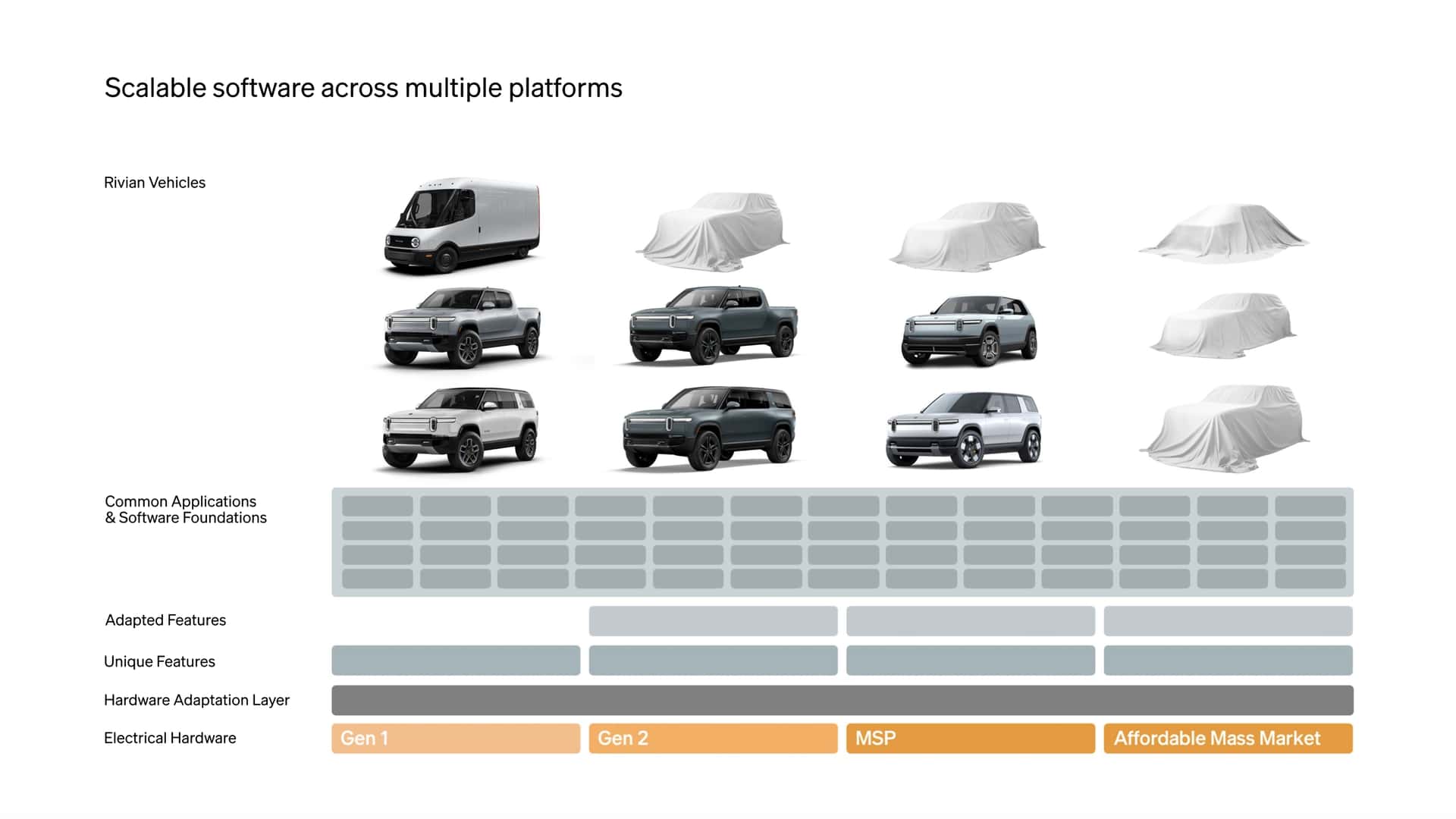
- The image depicts a progression from first-generation R1 vehicles and Amazon vans to second-generation R1s, with additional covered shapes suggesting future SUVs and trucks.
- This partnership underscores the strategic importance of advanced software in the evolving electric vehicle market and provides significant capital infusion for Rivian’s continued development.
Strategic Partnership with Volkswagen Bolsters Rivian’s Future
The core of Rivian’s recent announcements revolves around its groundbreaking partnership with Volkswagen. This collaboration is set to establish a 50/50 joint venture, designed to leverage Rivian’s sophisticated software and electrical architecture for integration into Volkswagen’s future electric vehicles. This strategic move is poised to accelerate Volkswagen’s transition into the software-defined vehicle era, a critical aspect of modern automotive innovation.
For Rivian, the benefits are substantial. Volkswagen’s commitment includes an initial investment of $1 billion, followed by additional investments of up to $4 billion, culminating in a potential $5 billion infusion. This capital is crucial for Rivian as it navigates the capital-intensive landscape of electric vehicle production and expansion.
The alliance not only provides significant financial backing but also serves as a strong validation of Rivian’s technological prowess, particularly its Zonal architecture and advanced software capabilities. This technological exchange could set a new precedent for collaborations within the global automotive industry, emphasizing shared innovation over outright competition in certain domains.
Unveiling the Mysterious Future: New Rivian Models Teased
Beyond the financial and technological implications of the Volkswagen partnership, Rivian’s shareholder letter contained an intriguing visual that has ignited speculation about its future product pipeline. First highlighted by BloombergNEF’s Corey Cantor on Threads, an image within the letter showcased several covered vehicle shapes, strongly suggesting a diversified range of *new Rivian models* in development.
Deciphering the Product Roadmap Image
The slide presents a clear evolutionary path for Rivian’s vehicle offerings. On the far left, the first generation of Rivian electric vehicles is visible, including the flagship R1S SUV, the R1T pickup truck, and the custom electric vans developed for Amazon’s delivery fleet. These vehicles established Rivian’s reputation for rugged, adventure-ready EVs.
Adjacent to these are the second-generation R1 vehicles, which InsideEVs recently reviewed. These updated models build upon the success of their predecessors, incorporating various enhancements and technological refinements. However, above these second-generation R1s, another vehicle is depicted under a sheet. Industry observers are keenly speculating whether this could be the long-rumored R1X, a performance-oriented variant of the R1 platform.
The true intrigue lies in the subsequent columns of the image. Here, several distinct SUV-like shapes, also shrouded under sheets, appear to represent vehicles entirely separate from the previously revealed R2 and R3 models. These silhouettes hint at a broader strategy to expand into different segments or offer more diverse body styles within Rivian’s portfolio, introducing a range of *new Rivian models* to the market.
Interpretations and Future Possibilities
A notable feature of these mysterious new shapes is the repetition of certain covered forms. This could imply several scenarios. One possibility is that Rivian is planning multiple variants of the same base vehicle, catering to different market needs or performance tiers. Alternatively, it has been suggested that some of these repeating shapes might be placeholder or “TBD” (To Be Determined) images, which do not necessarily reflect the final design or dimensions of the planned vehicles.
It is important to exercise caution in inferring too much from these preliminary visuals until further official clarity is provided by the company. When approached for comment on these potential future products, “A Rivian spokesperson declined to comment on our report. Presumably, these could then be future products, as automaker spokespeople rarely comment on what’s coming next.” This customary response from automakers only adds to the anticipation surrounding what Rivian has in store.
Rivian’s Expanding Horizon: Beyond Current Offerings
The R2, R3, and R3X models, unveiled earlier in 2024, have already generated significant buzz with their more accessible price points and compact designs, targeting a broader consumer base. The R2, an electric SUV, is expected to start at around $45,000, while the R3 and its rugged R3X variant promise even more compact, sporty electric crossovers.
The new image from the shareholder letter indicates that Rivian’s long-term vision extends far beyond these immediately visible horizons. This suggests a comprehensive strategy to cement its position as a diverse electric vehicle manufacturer, capable of addressing various market segments from premium adventure vehicles to more mainstream offerings and potentially even new categories of *new Rivian models*.
While the Investor Day call offered limited additional specific details about these upcoming products, the release of this image unequivocally signals that Rivian possesses a robust and extensive product roadmap. This strategic foresight, coupled with the substantial investment and technological collaboration with Volkswagen, positions Rivian for sustained growth and innovation in the highly competitive electric vehicle landscape.
Frequently Asked Questions (FAQ)
What is the significance of Rivian’s partnership with Volkswagen?
The partnership involves Volkswagen investing up to $5 billion in Rivian and establishing a 50/50 joint venture. This collaboration aims to share Rivian’s advanced software and electrical architecture with Volkswagen, accelerating VW’s EV development while providing crucial capital for Rivian’s growth.
What new Rivian models are hinted at in the shareholder letter?
An image in Rivian’s shareholder letter shows several covered vehicle shapes, suggesting potential new Rivian models beyond the R1S, R1T, R2, R3, and R3X. Speculation includes a possible R1X and other SUV-like designs not previously announced, indicating an expanded product pipeline.
When will these new Rivian models be officially unveiled?
Rivian has not provided specific timelines for the official unveiling of these newly teased models. Automaker spokespeople typically decline to comment on future products, maintaining a veil of secrecy until closer to their launch dates. Further clarity is awaited from the company.
How does this partnership benefit Rivian financially?
Volkswagen’s commitment includes an initial $1 billion investment, with additional tranches totaling up to $4 billion. This capital injection, reaching a potential $5 billion, will significantly bolster Rivian’s financial stability, support ongoing research and development, and aid in scaling production capacities.
What is Rivian’s current product lineup?
Currently, Rivian produces the R1S electric SUV, the R1T electric pickup truck, and electric delivery vans for Amazon. The company has also unveiled the R2, R3, and R3X, which are expected to launch in the coming years, targeting a broader consumer market with more accessible pricing.
Why is Volkswagen investing in Rivian’s software?
Volkswagen seeks to integrate Rivian’s advanced software and electrical architecture into its own EV platforms. This move is designed to accelerate Volkswagen’s development of software-defined vehicles, a critical technological frontier in the modern automotive industry, and enhance its competitive edge.
Is the R1X confirmed by Rivian?
No, the R1X is not officially confirmed. Its existence is speculative, based on an obscured vehicle shape in the shareholder letter’s product roadmap image. Rivian has not provided any official details regarding a performance-oriented R1 variant or any other specific model from the teased silhouettes.