
Key Takeaways:
- Tesla is developing a hybrid robotaxi service, combining a company-operated fleet with vehicles contributed by private owners.
- CEO Elon Musk described this model as a ‘combination of Airbnb and Uber,’ allowing owners to control vehicle usage.
- The service relies on a ‘vision-only architecture’ with end-to-end neural networks, trained on billions of miles of real-world data.
- While Tesla is accelerating the launch of more affordable vehicles, the dedicated Tesla robotaxi is anticipated later.
- Skepticism persists given the long-standing promises for Full Self-Driving (FSD) capabilities, which currently require driver supervision.
During its first-quarter earnings call on April 23, 2024, Tesla provided its most explicit details yet regarding its ambitious entry into the ride-hailing sector with a proprietary robotaxi service. Investors and analysts had keenly anticipated clarity on the automaker’s strategic pivot, especially following recent reports suggesting a shift in development priorities.
While a full exposé of the Tesla robotaxi project was not delivered, the call offered significant insights into the conceptual framework and operational model Tesla envisions for its autonomous ride-sharing platform. The company confirmed its intent to establish a service that blends aspects of traditional ride-sharing with a novel approach to fleet management, integrating private vehicle owners into its future ecosystem.
Tesla’s Dual-Fleet Robotaxi Strategy
Tesla CEO Elon Musk elaborated on the company’s vision during the conference call, outlining a dual-pronged operational strategy for the Tesla robotaxi fleet. This approach is designed to leverage both company-owned autonomous vehicles and a network of cars contributed by individual Tesla owners.
Musk articulated a flexible model where private owners would possess the autonomy to “add or subtract their cars from the fleet whenever they want.” This unprecedented level of owner participation extends further, as owners would also be able to “decide if they want to only let the car be used by friends and family, or only by five-star users or by anyone.” This statement underscores Tesla’s commitment to user control and personalized service.
Drawing an analogy to existing disruptive platforms, Musk succinctly characterized the planned Tesla robotaxi service as a “combination of Airbnb and Uber.” This comparison suggests a decentralized, peer-to-peer element alongside a professionally managed component, potentially allowing Tesla owners to generate income from their autonomous vehicles when not in personal use, similar to how property owners leverage Airbnb.
The Technological Foundation of Autonomy
The first-quarter earnings report also offered a glimpse into the technological bedrock upon which the Tesla robotaxi service is being built. Tesla affirmed its substantial investments in developing the necessary “hardware and software ecosystems to achieve vehicle autonomy and a ride-hailing service.” This foundational work is critical for realizing a commercially viable self-driving transportation network.
The company expressed confidence in its technical direction, stating, “We believe a scalable and profitable autonomy business can be realized through a vision-only architecture with end-to-end neural networks, trained on billions of miles of real-world data.” This statement reinforces Tesla’s long-standing commitment to a camera-centric approach for self-driving, eschewing reliance on lidar or radar for primary perception.
The ‘vision-only’ strategy posits that human-level driving can be replicated purely through visual input, processed by advanced neural networks. The mention of ‘end-to-end neural networks’ highlights a system where raw camera data is directly fed into a deep learning model that outputs driving commands, aiming for a more seamless and intuitive autonomous driving experience. The ‘billions of miles of real-world data’ refers to the vast dataset collected from Tesla vehicles globally, which is instrumental in training and refining these complex AI models.
Previewing the Ride-Hailing User Experience
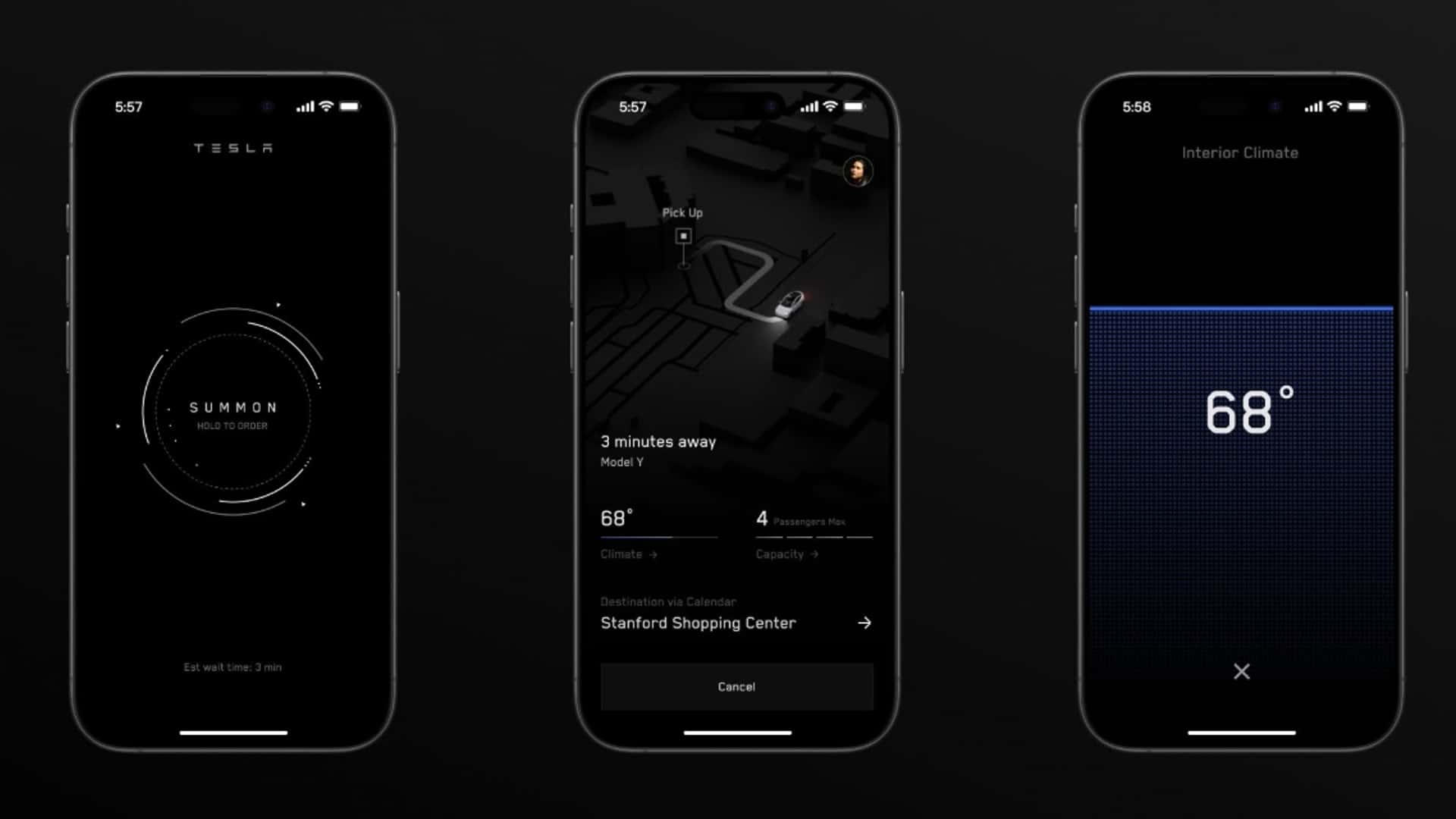
Accompanying the strategic announcements, Tesla also released preliminary renderings of the potential ride-hailing functionality integrated within its existing mobile application. These visual previews offer early insights into how users might interact with the future Tesla robotaxi service.
The renderings notably displayed a “Summon” button, which could logically be the primary interface for requesting an autonomous taxi. Another screen indicated a temperature setting of “68 degrees,” hinting at advanced user customization features. This suggests that passengers might be able to adjust in-cabin climate preferences before their autonomous ride arrives, enhancing comfort and personalization in the Tesla robotaxi experience, although specific details remain limited.
These early interface details, while scant, are Tesla’s way of providing tangible evidence of ongoing development and the conceptualization of the user journey for its future autonomous ride-hailing platform.
Strategic Reaffirmation Amidst Shifting Priorities
The latest revelations arrive amidst a period of intense scrutiny for Tesla, particularly concerning its long-term product roadmap. A recent report by Reuters had suggested a pivot away from developing a more affordable consumer vehicle, instead prioritizing the Tesla robotaxi project. This sparked considerable uncertainty among stakeholders regarding the automaker’s future trajectory.
During the earnings call, Tesla sought to address these concerns. The company indicated that it is now “accelerating the launch timing of new vehicles, including more affordable models.” This suggests a revised strategy that aims to deliver on both the promise of more accessible electric vehicles and the development of the autonomous ride-hailing service, with the dedicated robotaxi expected “later on” in the product pipeline.
The detailed mention of a ride-hailing business in the earnings call was largely perceived as an effort to reassure investors. It served to demonstrate that a clear, albeit long-term, plan is indeed taking shape behind the highly anticipated Tesla robotaxi initiative, providing a strategic anchor for the company’s future growth narrative.
The Road Ahead: Challenges and Past Promises
Despite the renewed commitment and strategic outlines, the successful deployment of a fully autonomous Tesla robotaxi fleet hinges entirely on the automaker’s ability to achieve true self-driving capabilities. This remains a significant hurdle, as Tesla’s current Full Self-Driving (FSD) feature, despite its advanced nomenclature and premium cost, necessitates constant driver supervision and has been noted for its occasional operational errors.
Historically, CEO Elon Musk has made ambitious pronouncements regarding Tesla’s autonomous future. Notably, he famously proclaimed that the company would have “1 million robotaxis on the road by 2020.” Such past statements, which have yet to materialize, often lead to a degree of skepticism among observers when new grand plans are unveiled.
As the company navigates the complex landscape of autonomous technology development and regulatory challenges, the journey towards a pervasive Tesla robotaxi service will undoubtedly be closely watched. While the vision is clear, the practical execution and timeline will ultimately determine the success of this ambitious venture, reminding many to approach such declarations with a cautious perspective.
FAQ Section
What is Tesla’s robotaxi plan?
Tesla plans to launch a robotaxi service operating a hybrid fleet. This will include self-driving vehicles owned by the company and cars contributed by private Tesla owners. CEO Elon Musk characterized this model as a ‘combination of Airbnb and Uber,’ aiming to revolutionize urban mobility through autonomous ride-hailing.
How will Tesla owners participate in the robotaxi fleet?
Tesla owners will have the option to “add or subtract their cars from the fleet whenever they want.” They can also set specific parameters for usage, such as allowing only friends and family, or restricting access to highly-rated ‘five-star’ users, offering flexibility and control over their vehicle’s participation.
What technology underpins Tesla’s self-driving ambitions?
Tesla’s strategy for autonomous vehicles, including its robotaxi service, is built upon a “vision-only architecture.” This system relies on a network of cameras and advanced “end-to-end neural networks” trained extensively on “billions of miles of real-world data” to perceive surroundings and make driving decisions without radar or lidar.
When is Tesla’s robotaxi service expected to launch?
During the Q1 2024 earnings call, Tesla stated that the ride-hailing functionality “will be available in the future” and that a dedicated robotaxi would arrive “later on.” While the company is accelerating the launch of more affordable traditional vehicles, a precise launch date for the robotaxi service has not yet been announced.
What challenges does Tesla face in deploying its robotaxi fleet?
The primary challenge for Tesla is achieving full, reliable self-driving capabilities. Its current Full Self-Driving (FSD) system still requires active driver supervision and has a history of unfulfilled promises regarding full autonomy. Regulatory approvals and public acceptance of driverless vehicles also represent significant hurdles.
What is the “Airbnb and Uber” analogy referring to?
Elon Musk used the “combination of Airbnb and Uber” analogy to describe the operational model of the Tesla robotaxi service. This suggests a blend where Tesla will operate its own fleet (like Uber’s drivers) while also allowing private owners to contribute their autonomous vehicles for public use (similar to how Airbnb hosts rent out their properties), creating a decentralized, owner-participating network.