
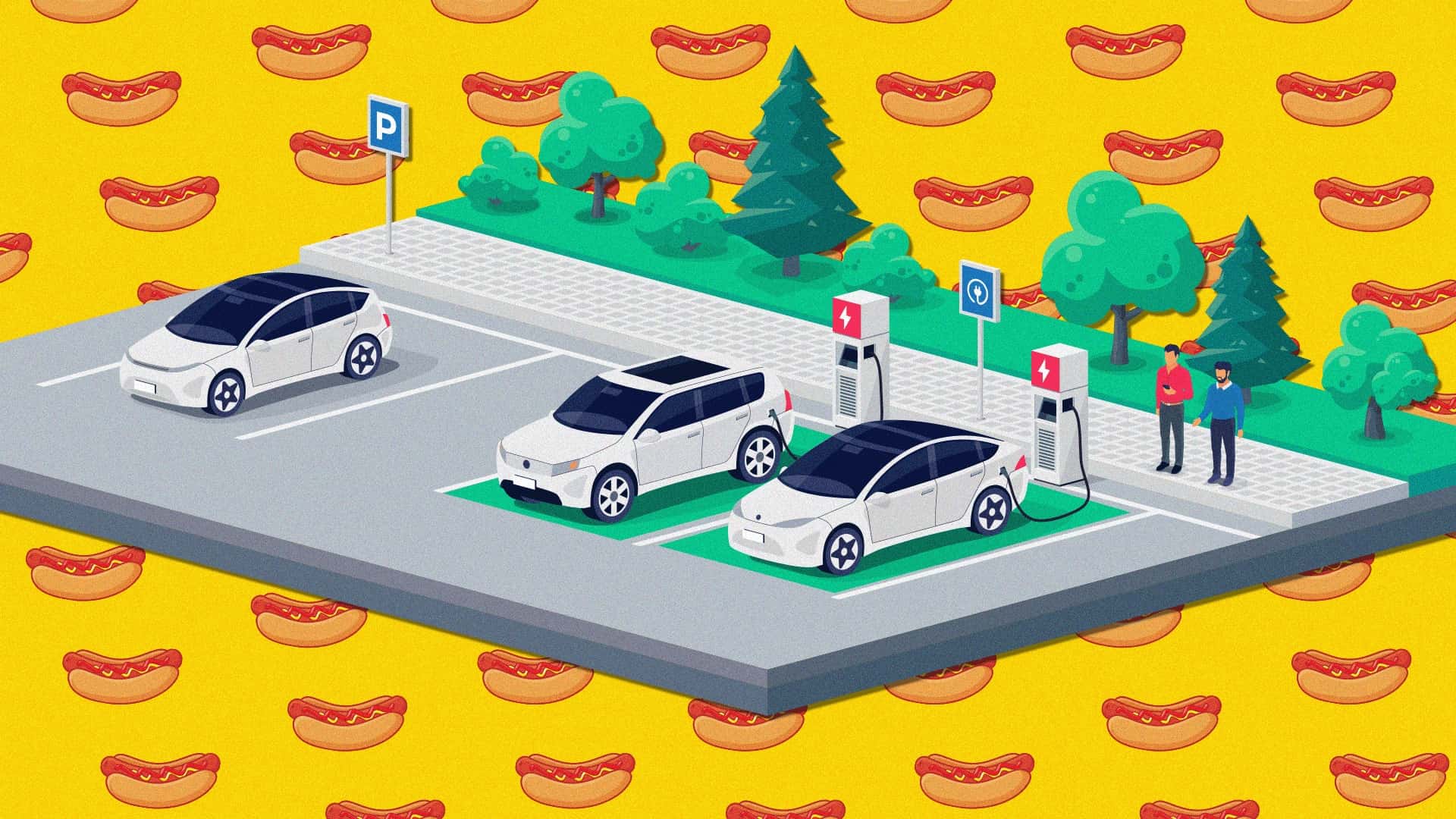
The landscape of electric vehicle (EV) adoption in the United States has seen dynamic shifts, marked by continuous improvements in battery range and charging infrastructure. While concerns about an EV’s driving range, often dubbed ‘range anxiety,’ have historically been a significant barrier for potential buyers, a new phenomenon is emerging, according to Swedish automotive giant Volvo. This shift indicates that EV drivers’ concerns are evolving, moving beyond the fear of running out of power to a new set of considerations related to rapid charging.
Key Takeaways:
- Volvo Cars’ chief engineering and technology officer, Anders Bell, has identified ‘hot dog anxiety’ as a new concern for EV drivers, replacing traditional ‘range anxiety.’
- This new anxiety refers to drivers overspending on ultra-fast public charging sessions because their vehicle charges quicker than they anticipate, leading to unnecessary top-ups.
- Advances in 800-volt EV architectures are enabling vehicles like the Volvo EX60, BMW iX3, and Mercedes-AMG GT to achieve 10-80% charge times in as little as 11-16 minutes.
- The rapid expansion of public fast-charging networks and improved charging speeds mean drivers might only need brief stops for sufficient range, especially if they charge primarily at home.
- While prevalent in premium EVs, ultra-fast charging capabilities are also becoming accessible in more affordable models like the Hyundai Ioniq 5 and Kia EV6.
- The phenomenon highlights a growing need for drivers to rethink their EV charging habits and optimize charging stops for efficiency and cost savings.
The Rise of ‘Hot Dog Anxiety’ in EV Charging Habits
During the U.S. debut of the Volvo EX60 in New York City, Anders Bell, chief engineering and technology officer at Volvo Cars, introduced an intriguing concept. He stated, “We have discovered a new phenomenon.” Bell elaborated on this, explaining, “It’s called hot dog anxiety, which replaces range anxiety.” This new term suggests a paradigm shift in the typical EV charging experience, moving from apprehension about reaching a destination to a practical concern about optimizing charging sessions.
Far from implying any culinary criticism, Bell used the analogy to describe a scenario where drivers stop for a quick meal, such as a hot dog, only to find their vehicle has charged far more rapidly than anticipated. This swift charging, enabled by increasingly powerful infrastructure and advanced battery technology, can lead to drivers inadvertently staying at a charging station longer than necessary. The consequence is often an overspend on electricity for range they do not immediately need, particularly for those who have access to overnight home charging.
Dramatic Improvements in EV Fast Charging Speeds
For many years, the scarcity of readily available and efficient public charging options posed a significant challenge for electric vehicle owners. However, the landscape is rapidly transforming. The United States is witnessing a considerable expansion of public fast-charging networks, accompanied by a proliferation of higher-powered charging stations. This infrastructure growth, coupled with innovations in EV battery technology, is fundamentally altering EV charging habits.
Modern electric vehicles, particularly those equipped with 800-volt architectures, are achieving charging speeds that were once considered futuristic. These advancements are making quick top-ups during long journeys increasingly feasible and efficient. For instance, the new Volvo EX60, a key player in this evolving market, boasts an impressive charging capability, able to go from 10% to 80% state of charge in a mere 16 minutes when connected to a 350-kilowatt station. This represents a substantial leap in efficiency, dramatically reducing the time commitment for EV charging.
Other manufacturers are also pushing the boundaries of rapid EV charging. The recently updated BMW iX3, for example, achieves an even higher maximum charging rate of 400 kW, providing up to 185 miles of additional range in just 10 minutes. At the forefront of this technological race is the newly unveiled Mercedes-AMG GT, which is projected to charge at a staggering 600 kW. This ultra-fast rate enables the vehicle to charge from 10% to 80% in an astonishing 11 minutes, setting a new benchmark for speed in the luxury EV segment.
The Cost Implication of Unnecessary Charging
With such remarkable charging speeds, Bell underscored that many drivers, especially on road trips, often require only a minimal top-up to comfortably reach their destination or return home. A full charge, or even a typical 10-80% top-up, may frequently be superfluous. Given that a vast majority of EV owners conveniently charge their vehicles overnight at home, road trips primarily necessitate brief, strategic stops for supplemental power.
The core issue of ‘hot dog anxiety’ arises when drivers lose track of how quickly their vehicle accumulates charge and, consequently, how rapidly charging costs can escalate. Bell articulated this concern plainly: “Just a few minutes later, they have charged for $25, which becomes a very expensive hot dog.” This statement highlights the potential for inefficient resource allocation when EV charging habits are not adapted to the new reality of ultra-fast charging.
While Volvo has not yet released specific data to substantiate this observed trend, the sentiment conveyed by Bell resonates with a broader transformation occurring across the automotive industry. The consistent shortening of charging times and the increasing prevalence of vehicles offering 300 miles or more of range, with many manufacturers now targeting over 400 miles, underscore this evolution.
Optimizing EV Charging for Efficiency
The shift towards quicker charging and extended range naturally leads to a reassessment of optimal EV charging habits. If a driver is, for example, 100 miles from home, a complete charge to 80% might be excessive. A quicker top-up to 40% could be entirely sufficient to reach home, where the vehicle can then be conveniently plugged in overnight at a much lower cost per kilowatt-hour. This strategic approach avoids unnecessary expenditure at high-cost fast-charging stations for range that will not be immediately utilized.
Moreover, the benefits of ultra-fast charging are no longer exclusive to premium electric vehicles. Models like the Hyundai Ioniq 5, with a starting price around $35,000, and its mechanically similar counterpart, the Kia EV6, both feature 800-volt architectures. These vehicles can achieve a 10-80% charge in approximately 20 minutes, bringing rapid charging capabilities to a broader consumer base. This accessibility further emphasizes the need for drivers across all price segments to adapt their EV charging habits.
Nuances in the Charging Landscape
It is important to acknowledge that ‘hot dog anxiety’ does not universally apply to all electric vehicle drivers. For owners of most Teslas and other mass-market EVs, where a 10-80% charge typically still requires 30-40 minutes, the risk of accidental overcharging or overspending due to premature completion is less pronounced. These drivers generally experience more traditional charging durations, making it easier to gauge their stop times.
Furthermore, this phenomenon is less relevant for EV drivers residing in apartments or other dwellings without convenient access to overnight home charging solutions. For these individuals, public fast chargers are often their primary or sole means of replenishing battery power. In such cases, maximizing range during each charging session, even if it means a longer stop, remains a practical necessity to ensure adequate mobility between charging opportunities. These drivers often prioritize the accumulation of extra range, as their reliance on public infrastructure dictates different EV charging habits.
As EV technology continues to advance, and charging infrastructure becomes even more ubiquitous and uniformly rapid across all vehicle segments, the concept of ‘hot dog anxiety’ is poised to become a more widespread and relatable consideration for the entire electric vehicle community. The ongoing evolution of EV charging habits will require drivers to become more discerning about their charging needs, balancing convenience with cost-effectiveness.
FAQ Section:
What is ‘Hot Dog Anxiety’ in the context of EVs?
‘Hot Dog Anxiety’ is a term coined by Volvo to describe a new concern for EV drivers. It refers to the unintended consequence of overpaying for electric vehicle fast charging because the car charges much quicker than anticipated, leading drivers to accumulate more range than needed while they are occupied, for instance, getting a hot dog.
How is ‘Hot Dog Anxiety’ different from ‘Range Anxiety’?
Traditional ‘Range Anxiety’ is the fear of an EV running out of power before reaching a charging station. ‘Hot Dog Anxiety,’ conversely, arises from the opposite problem: vehicles charging so rapidly that drivers may inadvertently overcharge and overspend, demonstrating a shift from concern about insufficient power to one of optimizing efficient EV charging habits.
What advancements are contributing to faster EV charging?
Key advancements include the proliferation of high-powered public fast-charging stations (e.g., 350 kW to 600 kW) and the adoption of 800-volt architectures in modern electric vehicles. These technologies allow cars like the Volvo EX60, BMW iX3, and Mercedes-AMG GT to achieve 10-80% charge times in under 20 minutes, significantly improving EV charging habits.
How can EV drivers avoid ‘Hot Dog Anxiety’ and optimize charging costs?
To avoid ‘Hot Dog Anxiety,’ drivers should assess their immediate range needs before initiating a fast-charging session. If primarily charging at home, a quick top-up to reach home might be more economical than a full 80% charge. Monitoring charging progress via smartphone apps can also help optimize stop times and adjust EV charging habits.
Does ‘Hot Dog Anxiety’ affect all EV drivers equally?
No, ‘Hot Dog Anxiety’ is more prevalent among drivers of premium EVs with ultra-fast charging capabilities and those with convenient home charging. Drivers of mass-market EVs with slower charging speeds or those who rely exclusively on public charging due to lack of home access are less likely to experience this specific concern, as their EV charging habits differ.
What does this phenomenon suggest about the future of EV charging?
This phenomenon indicates that as EV technology and infrastructure rapidly advance, the focus is shifting from merely having access to charging to optimizing the efficiency and cost-effectiveness of each charging session. Future EV charging habits will likely prioritize shorter, more frequent, and more precisely managed stops to align with actual travel needs.