
Key Takeaways:
- Hansshow’s second-generation Tesla Supercharger extension cable, designed to aid non-Tesla EV owners, was recently tested by charging expert Tom Moloughney.
- Intended to resolve charging port location issues at V3 Superchargers, the 8-foot NACS to CCS1 adapter promised enhanced functionality.
- However, real-world tests with a Rivian R1S and Ford F-150 Lightning revealed the production unit prematurely halted charging sessions.
- This performance contrasts sharply with a flawlessly operating pre-production prototype, raising concerns about reliability and its steep $729 price tag.
- EV manufacturers caution against using unapproved accessories, potentially voiding warranties for damages incurred.
The burgeoning landscape of electric vehicle (EV) charging has seen significant advancements, particularly with Tesla’s decision to open its vast Supercharger network to non-Tesla vehicles across the United States. This strategic move aims to alleviate range anxiety and enhance accessibility for a broader spectrum of EV owners, thereby accelerating EV adoption.
However, this expansion has unveiled a specific compatibility challenge: the physical design of Tesla’s third-generation (V3) Supercharger stalls. These units were engineered with Tesla vehicles in mind, featuring relatively short cables optimized for cars with a charging port conveniently located on the left rear fender.
For many non-Tesla EV models, whose charging ports are often positioned elsewhere on the vehicle, this design can create considerable inconvenience. Owners frequently find themselves forced into awkward parking maneuvers, sometimes even double parking, simply to reach the charging connector. This necessity not only occupies multiple charging stalls but also poses a logistical hurdle at busy charging stations.
Addressing the Charging Port Conundrum for Non-Tesla EVs
Recognizing this growing pain point, several third-party manufacturers have sought to innovate solutions. Among them, Hansshow introduced a specialized Tesla Supercharger extension cable. This product is designed to serve a dual purpose: acting as an extension and functioning as a DC fast-charging adapter, converting the Supercharger’s Native American Charging Standard (NACS) connector to the Combined Charging System (CCS1) standard prevalent in many non-Tesla EVs.
The initial iteration of Hansshow’s extension cable faced severe criticism, particularly from charging experts like Tom Moloughney, an esteemed contributor to InsideEVs. His assessment of the first-generation product highlighted significant safety concerns, deeming it a potential hazard.
In response to these critical reviews, Hansshow developed a second-generation version. A prototype of this revised product underwent testing and reportedly resolved the issues identified in its predecessor, instilling optimism for a reliable and safe solution. The company’s promise was to deliver a production model that replicated this improved performance, offering a seamless charging experience for non-Tesla owners.
Expert Evaluation: The Second-Generation Cable Under Scrutiny
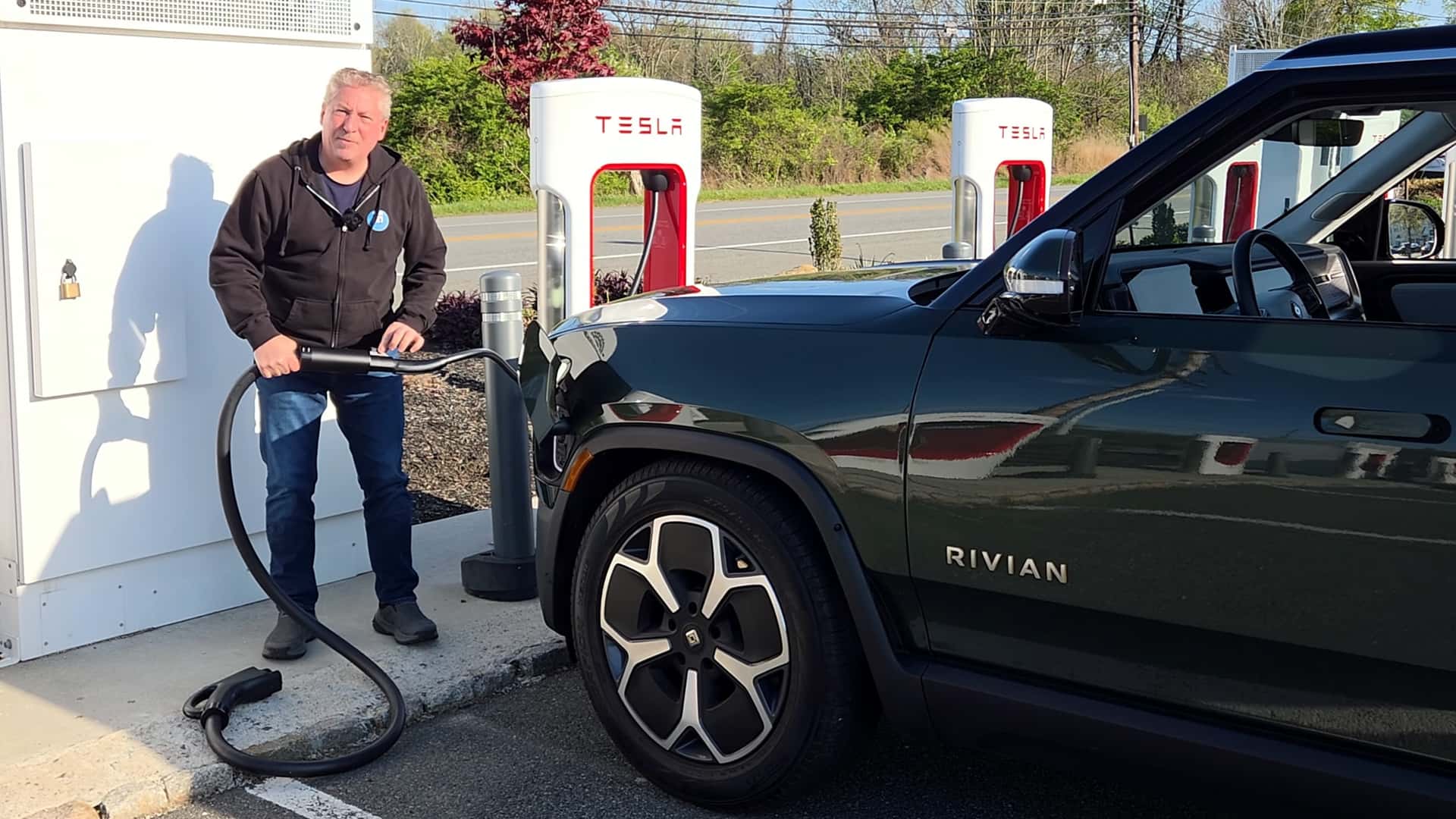
Tom Moloughney, renowned for his meticulous and real-world testing methodologies, recently acquired and rigorously evaluated the final production version of Hansshow’s second-generation Tesla Supercharger extension cable. His testing protocol was designed to push the 8-foot NACS to CCS1 adapter to its limits, simulating demanding charging scenarios.
The specific model tested was the 8-foot version, rated to handle 1,000 volts and 350 amps. To provide a robust assessment, Moloughney aimed to subject the cable to an hour of continuous stress charging. He utilized two prominent non-Tesla EVs, a Rivian R1S and a Ford F-150 Lightning, both known for their substantial battery capacities and high-power charging demands, often requesting up to 500 amps during the initial phase of a low-state-of-charge session.
Unexpected Performance Shortfalls in Real-World Tests
Despite the promising performance of the pre-production prototype, the commercialized second-generation Tesla Supercharger extension cable fell short of expectations during Moloughney’s comprehensive testing. The intended hour-long stress test could not be completed, revealing significant inconsistencies in the cable’s performance.
When connected to the Rivian R1S, the charging session abruptly terminated after just 17 minutes. A subsequent attempt with the Rivian yielded similar negative results, failing to sustain a charge. The expert noted that the surface temperature of the cable never exceeded 100 degrees Fahrenheit, suggesting that thermal management was not the primary cause of the failure.
The testing continued with the Ford F-150 Lightning, but the results were equally disappointing. The charging session with the electric pickup truck ceased automatically after a mere eight minutes. To rule out potential issues with a specific Supercharger stall, Moloughney repeated the tests at an alternative Tesla Supercharger location, but the outcomes remained unchanged.
This stark contrast between the flawless operation of the pre-production prototype and the underperformance of the final product raises critical questions about manufacturing consistency and quality control. The physical appearance of both versions was identical, making the disparity in functionality particularly puzzling for the expert.
Financial and Warranty Implications of Unapproved Accessories
Beyond the performance discrepancies, the financial investment required for this Tesla Supercharger extension cable is substantial. The 8-foot variant retails for $729, a considerable sum for a charging accessory. This price point becomes a significant concern when the reliability of the product is compromised, as demonstrated in the expert’s review.
Furthermore, EV owners must contend with important warranty considerations. Major electric vehicle manufacturers universally advise against the use of aftermarket extension cables or charging adapters that have not been officially approved by them. Deploying such uncertified accessories introduces a notable risk.
In the unfortunate event that damage occurs to the vehicle’s charging system or battery during a charging session while using an unapproved extension cable or adapter, the vehicle’s warranty is highly likely to be voided. This places the financial burden of any repairs entirely on the owner, transforming what initially appears to be a convenient solution into a potentially costly liability.
The Broader Landscape of EV Charging Compatibility Challenges
The issues encountered with Hansshow’s Tesla Supercharger extension cable underscore the broader challenges within the rapidly evolving electric vehicle charging ecosystem. The push towards a unified charging standard, particularly with the widespread adoption of NACS by numerous automakers, is a positive development. However, the transition period necessitates robust and reliable adapter solutions.
Ensuring seamless charging compatibility for a diverse range of EVs across various charging networks is paramount for continued growth and consumer confidence in electric mobility. Solutions like extension cables and adapters play a crucial role in bridging existing infrastructure gaps, but their efficacy, safety, and reliability cannot be overstated.
As the industry moves forward, the development and certification of such accessories by reputable manufacturers, often in collaboration with EV makers, will be essential. This ensures that convenience does not come at the expense of safety, performance, or financial protection for the end-user.
Conclusion: A Promising Concept, but Lacking Execution
The concept behind Hansshow’s second-generation Tesla Supercharger extension cable remains a highly relevant and necessary innovation for non-Tesla EV owners navigating the Supercharger network. The need for a reliable adapter that extends reach and converts charging standards is undeniable, addressing a genuine problem faced by a growing segment of the EV community.
However, the expert’s rigorous testing has revealed that the production version of this specific product fails to deliver on its promise of consistent and reliable performance. The premature termination of charging sessions, despite the successful run of a pre-production prototype, highlights a significant flaw that undermines its utility and value proposition.
Given its steep price point and the critical warnings from EV manufacturers regarding warranty implications, prospective buyers are urged to exercise extreme caution. The search for a fully dependable, manufacturer-approved, and truly plug-and-play solution to extend Supercharger access for all EVs continues.
Frequently Asked Questions About Tesla Supercharger Extension Cables
What problem do Tesla Supercharger extension cables aim to solve?
These cables are designed to help non-Tesla EV owners whose vehicles have charging ports located in positions that make it difficult to reach the relatively short cables of Tesla V3 Superchargers. They extend the cable reach and often include an NACS to CCS1 adapter for compatibility.
Why are Supercharger cables short for non-Tesla EVs?
Tesla Superchargers, especially V3 stalls, were originally designed with Tesla vehicles in mind, where the charging port is consistently on the left rear. This placement allows for shorter, more efficient cable designs, which become inconvenient for other EVs with varying port locations.
Who tested Hansshow’s second-generation extension cable?
The second-generation Hansshow NACS to CCS1 DC fast-charging extension cable was put to the test by Tom Moloughney, a recognized charging expert and contributor to InsideEVs, known for his thorough real-world evaluations of EV charging equipment.
What were the findings of the expert’s test?
Moloughney’s tests revealed that the production version of Hansshow’s 8-foot extension cable prematurely stopped charging sessions on both a Rivian R1S and a Ford F-150 Lightning, despite the cable’s surface temperature remaining low. This performance was inconsistent with a previously tested prototype.
Are there risks associated with using unapproved charging extension cables?
Yes, EV manufacturers strongly advise against using extension cables or adapters that are not manufacturer-approved. Using such uncertified accessories could potentially lead to vehicle damage and may void the vehicle’s warranty if any issues arise during a charging session.
What is the price of the Hansshow Tesla Supercharger extension cable?
The 8-foot version of Hansshow’s second-generation NACS to CCS1 DC fast-charging Tesla Supercharger extension cable is currently priced at $729. This cost, coupled with the product’s performance inconsistencies, raises concerns about its overall value for consumers.